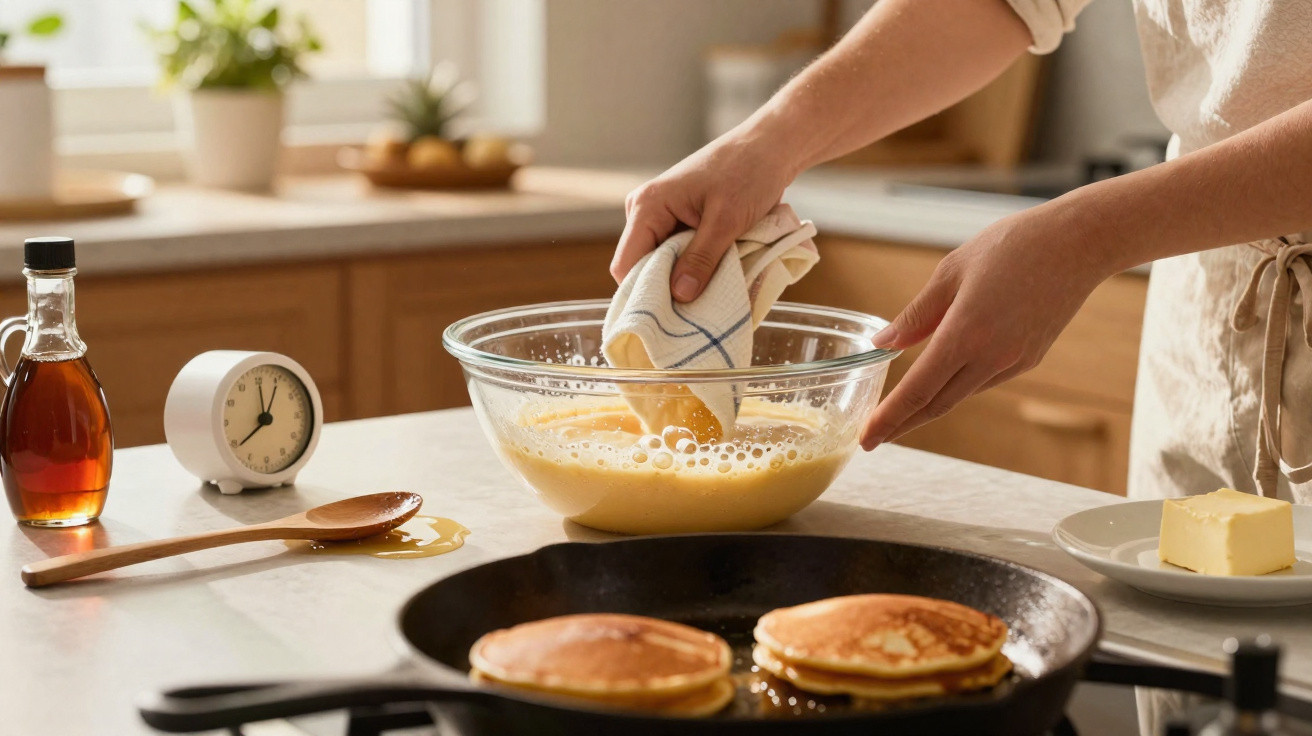
Saturday morning: sunlight slips through the blinds and you are already imagining a perfect stack of pancakes. They are golden and fluffy, with delicately crisp edges, like the ones served at that diner forever scented with coffee and butter. You whisk, pour and hear the batter sizzle… then turn them over and think, “Oh. It’s these again.” They are flat, slightly rubbery and perfectly edible, but not that good. Not “restaurant good.”
You have tried extra sugar, a better pan, viral recipes, more butter, less butter, oat milk and no milk. Yet they still never seem quite right.
According to chefs, the difference is not down to some hidden ingredient. Instead, it comes from one small, unremarkable action that nearly every home cook misses.
Why restaurant pancakes taste “different”
Speak to any brunch chef and you will hear a familiar answer: most homemade pancakes go wrong before the batter ever reaches the pan. The problem is neither the pan nor the toppings. It is time.
In restaurants, pancake batter is hardly ever cooked immediately after mixing. It is allowed to rest. That is the “tiny step” separating an acceptable homemade stack from the cloud-like towers people happily pay for on Sundays.
At home, impatience often wins. We are hungry, managing children, coffee and emails, so we stir enthusiastically and cook straight away. The result may look like a pancake, yet its texture reveals the truth with the first mouthful.
Imagine a hectic brunch shift at a small city café. The cook at the back cannot prepare fresh batter every time an order arrives. Instead, they make a large batch at 8 a.m., label the container and place it in the fridge.
By 9:30, the mixture has rested for at least 30 minutes, and sometimes for an hour. Its proteins have loosened, the flour has fully absorbed the liquid, and its bubbles have become steadier and more uniform. The pancakes race from the hotplate, rise within seconds and arrive on your plate tasting like a minor miracle.
Meanwhile, at home, most of us mix, pour and ask ourselves why our pancakes never resemble that Instagram photo.
The science chefs rely on is straightforward. Once flour meets liquid, its starch needs time to absorb it. Gluten strands that have been worked by mixing also need time to relax. Baking powder and bicarbonate of soda start reacting as soon as moisture touches them, although their full effect is not immediate.
When you miss out the resting period, the batter is still effectively “fighting” itself. The gluten remains tight, the bubbles are erratic and uneven, and the flour has not fully combined. The pancake cooks through before those elements can settle into place.
That leaves you with denser middles, rubbery edges and the mildly springy chew you may have been blaming on the pan.
Resting pancake batter: the small step chefs always use
The method could hardly be simpler: after mixing your pancake batter, leave it alone. Cover the bowl, place it in the fridge, or keep it on the worktop if the kitchen is not too warm, then step away for 15–30 minutes.
During that calm interval, the batter changes. It becomes a little thicker without turning pasty. You may see a light foam on top rather than forceful bubbles bursting everywhere. Poured into the pan, it falls in a slow, silky ribbon instead of splashing out thinly and runny.
This is the moment when homemade pancakes start acting like restaurant pancakes.
Anyone who has made pancakes for a group may already have spotted this effect without recognising it. The first pancakes from freshly mixed batter are… fine. Then, 20 minutes later, you cook a second batch from batter that has simply been sitting there, and suddenly the pancakes are taller, more even and almost cake-like.
One home cook I interviewed in Brooklyn assumed the difference came from her “warming up the pan”. When a line cook at a New Jersey diner heard this, he laughed and replied, “Nope. That’s your batter finally chilling out.”
We have all experienced it: you taste a friend’s pancakes, ask, “What did you put in this?”, and hear them answer, “Honestly? I just made the batter earlier.”
From a chef’s point of view, resting serves two purposes. First, it relaxes the gluten made tense by whisking. Less tension produces pancakes that are softer and lighter. Second, it allows the raising agents to spread evenly, meaning every ladleful rises rather than only the first few.
Professionals also mention another advantage: resting helps prevent overmixing in the first place. With new batter, people see lumps, worry and continue stirring. In rested batter, most small pieces of flour disappear by themselves.
Honestly, hardly anyone follows this step every day. But as soon as you do it one morning, you understand why restaurants do not rush to cook batter the instant it has been whisked.
How to rest pancake batter like a professional
Chefs do not make a ceremony of it. They gently mix the batter until no large pockets of dry flour remain, then stop. A handful of small lumps is completely acceptable, even desirable. Next, they cover the bowl and leave it to rest. Fifteen minutes is the “bare minimum” cited by many, 30 minutes is ideal, and up to an hour still works brilliantly.
You can fit this into your morning at home. Make the batter first, then have a shower, preheat the pan, make coffee or lay the table. When you return, do not start whisking again as though you are beginning from scratch. Instead, make one or two slow folds from the bottom upwards to loosen it a little.
The batter should feel thicker and more unified. That is the signal that it is ready to cook.
There are a few mistakes that almost everybody makes. Mixing too vigorously is one of them. Whisks are useful, but they encourage us to beat the batter as if it were whipped cream. Once the flour is wet and the mixture is largely even, stop mixing.
A second mistake is adding extra flour or milk after resting because the consistency “looks wrong”. Rested batter usually appears thicker than it did at the beginning, but that is precisely why it turns into a fluffy stack rather than a flat disc. Only adjust it when it is clearly as thick as cement or as thin as soup.
And yes, that long-standing family habit of “making batter while the pan heats and pouring right away” is probably the reason you have felt quietly let down for years.
Chefs discuss this stage with the calm of people who have watched thousands of pancakes rise and fall. One pastry chef put it in a memorable way:
“Resting the batter is the difference between pancakes you eat and forget, and pancakes people text you about later.”
For a practical approach on a busy morning, here is the straightforward routine many cooks wish they had learned sooner:
- Whisk the wet and dry ingredients separately, then bring them together with a light touch.
- Stop mixing while tiny lumps are still visible.
- Cover the batter and rest it for 15–30 minutes, either in the fridge or on the worktop.
- Fold it gently once, then cook over medium heat rather than fierce heat.
- Do not press the pancakes down with a spatula while they are cooking.
Why you will not want to skip the resting step again
The first time you rest batter before cooking, the difference is understated yet unmistakable as you pour a ladleful into the pan. The rounds spread more slowly, keep their form and rise from the middle. Bubbles appear in tidy little patterns rather than in frantic bursts. After turning them, you will see a uniform deep golden underside instead of patchy pale areas.
Then there is the texture. They are softer and taller, without becoming heavy like cake. It is the sort of crumb that absorbs maple syrup without collapsing into a soggy mess. Suddenly, it is easy to see how restaurant pancakes can feel both light and satisfying.
What is surprising is the speed with which this “tiny step” changes your whole pancake routine. You begin allowing for it without much thought: batter first, life second. Some people even prepare it the evening before, turning the ritual into a small treat waiting in the fridge.
That is the understated luxury of cooking at home: no costly equipment or chef’s jacket is required. All you need is a brief pause, a little patience and the readiness to let the batter rest while you get on with your morning.
The next time someone at the table asks why these pancakes taste “so much better today,” you will know that the real reason is not a secret ingredient. It is the choice not to hurry.
| Key point | Detail | Value for the reader |
|---|---|---|
| Rest the batter | Leave pancake batter for 15–30 minutes before cooking | A lighter, fluffier texture closer to restaurant pancakes |
| Mix gently | Stop stirring once dry patches have disappeared; small lumps are fine | Avoids tough, rubbery pancakes caused by overworked gluten |
| Trust the thicker look | Rested batter looks thicker but spreads and rises more effectively | More reliable results without continually altering the recipe |
FAQ:
- Question 1 How long should I rest pancake batter for the best result? Most chefs advise a minimum of 15 minutes, while 30 minutes is ideal. If you are planning ahead, leaving it for up to an hour works well and will not damage the batter.
- Question 2 Can I leave pancake batter in the fridge overnight? You can, particularly with a baking powder-based recipe. It will become thicker, so in the morning you may need to loosen it with a spoonful of milk, but the pancakes should still be tender.
- Question 3 Should I stir the batter again after resting? Only very lightly. One or two slow folds are sufficient to bring together any separated batter. Whisking vigorously after resting will undo its benefits.
- Question 4 What if my rested batter looks too thick? If it is too thick to pour, add milk one tablespoon at a time, folding gently. Stop as soon as it runs from your spoon or ladle in a slow ribbon.
- Question 5 Does this resting step matter for boxed pancake mixes too? Yes. Even shop-bought mixes benefit from a short rest, which allows the flour to hydrate and the batter to stabilise, taking you closer to that restaurant-style texture.









Comments
No comments yet. Be the first to comment!
Leave a Comment