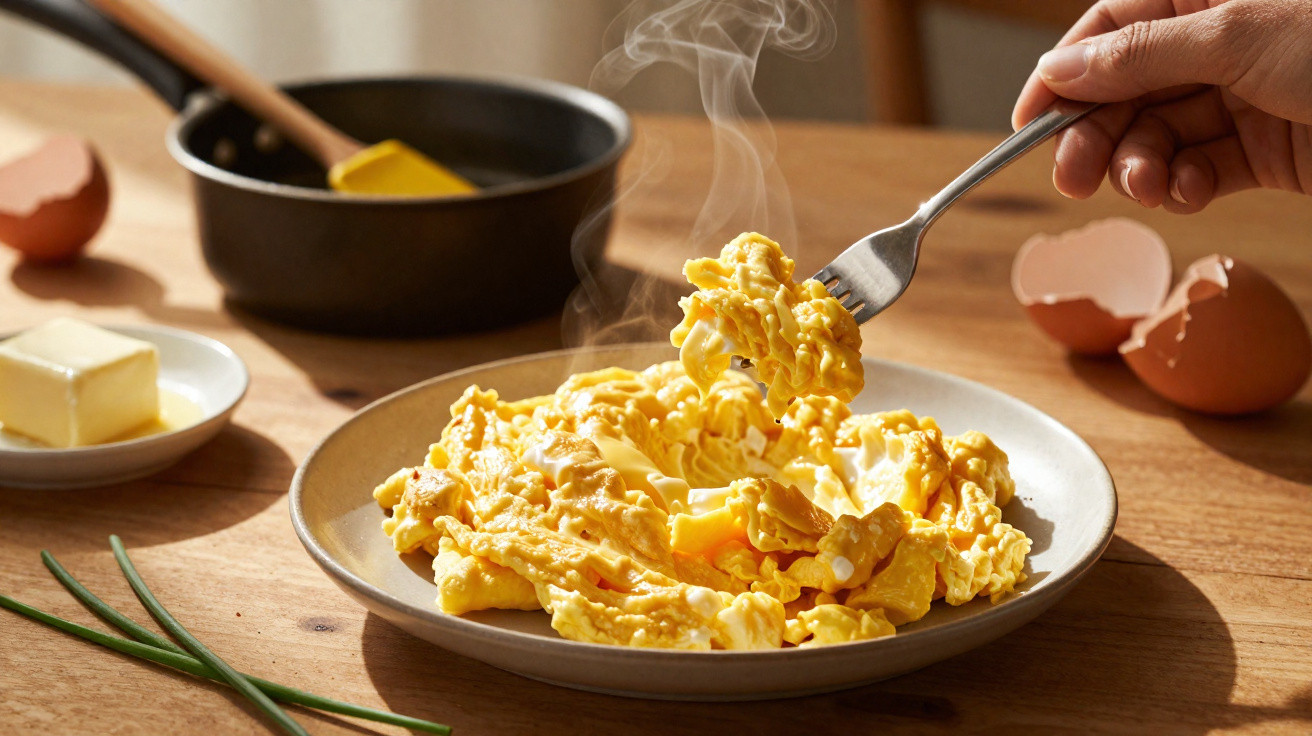
The plate arrived with a quiet sense of theatre.
Steam rose in unhurried curls, while the toast was topped with a golden cloud that was technically “scrambled eggs” yet looked more suited to a television cookery programme than an ordinary weekday breakfast. A fork slipped in and made that faint, silky sound, almost like whisking cream. After one mouthful, the table fell quiet. At last, someone said, “Ok, what did you do to these eggs?”
The cook simply shrugged, as though it were nothing. “Just scrambled eggs.”
Yet everybody at the table knew they were anything but “just” eggs.
That is when you understand that fluffy scrambled eggs are not the result of chance or natural talent. They rely on a technique: a small ritual.
Once you have grasped it, it is difficult to return to the old way.
The quiet obsession behind perfect scrambled eggs
There are two types of scrambled eggs in the world: the flat, dry, faintly rubbery sort many of us grew up eating, and the kind that resembles a cross between a cloud and custard, folding gently into soft curds.
Most people assume the distinction comes down to ingredients: extra butter, luxurious cream or some hidden product from a chef.
Actually, it comes down to how the eggs are handled in the pan.
Honestly, the fluffiest scrambled eggs are made by cooks who care a little obsessively about texture. They observe the eggs as though they are alive. They treat the heat like a dimmer switch rather than an on-off control. They do not stir without purpose; they guide the mixture.
One breakfast cook at a small London café became locally well known despite never sharing a recipe online. Regulars asked for “her eggs” and brought friends along simply to try them. She used supermarket eggs, ordinary butter and inexpensive pans.
Her secret was a ritual. She beat the eggs until they appeared almost excessively airy, then poured them into a barely warm pan. Next, she moved the mixture slowly and patiently with a soft rubber spatula. There was no hurrying, no phone in her hand and no multitasking.
Customers attempted to recreate them at home. Most did not succeed straight away. They had the same ingredients but a different outcome. It was not the recipe they were getting wrong; it was the rhythm they were missing.
Scrambled eggs may look straightforward, but they are a brief chemistry lesson happening in your frying pan. Cracking and beating an egg breaks up its proteins while trapping tiny bubbles of air in the mixture. That air can transform dense eggs into something light and fluffy.
Heat then causes those proteins to tighten. When the heat is too fierce, they contract quickly, forcing out moisture and air. That is when tender eggs become chewy.
With gentle, controlled heat, however, the proteins set gradually and hold on to more moisture and air.
Butter or milk do more than contribute flavour. They alter how the proteins bind together. Fat coats them, while water produces steam. Together, this can give breakfast a soft, almost mousse-like texture. The pan, spatula and timing all become part of a quiet negotiation between egg and heat.
The real “secret” method most people miss
For truly fluffy scrambled eggs, the important work begins before the eggs reach the pan. Take a bowl and whisk the eggs for longer than seems sensible. Keep going beyond the point where they are merely combined. You want an even yellow mixture that is slightly foamy, with tiny bubbles on its surface.
Add a small pinch of salt at this point. Not a large amount, just enough to season lightly and begin relaxing the proteins. Then add a splash of cold milk, cream or even water - roughly one teaspoon per egg. As the curds form, that small quantity of liquid turns to steam and expands within them.
Now turn to the pan. Set it over low to medium-low heat and melt a small knob of butter. The butter should make a gentle sizzle, rather than an aggressive hiss. Tip in the eggs and leave them for a few seconds. Rather than stirring furiously, use a soft spatula to ease the eggs from the edges towards the middle in slow, measured movements.
Stress is the greatest enemy of fluffy eggs: rushed mornings, impatient heat and the urge to turn up the hob because you are hungry and running late. On a busy day, many people set the heat to high, stir all the life out of the eggs, then wonder why they taste like a hotel buffet at 10:45 am.
Let us be honest: nobody really does this every day. You are not going to stand over the hob like a Zen monk each morning, and that is perfectly fine. But when you have a few additional minutes, that is your chance to slow down a little.
Begin on a low heat and resist walking away. Once curds start to appear, maintain gentle movement. Do not crush them; fold them. If the eggs begin cooking too quickly, take the pan off the heat rather than panicking. That single habit prevents countless batches of scrambled eggs from turning rubbery.
An older chef once said, while watching a young cook scramble eggs too quickly:
“You’re not fighting the eggs. You’re listening to them.”
It may sound poetic, perhaps even slightly dramatic, but it stays with you. Good scrambled eggs are a small conversation. You pour, wait, nudge and pause. Stop cooking when they still seem a little underdone, as the residual heat in the pan will continue the work.
To make it easy, here is a quick mental checklist you can glance at while cooking:
- Whisk for longer than you think necessary
- Begin with low heat rather than high heat
- Use a soft spatula and gentle folds
- Take them off the heat when they are still slightly glossy
- Leave them to rest for 10–20 seconds before serving
Why fluffy scrambled eggs are more than “just breakfast”
On a hectic weekday, scrambled eggs are often a supporting player: something thrown together while checking emails or packing a bag. Yet there is a subtle change in the room when the plate holds soft, pillowy eggs rather than a hurried pile of yellow.
They suggest care. They feel as though someone - even if that person is you - decided that texture, temperature and timing mattered for a few minutes. On a grey morning, that soft topping on toast can feel like a small, edible act of kindness.
At the weekend, serving exceptionally fluffy eggs changes the pace around the table. People slow down, make comments and compare them with other versions they have eaten. It is such a basic food, but it can bring back powerful memories: grandparents’ kitchens, hotel breakfasts, hangover remedies, first flats with poor pans and even worse coffee.
More practically, once you have mastered this gentle technique, you can begin experimenting. Fold through fresh herbs at the very last moment, add a scattering of strong cheese that melts into the layers, or spoon ricotta over the top. You can even take an almost minimalist approach, using only eggs, butter, salt and time.
We have all experienced a moment when a minor improvement to an everyday routine feels unexpectedly luxurious. Soft, fluffy scrambled eggs belong in that category. They cost next to nothing and may take only three extra minutes, but they can change how you see “just another breakfast”.
If you pass your method on to another person - a child learning to cook, a friend who always burns eggs or a partner who never eats in the morning - the ritual continues. It becomes “our way of making eggs”: a small secret shared one slow fold at a time.
| Key point | Detail | Benefit for the reader |
|---|---|---|
| Whisking and air | Whisk for longer to capture tiny air bubbles and make a foamy mixture | Produces a lighter, cloud-like texture without specialist equipment |
| Low, controlled heat | Cook over low to medium-low heat and remove while the eggs remain slightly glossy | Avoids rubbery eggs and keeps them soft and creamy |
| Gentle movement | Use a soft spatula to fold slowly from the edge towards the centre | Creates tender curds instead of breaking them into dry crumbs |







Comments
No comments yet. Be the first to comment!
Leave a Comment