Half-melted ice cream, peas fused into a frosty block and that questionable pack of chicken lost at the back: it is a familiar freezer scene. The motor hums more forcefully, with a weary low drone filling the small kitchen. You shift a few things about, attempt to get “organised”, shut the door and hope next month’s electricity bill is not too painful.
Later, while looking through your phone over a mug of tea, you come across an unusual suggestion: putting aluminium foil inside the freezer. Not using it to wrap food, but laying it within the appliance itself. Initially, it sounds like the sort of online tip that fills your feed briefly, vanishes the following week and never proves useful in real life.
Still, the more you read, the more plausible it becomes. A plain piece of shiny foil, positioned in one particular area, could help a freezer run with less effort and cool more effectively. It is one of those small changes that rarely gets mentioned in the appliance shop.
After hearing about it, you may never look at your freezer walls quite the same way.
Why your freezer may waste more electricity than expected
Watch your freezer for a minute and one thing becomes apparent: it does not freeze uniformly. The rear wall may be covered in frost, the front can be a little warmer, and certain areas seem to sit in between. This inconsistent cooling is where energy can be lost. The freezer has to work to chill dead spots where cold air is not circulating well, while heat enters through every gap and poorly stacked container of leftovers.
After a hectic weekday, most of us simply put food inside and close the door. Cartons end up at an angle, bags press against vents and ice accumulates on the back panel. Gradually, the freezer becomes a disorderly cave, with cold pockets and warmer corners quietly competing. Its compressor must then run for longer to achieve the temperature it maintained when the appliance was new. Your energy bill rises with it.
One figure is particularly telling: according to various energy agencies, an inefficient freezer that is overfilled or coated in frost may consume 10 to 30% more electricity than it needs to. You pay that extra cost every month, often without noticing. A UK family monitoring their use with a smart plug found that their ageing freezer was starting up much more often than expected. Following a modest tidy-up and a few small changes inside, compressor cycles fell by nearly a quarter.
It is these “tiny adjustments” that make aluminium foil hacks worth considering. They will not repair a failing motor or fix a damaged door seal. Instead, they influence the physics inside the compartment. They help direct cold air and lower what engineers call thermal resistance: the small barriers that prevent cold from working efficiently. Improve that unseen process and the appliance can operate more easily.
Aluminium foil is not a miracle product, but it has useful properties: it reflects radiant heat and transfers temperature rapidly. Those qualities can make it an unexpected helper inside a freezer. Rather than allowing cold air to collect in one place while warmer areas persist, the foil can help even out conditions, almost like a temperature mirror. That slight advantage may matter during hot weather or in a confined kitchen where the freezer sits beside a warm wall.
Naturally, every such tip has its limits. A foil strip cannot make a 20-year-old freezer perform like a new A+++ energy-rated model if its seal is split or its thermostat is failing. However, if the appliance is otherwise in sound condition, improving how cold travels inside may lead to fewer motor starts, less ice build-up and a quieter background hum. The physics does not change; you are simply giving it a small advantage.
Where to put aluminium foil in the freezer
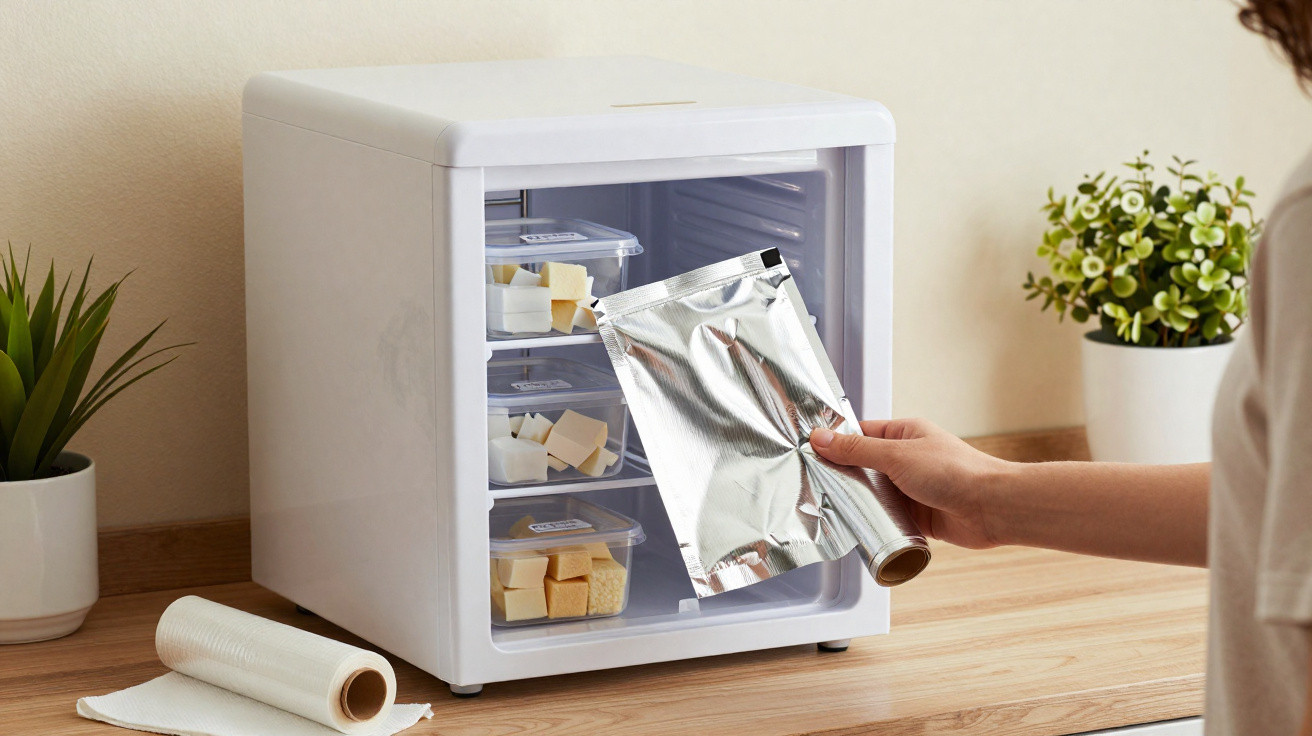
The key position is neither on the door nor the top shelf, and it is not around your leftovers. The most useful location is the back-wall or bottom-shelf area: the freezer’s coldest zone and the place where frost generally appears first. Put one flat, smooth sheet of aluminium foil directly on a shelf or tray, with its shiny side facing upwards, taking care not to obstruct vents or air inlets.
The principle is straightforward: foil acts rather like a “cold mirror”. It takes on the low temperature from the wall and helps distribute it across the shelf, allowing food to freeze more evenly. That consistency is important because warmer sections make the thermostat keep calling for the compressor to work. When cooling is better distributed, the freezer can reach its set temperature more quickly and switch off sooner.
In practice, many people begin by placing a rectangular piece of foil on the bottom shelf, often home to frozen vegetables and neglected pizza boxes. A home cook in Spain monitored her freezer with an inexpensive digital probe for two weeks. Once she had put foil on the bottom shelf and cleared a blocked vent, temperature variation between the front and rear fell by several degrees.
She did not adjust the thermostat. What improved was the consistency of the cold. Frozen food remained at a steadier temperature, while the compressor did not start every time somebody opened the door for a few seconds. In a busy home, where children are regularly looking for snacks, that stability can gradually save genuine watt-hours on the meter.
The reasoning is clear. Freezers become less efficient when they are continually dealing with internal temperature spikes. When warm air gets in, it does not disperse evenly; instead, it forms pockets. By reflecting cold from the rear and base areas, aluminium foil may help limit these pockets. Its metal surface takes on the chill quickly and transfers it to nearby food faster than an uncovered plastic shelf.
There is another, more subtle, advantage. Ice and frost can adhere more readily to textured plastic than to foil. In some cases, the sheet therefore acts as a replaceable layer where thin ice forms first and can be removed more easily. Less thick frost on structural surfaces means improved thermal contact between cold air and food, so the compressor does not have to force its way through an igloo on every cycle.
How to use aluminium foil without damaging your freezer
Begin with a clean surface. Spend five minutes removing loose ice, discarding anything clearly affected by freezer burn and freeing the vents. Next, cut a sheet of aluminium foil to fit the bottom shelf or tray you intend to use. Smooth it down with the shiny side uppermost, ensuring it does not curl or extend up the back wall, where it could interfere with sensors or vents.
Keep a small space around its edges so air can circulate freely. If your freezer uses wire shelves, gently fold the foil around one or two front bars to stop it sliding. Nothing else is required: no tape, adhesive or foil fixed to the walls. Then return the frozen food, preferably in flat layers rather than tall, random stacks that obstruct the cold.
People often overdo tips like this. They line every shelf, cover the door compartments and even attach foil to the sides. At that point, the method can have the opposite effect. Metal over sensors or blocked vents reduces airflow and may speed up frost formation. The simple rule is to be selective rather than comprehensive: use one or two important surfaces, not the whole interior.
Eventually, the foil may crease, become marked or tear slightly. That is not a sign that you have done it wrong. Regard it as a disposable layer to replace every few months when you give the freezer a quick reset. Let’s be honest: nobody really does that every day. A seasonal clear-out and a fresh piece of foil can put things right without making freezer care feel like another full-time task.
“When people think about saving energy, they imagine big purchases - new appliances, solar panels, smart thermostats,” notes home energy consultant Laura Green. “Yet a lot of the low-hanging fruit is inside the machines you already own. How you load and guide the cold can be almost as powerful as buying something new.”
This is also where the emotional element appears. On a packed evening, no one is eager to “optimise airflow in the freezer”. But on a Sunday morning, coffee in hand, that small job can feel unexpectedly rewarding. You are taking back control of a space that normally resembles a cold junk drawer.
- Put foil only on level shelves or trays, never directly over vents.
- Use one smooth sheet instead of several small overlapping pieces.
- Replace the foil every 3–6 months, or after a major defrost.
- Pair the foil tip with a quick door-seal test using a sheet of paper.
- Leave at least 1–2 cm of clear space in front of the back wall for airflow.
The understated pleasure of a freezer that simply works
Once the foil is fitted, the shelves are reasonably organised and the vents are unobstructed, your view of that humming box in the corner can change. Rather than seeing it solely as storage, you begin to recognise it as a small climate system over which you have some influence. Temperatures vary less. Ice cream keeps the correct texture. Opening the door late at night no longer presents that strange mix of half-melted and rock-solid food.
At a deeper level, it offers a different approach to energy use. Rather than waiting for a costly, major upgrade, you work with the appliances already in your home and try to help them perform at their best. That does not mean you will never need to replace the freezer, nor that a sheet of foil can erase years of wear. It simply means that you are no longer a passive user standing before a white box buzzing away in the dark.
We have all received an electricity bill and wondered which everyday part of life is quietly consuming pounds. In reality, there is seldom one enormous culprit. It is usually a collection of small, settled habits: leaving items where they are, never inspecting the seals and ignoring that continual low hum. Placing aluminium foil in the correct spot will not transform your finances overnight. But it may prompt you to act, serving as a small reminder that your home is not fixed in place. A few considered actions, repeated occasionally, can gradually create a kitchen that feels more manageable and perhaps an electricity bill that stings a little less.
| Key point | Detail | Benefit for the reader |
|---|---|---|
| Aluminium foil placement | On the base or coldest shelf, shiny side upwards, without blocking air vents | Improves cold distribution and reduces compressor running time |
| Effect on internal temperature | Limits warm pockets and variation between the front and back of compartments | More even freezing, better-preserved food and less waste |
| Combining it with good habits | Light cleaning, periodic defrosting, checking the door seal and allowing space when storing food | Improves overall freezer efficiency without an expensive investment |















Comments
No comments yet. Be the first to comment!
Leave a Comment