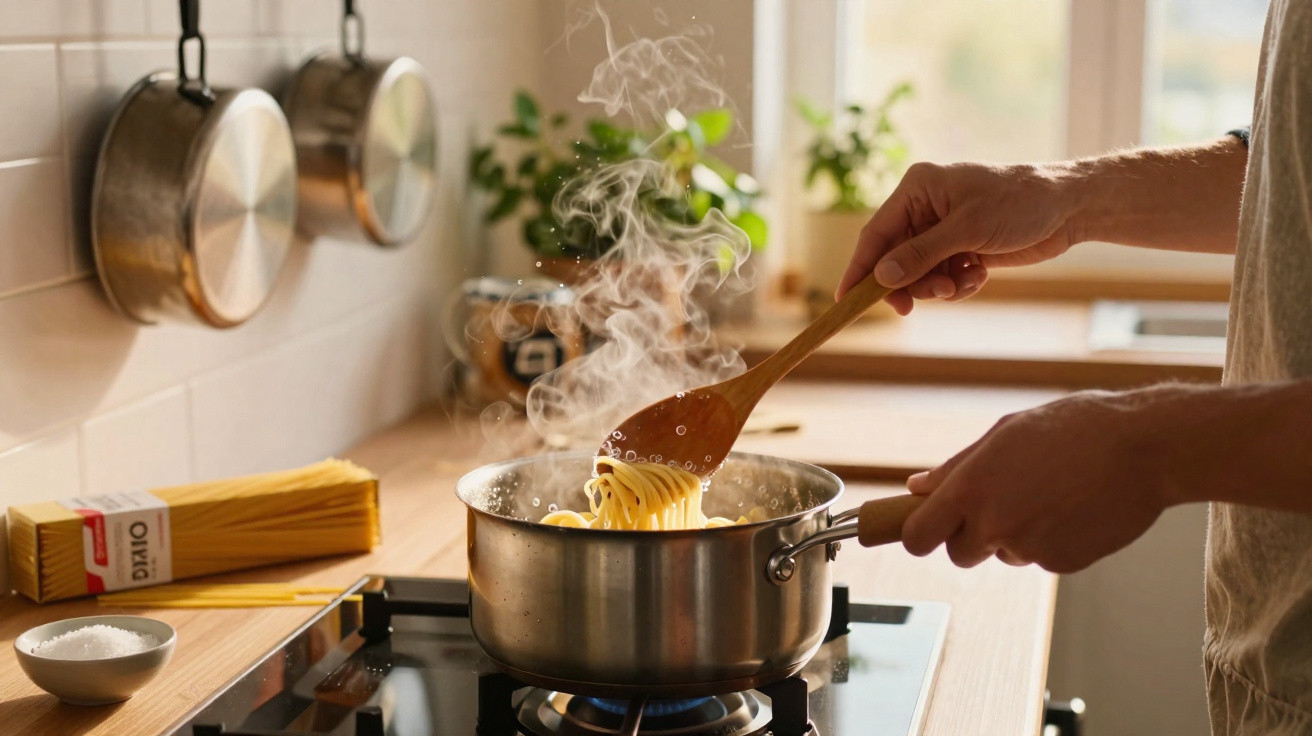
The night I finally gave the “wooden spoon trick” proper attention began with an entirely ordinary kitchen disaster. Pasta was bubbling away, my phone was vibrating on the worktop, a child was asking about their sports bag, and I thought, “Two more minutes, it’s fine.” You can guess what happened. The pan began to hiss, foam crept upwards in slow motion, and then whoosh - a creamy white cascade poured over the side and onto the glass hob.
Rather than merely swearing for once, I reached for the nearest thing: a long wooden spoon. Remembering something I had vaguely seen on TikTok, I placed it across the top of the pan.
The foam rose… met the spoon… and stopped.
For one brief, silent moment, it felt as though the whole kitchen was holding its breath.
The oddly calming effect of a wooden spoon on boiling pasta
Anyone who has watched pasta water knows it can seem to have a character of its own. At first, it is placid and clear, with a few slow bubbles; then, without warning, it becomes a volcanic froth apparently offended by the very existence of your hob. One second you are scrolling on your phone, and the next you are rushing across the kitchen with a tea towel, questioning every decision you have made.
That is what makes a plain wooden spoon laid over a pan look so peculiar. There is no advanced technology involved, nor some silicone gadget advertised on Instagram. It is simply a piece of wood much like the one your grandmother may have used. Yet the rolling boil appears to obey it. The foam rises, reaches the spoon and then sinks back down, as though it has been instructed to settle itself.
Everyone seems to know one person who insists this trick works. For me, that person is Anna: she comes from an Italian family and takes pasta very seriously. I once watched her cook in the small kitchen of her flat. There was no timer and no fuss: the water was generously salted, the spaghetti went in and the lid was left half open. When the boil began to build, she casually put a wooden spoon across the pan before walking away to answer a voice note.
I lingered like an anxious restaurant trainee, watching the foam and already imagining the cleaning job ahead. The water swelled, touched the spoon and withdrew. It rose again, with the same result. Before long, I stopped staring and accepted that this simple, low-tech method worked well enough for her to trust it in a rented flat with white walls and a deposit at stake.
There is no magic involved; it is simply physics lending a small hand. As pasta cooks, starch escapes from the noodles into the water, trapping tiny steam bubbles. The bubbles collect into a dense foam that keeps expanding until it spills over the edge. A wooden spoon disrupts this foam in two ways.
Firstly, it interferes with surface tension: when bubbles meet the spoon, they burst and lose their form. Secondly, wood is comparatively cool beside boiling water, so steam condenses when the foam touches it, reducing the froth. The trick does not stop the water boiling; it only slows the chaos at the rim.
It is not a foolproof solution. Think of it more as a gentle request for the water to remain in the pan.
How to use the wooden spoon trick without causing more trouble
The method is almost comically straightforward. Bring a pan of water to the boil, salt it, add your pasta and, when the water returns to a vigorous rolling boil, position a dry wooden spoon horizontally across the top. Its ends should sit on the rim like a small bridge.
Choose a long spoon rather than a short, stubby one that could slip inside. Make sure the handle is not dipping into the water. Next, turn the heat down slightly so that the boil remains lively but no longer wild. The spoon can help manage the foam, but the hob setting determines whether it can keep pace.
This is where many of us go wrong: we act as if the spoon is a magical charm that lets us disappear for ten minutes. Because we are hungry and tired, we turn the heat up fully, then blame the spoon when foam still spills over. In reality, hardly anybody stands calmly at the hob, stirring with the serenity of a cookery programme.
We are managing WhatsApp, emails, children and laundry. Treat the wooden spoon as a safety net rather than a force field. If the pan is already full to the brim, or if you seal it tightly with a lid, no spoon on earth will prevent a starchy eruption. Leaving a little headroom and using a medium-high heat makes a considerable difference.
There is another, quieter advantage that cooks mention when asked about this technique. It is not only about avoiding mess; it is also about creating rhythm. You set the spoon in place, reduce the heat by a notch, and the whole situation feels slightly more manageable.
“People always ask if the wooden spoon trick is foolproof,” laughs Marta, a home cook who teaches budget-friendly classes. “I tell them, no, the foolproof part is you staying in the kitchen. The spoon just buys you a few extra seconds to react instead of panic.”
- Leave space at the top: Do not fill the pan to its rim. Allowing 2.5 to 5 cm above the water makes the spoon much more effective.
- Choose a dry, sturdy wooden spoon: Damp or cracked spoons do not burst bubbles as efficiently and may absorb too much heat.
- Lower the heat a little once the water returns to the boil, allowing foam to rise gradually rather than erupt all at once.
- Stir once or twice during the first few minutes; this spreads the starch and settles the foam before it becomes unmanageable.
- Do not close the pan completely with a lid. A lid left slightly ajar, together with the spoon, gives steam a route to escape.
More than a hack: what a simple wooden spoon reveals about cooking
The wooden spoon trick sits somewhere between science and superstition, which may be why it remains so appealing. You see the foam fall back, feel briefly clever and sense a connection with everyone who has balanced a spoon over an old metal pan on a busy cooker. It is a small, everyday compromise between boiling water and limited time.
On certain evenings, it will let you down, especially if you leave it too long or turn the heat up too far. On others, it will spare your glass hob a sticky white coating and give you precisely the three seconds needed to reach for the control and reduce the heat. Often, it will simply remain in place, quietly doing its job while you grate cheese or respond to one final message.
There is something reassuring about that: even in a kitchen full of smart appliances and countless hacks, a worn piece of wood still has its place. It is a tip that can be passed on with a gesture rather than a link. Perhaps that is why people continue to discuss it, share it in reels and mention it over family meals, asking: “Have you tried the spoon yet?”
| Key point | Detail | Value for the reader |
|---|---|---|
| Wooden spoon disrupts foam | It breaks surface tension and cools bubbles when they make contact | Fewer sudden boil-overs and less frantic cleaning |
| Heat level still matters | The spoon performs best with a strong but controlled simmer, rather than maximum heat | Helps you cook pasta more calmly and consistently |
| Pan space and setup | Leave room above the water, use a long dry spoon and avoid a tightly sealed lid | Turns a viral “hack” into a dependable daily habit |
FAQ:
- Question 1 Does the wooden spoon trick always prevent boiling water from overflowing?
- Question 2 Why should I use a wooden spoon instead of one made from metal or plastic?
- Question 3 Could this trick harm my spoon or affect the flavour of the pasta?
- Question 4 Is it safe to leave the spoon across the pan while I am in another room?
- Question 5 Apart from using a spoon, what can I do to stop pasta water overflowing?








Comments
No comments yet. Be the first to comment!
Leave a Comment