The lettuce seemed perfectly harmless on Sunday evening.
Curly, vibrant and promising in its flimsy supermarket bag. Yet by Wednesday morning, it had become the all-too-familiar disappointment lurking at the back of the fridge: limp, damp, and somehow slimy and dry at once. You take out the bag, recoil at the smell, then guiltily tip the lot into the bin.
One evening in an overly bright kitchen, a friend casually slipped one paper towel into her bag of washed leaves before giving it a loose twist to close. “Game changer,” she said, as though it were nothing special. A week later, her salad leaves still made an audible snap between her fingers.
Same lettuce. Same fridge. Same weekday chaos. The only difference was one extra piece of paper, quietly doing its job in the dark.
That seemingly tiny habit raises a much larger question.
Why lettuce becomes limp and soggy so quickly
A look inside your salad drawer tells the tale. Bags of mixed leaves swollen with air, half a romaine lettuce, and that optimistic bag of rocket bought for “healthy lunches this week”. Within two days, the rocket has already begun to wilt. Moisture beads inside the bag. Touch a leaf and it feels weary, as if it has had a difficult time.
Lettuce is still alive when you purchase it. It continues to breathe, lose water and respond to its surroundings. When it is enclosed in a sealed plastic bag, every small drop of moisture it gives off is trapped. The leaves end up sitting in their own humidity, and crispness quickly becomes mushiness.
On a rushed Tuesday evening, you might wash an entire lettuce, leave it in a colander for a minute, then put it straight into a bag to deal with later. The water left clinging to the leaves appears harmless. But by the following morning, the bag resembles a miniature rainforest: condensation covers the plastic, water gathers in the folds of the leaves, and a few edges have darkened and become almost translucent.
At first, it is easy to overlook. You take a handful for a sandwich, remove the clearly slimy pieces and assure yourself you will finish the rest tomorrow. By Friday, the whole bag is beyond saving. That €2.50 of good intentions has become a soft, sticky mess in the bin. Repeat that across weeks and households, and it adds up to a quiet landslide of wasted food and money.
The science behind it is almost painfully simple. Lettuce leaves contain plenty of water. In a damp, enclosed setting, their cells deteriorate more quickly. Excess moisture supports bacteria and mould, while the plastic bag holds in ethylene and humidity, speeding up decay. In effect, you are making a tiny greenhouse for rot.
It is dryness, rather than cold alone, that helps lettuce remain crisp. Crisp leaves are turgid: their cells are full of water without being overwhelmed by it. When water builds up on the outside of a leaf, it disrupts gas exchange and weakens its structure. A snappy leaf becomes floppy. The aim is not to keep lettuce “wet and fresh”; it is to keep it hydrated inside while leaving its surface reasonably dry. This is where an ordinary paper towel becomes the quiet hero of the story.
The one-paper-towel lettuce trick that changes everything
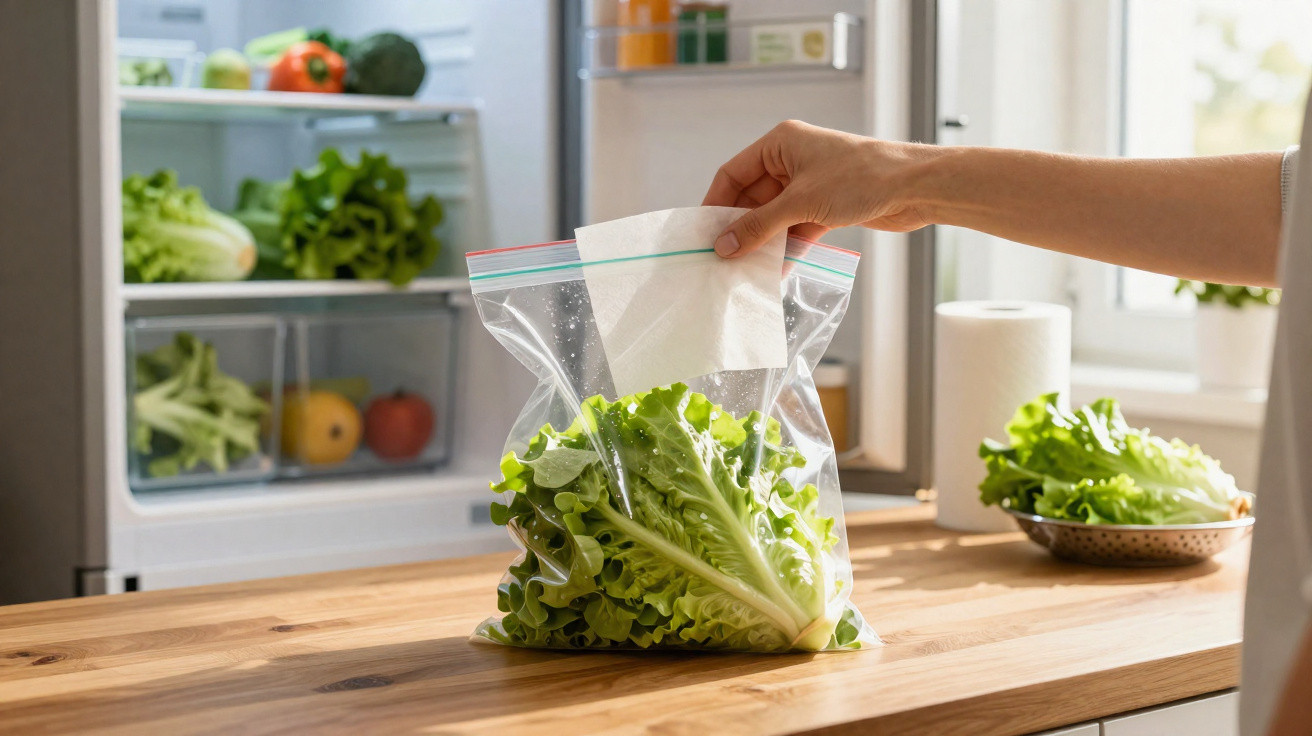
The technique is almost ridiculously easy. Once you have washed and roughly dried your lettuce by spinning it or shaking it over the sink, put the leaves into a resealable bag or container. Before sealing it, place one sheet of paper towel on top of the leaves, rather like a loose lid.
The towel does not need careful folding. It only needs to touch a few leaves while remaining exposed to the air inside the bag. Close the bag with a small amount of air left inside instead of pressing it flat like a vacuum pack. That is all. No specialist container, vacuum machine or elaborate routine: simply a layer that absorbs the surplus moisture released by the leaves each day.
As the week passes, that single sheet gradually darkens and softens without attracting attention. It takes in condensation before it can fall back onto the lettuce, and absorbs the tiny pools of water that would otherwise work their way into every crease. Suddenly, your midweek salads stay bright and crisp rather than taking on the colour of worn-out socks.
In practical terms, the method still works when life is hectic. Wash the lettuce once, on the day you bring it home. Spin or shake it reasonably dry, then store it with the towel. Later, when you arrive home hungry and impatient, the preparation has already been done. Open the fridge, take out the bag, pull out crisp leaves and eat. There is no additional washing or last-minute rinse in icy water.
People who have tested the trick often describe a striking improvement. Some say their leaves remain crisp for a full five to seven days. Others find that sliminess takes at least three extra days to appear. Even if your fridge is crammed full and lacks the ideal produce setting, the paper towel creates a small protective buffer against less-than-perfect habits.
There is a further, understated advantage: wasting less means buying less. The lettuce bought on Sunday no longer feels like a gamble. It becomes a dependable ingredient instead of a ticking time bomb. For many home cooks, that modest change affects how often they choose vegetables on weekday evenings. When preparing lunch means opening a bag of crisp greens rather than confronting unidentified sludge, salads cease to feel like a task.
The reasoning is brutally simple. The paper towel works as a sacrificial sponge. Lettuce releases moisture, humidity rises inside the bag and droplets develop. Instead of those droplets returning to the leaves, the towel absorbs the humidity. Conditions in the bag move from wet and stifling to gently dry and breathable.
You are not drying out the lettuce. You are stopping it from soaking in its own perspiration. The fibres in a towel retain water far more effectively than a smooth plastic bag can. The leaves therefore stay dry on the surface while remaining hydrated within. The cold air of the fridge then does the rest by slowing the natural breakdown of the cells.
This reflects what professional kitchens and certain salad brands already do on a bigger scale: controlling moisture rather than battling it. At home, however, you can achieve it with a one-cent piece of paper. There is no new gadget or extra storage space involved, only a small adjustment to the way you close the bag after washing your greens.
Setting up a lettuce routine for crisp leaves all week
Begin as soon as you return from the shop. Remove the lettuce from its original bag. Rinse the leaves under cold water, separating them with your fingers to wash away any grit and soil. Shake them well, then either use a salad spinner or lay them briefly on a clean tea towel.
Once the leaves appear mostly dry but are still cool and lightly damp to the touch, move them to a large, clean plastic or glass container, or to a resealable bag. Avoid packing them tightly. Set one sheet of paper towel loosely over the leaves, then close the container or nearly zip the bag, leaving a slight opening so the air is not under pressure.
Place the lettuce in the fridge, preferably in the salad drawer. Each time you open the bag during the week, check the towel. If it is saturated or beginning to tear, replace it with a clean sheet. The leaves below will remain protected, and one quick change keeps the routine effective.
This is where real life intervenes: most people do not have the energy to wash, spin and store every green vegetable perfectly as soon as they get through the door. You arrive home tired, shopping ends up on the worktop, children are shouting, emails are pinging, and you simply put the bag in the fridge for later. “Let’s be honest: no one really does that every day.”
If this sounds familiar, make the task easier. Even without washing the lettuce first, you can place a paper towel in the bag it came in. Open it, gently loosen the leaves, lay a towel across the top and close it again. The result will not be as dramatic as the full wash-and-dry routine, but it should still help the lettuce stay crisp for longer and reduce that swampy smell.
Over-drying is another frequent error. Some people worry so much about moisture that they leave lettuce out until it has wilted before storing it. The target is not bone-dry leaves; it is surface-dry, internally hydrated leaves. If they feel papery, you have taken it too far. Also, do not force too many leaves into a small bag. Compressed lettuce bruises more quickly and starts to rot at pressure points.
One home cook described it in a memorable way:
“The paper towel is like a raincoat for my salad. The storm is still there, but it hits the coat first, not me.”
That image neatly explains why the trick can feel almost emotional after you have used it for a while. You no longer dread discovering what is waiting at the bottom of the salad drawer.
The emotional effect is genuine. During a long week, opening the fridge to fresh greens that are ready to eat can feel as though someone has quietly done you a favour. More deeply, using what you buy instead of throwing it away changes the feel of daily life: less guilt, less unspoken frustration, and a small sense of capability whenever those leaves still crunch beneath your knife.
- Use one paper towel for each bag or container, placing it loosely on top of the leaves.
- Replace the towel when it becomes very wet or begins to sag onto the lettuce.
- Do not overfill the container; the leaves need some room and air.
- If possible, keep the lettuce in the fridge’s salad drawer, away from very wet produce.
The understated pleasure of lettuce that really lasts
There is something almost personal about knowing exactly what you will find in your fridge. You open the drawer and, instead of taking a chance, you have a quiet certainty. The lettuce purchased on Sunday still looks vivid on Friday. Its leaves bend but do not collapse, and they snap when torn. That small confidence carries over into the rest of your cooking.
People seldom discuss it, but much of everyday stress is concealed in these minor let-downs: forgotten herbs, a bag of spinach that turned to liquid overnight, or the lettuce you were sure you would use this time. Each small failure can suggest that you are not quite managing everything. Extending the life of your greens will not solve your week, but it does gently take away one layer of background irritation.
A single paper towel in a single bag will not change the planet either. Nevertheless, there is a quiet satisfaction in reducing waste at such a small scale. You begin to spot patterns: which vegetables keep well, which ones wilt fastest, and where moisture gets in. You may mention the trick to a colleague at lunch or a friend who complains that “salad just never keeps”. Before long, a throwaway detail becomes a useful piece of shared knowledge, passed from one person to another like a family recipe.
We have all found a simple kitchen habit and wondered, “Why did no one tell me this ten years ago?” Putting a paper towel in the lettuce bag is one of those habits. It is small enough to dismiss, yet significant enough to quietly alter weekday meals, your food budget and perhaps even how you view that unglamorous salad drawer waiting in the dark.
| Key point | Detail | Benefit for the reader |
|---|---|---|
| Paper towel as a moisture sponge | Absorbs condensation in the bag before it settles on the leaves | Keeps lettuce crisp and prevents slime for several additional days |
| Store washed, surface-dry leaves | Wash once, spin or shake dry, then refrigerate with a towel on top | Makes weekday salads quick, easy and more likely to actually happen |
| Check and replace the towel | Change the sheet when it appears very wet or starts to sag | Reduces food waste, saves money and lessens fridge frustration |











Comments
No comments yet. Be the first to comment!
Leave a Comment