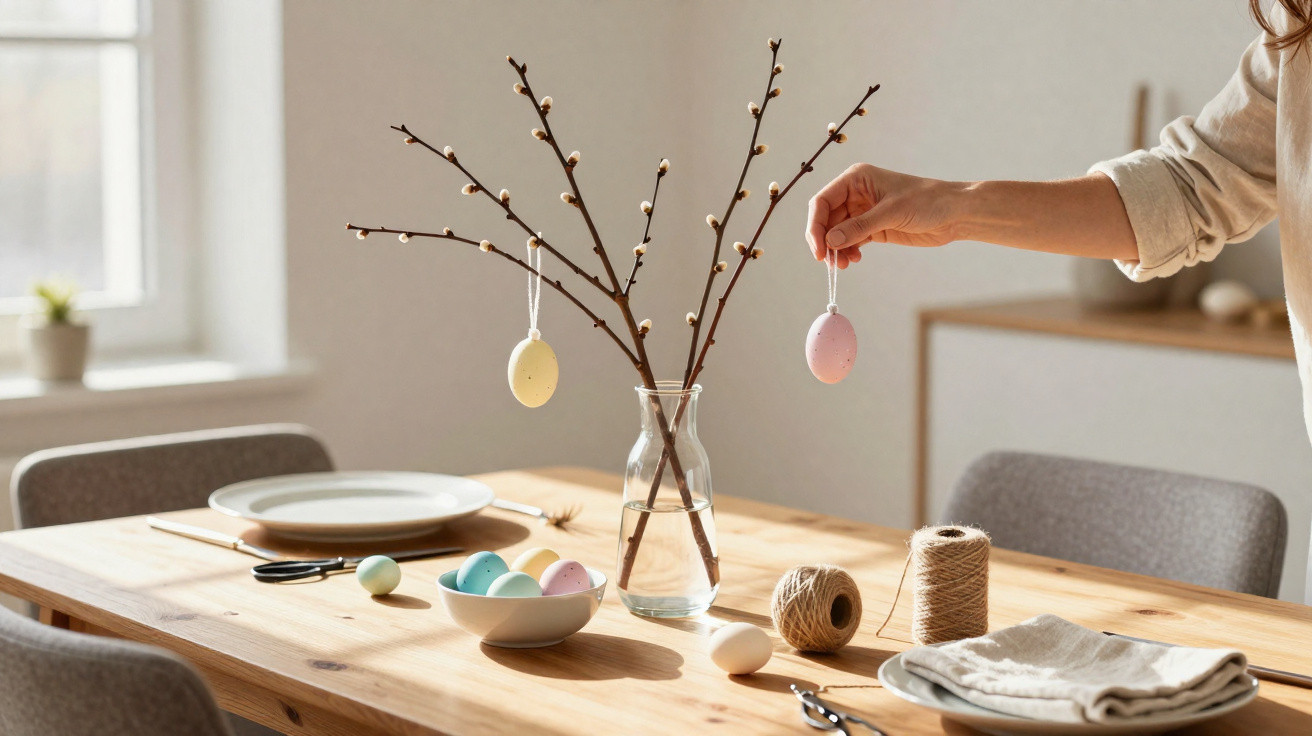
Many people are currently planning their big Easter meal, but enthusiasm for overloaded table runners, glittery rabbits and plastic decorations is fading. In their place, one idea is taking centre stage: with just a few materials, a touch of nature and a little flair, it creates a festive yet contemporary table setting – easily outshining the traditional tablecloth.
Why the traditional Easter table has had its day
A few years ago, the rule was simple: the more there was on the table, the more festive it looked. More candles, more figurines, more decorations. That trend has now clearly shifted. Many hosts want a clean-looking table, with sufficient room for serving bowls, platters and glasses, while still having one striking focal point that feels suitably spring-like.
This is exactly where the new idea comes in: rather than arranging flat decorations across the table, it draws the eye upwards. The tabletop remains clear, while the visual impact becomes greater. Minimal effort, maximum effect.
The effect does not come from quantity, but from height, airiness and a few carefully chosen details.
The result feels less like something from a decorations shop and more like an expression of personal style. With a little experimentation, you can create an atmosphere that is noticeably more relaxed and at the same time more refined than the Easter arrangements that were once commonplace.
The new centrepiece for the Easter table: a simple branch arrangement
A “tree” in a vase instead of a crowded centrepiece
The star of this Easter idea is essentially a branch arrangement in a vase – often called an “Easter tree”. All it takes is a few branches, a weighty container and some lightweight hanging ornaments. It has a rustic yet modern feel and works just as well in a country-style kitchen as in a minimally furnished city flat.
Instead of creating a dense landscape of decorations directly on the table, it produces a vertical focal point that rises upwards. Guests can still see one another, conversation remains uninterrupted, and there is plenty of room for plates, bowls and bread boards.
- The decoration extends upwards rather than outwards.
- Most of the table surface remains clear.
- The arrangement looks tidy despite its festive appearance.
- Nature visibly takes centre stage.
The best branches to use
A walk through the park, along a riverbank or around your own garden is enough to find branches for the ideal Easter arrangement. They should be reasonably sturdy without being too heavy. Particularly popular choices include:
- Willow branches with soft catkins
- Hazel branches with a gentle curve
- Cherry branches or other early fruit trees with buds
Place the branches in a large, preferably heavy vessel – such as a stoneware jug, a large glass cylinder or a rounded vase with a wide base. A secure footing is essential, as ornaments will later be hanging from the branches.
How to create an Easter tree step by step
Materials that almost everyone already has at home
Anyone who does not want to rush out to a decorations shop will appreciate this short list of materials. Much of it will already be in drawers at home or can easily be substituted.
| Required | Details |
|---|---|
| Large, sturdy vessel | A heavy base and a shape that is not too narrow, so it cannot topple over |
| 5–10 medium-sized branches | Willow, hazel or fruit tree branches, depending on your preference |
| Lightweight hanging eggs | Blown real eggs, paper, wood or plastic |
| Fine string or pastel-coloured ribbons | Around 2–3 metres, ideally in just 1–2 shades |
| Moss, grass or dried flowers | To cover the vase rim and decorate the base area |
Arranging it: from the base to the final ornament
Start by placing the branches in the vessel. If you like, weigh down the bottom with gravel or a few stones so that nothing wobbles. Then arrange the branches into a loose, airy shape – not a dense bush, but more of a “framework” from which the decorations can hang attractively.
Next comes the enjoyable part that defines the overall look: decorating it. A clear colour choice helps prevent the arrangement from looking cluttered. One or two shades are entirely sufficient, for example:
- Cream, light grey and natural-coloured ribbons for a Scandinavian look
- Powder pink and white for a romantic touch
- Yellow and green tones for classic Easter charm
Attach the lightweight eggs using string or ribbons, spacing them at different heights. You can also add small wooden figures, paper tags or minimalist metal shapes, but it is best to be sparing. A few well-positioned elements look far more refined than an overloaded branch arrangement.
An Easter tree relies on space between the elements – every empty area makes it look more elegant.
Finally, do not forget the base: a layer of moss, a wreath of dried grass or a ring of small flowers around the vessel’s edge visually connects the arrangement with the table.
Where the Easter tree makes the greatest impact
In the middle of the table or as a backdrop?
The most obvious place is, of course, at the centre of the table. Here, the branch arrangement forms something of a “roof” over the gathering without interrupting sightlines. Plates, serving bowls and bread baskets can be arranged around it, meaning the tablecloth needs hardly any additional decorative elements.
If the arrangement is especially tall or wide, another setting may be more suitable: a sideboard in the dining room, a small table beside the sofa or a chest of drawers in the hallway. From there, it brings a spring-like mood without getting in the way when serving food.
Add a few candles in warm shades such as dusky pink, beige or pale yellow, and you quickly create a calm, almost deliberate alternative to flashing LED lights and colourful plastic.
Sustainable, inexpensive and different every year
One benefit is particularly striking: the basic elements can be reused time and again or sourced from nature. Branches can be composted or burned in the garden after the celebration, while wooden or paper eggs can be stored away with the Easter decorations and brought out again the following year – simply with a different colour scheme.
Over time, this creates a small collection of ornaments that tell personal stories: eggs painted by the children, finds from the market and reminders of previous celebrations. The decorations become more personal without requiring investment in new mass-produced items every year.
Ideas for distinctive accents and variations
For minimalists, families and decoration enthusiasts
The basic structure always remains the same, but the effect changes greatly depending on the details:
- Minimalist: Branches only, white eggs and natural-coloured string. No additional colours or glitter.
- Family-friendly: Eggs painted by the children, colourful paper ornaments and small wooden animals among the branches.
- Very natural: Plenty of unbleached eggs, moss, small feathers and dried grasses – almost like a piece of woodland in the living room.
- Elegant: Glass or porcelain eggs, satin ribbons and understated metallic accents in gold or copper.
Anyone who wants to take the idea a step further can simply swap the ornaments after Easter: replace the eggs with small glass prisms, photographs, dried leaves or mementoes of summer days. The Easter tree then becomes a seasonal feature that accompanies the passing year.
Safety and care considerations
Although the decoration looks simple, hosts should keep a few points in mind. Dry branches catch fire more easily, so never place candles too close to them or leave them burning unattended. In homes with very dry central heating, make sure that the branches are not positioned directly above a radiator.
The stability of the vessel also deserves attention, particularly where children or pets are present. A non-slip mat, perhaps a few adhesive pads beneath the base, and a position away from main walkways can help to prevent accidents.
If someone in the family has a pollen allergy, it is better to choose already dried branches without flowers or high-quality artificial alternatives. In this case, neutral colours and natural materials such as wooden ornaments help ensure that the display does not look artificial.
With these few simple touches, one thoughtfully designed branch arrangement replaces the traditional, often overfilled Easter table setting – while delivering exactly what many people want right now: less clutter, more atmosphere and a piece of real nature in the living room.















Comments
No comments yet. Be the first to comment!
Leave a Comment