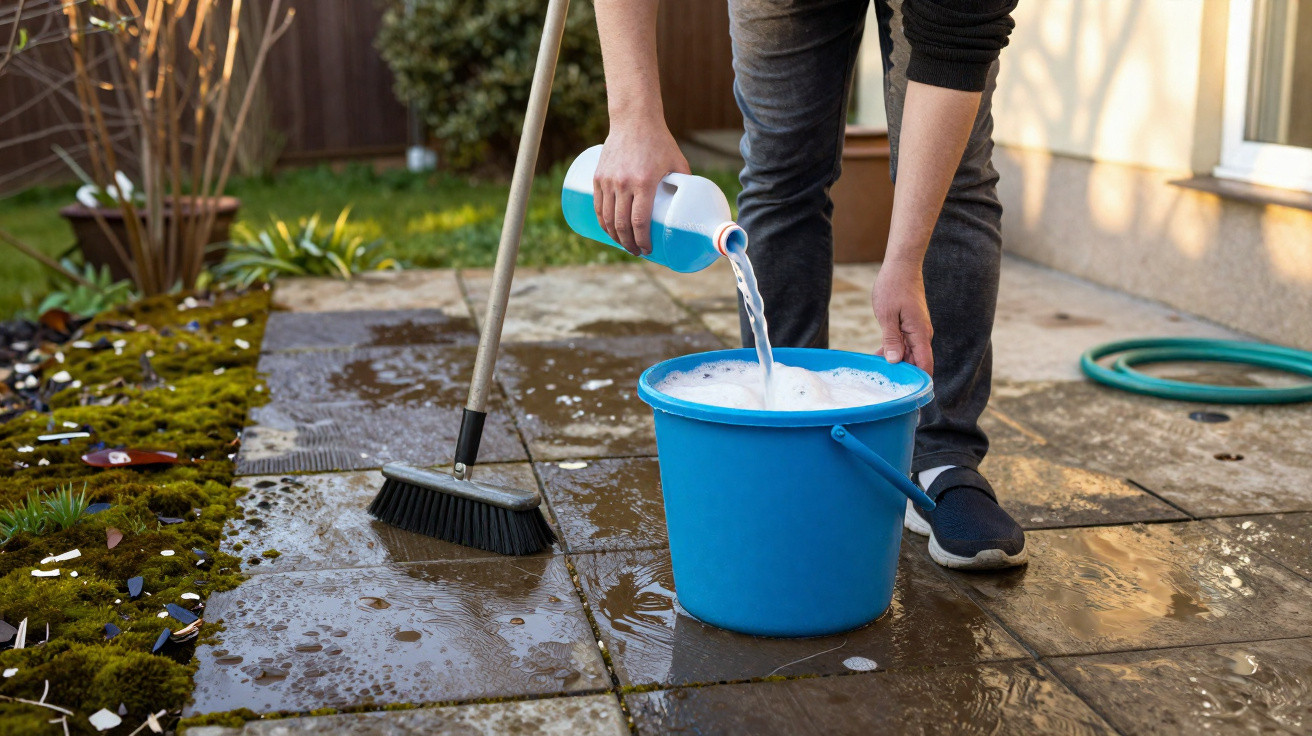
Many people know the situation: you open the door, take your first step onto the patio – and nearly slip because everything is coated in green slime. Rather than spending hours battling with a pressure washer and chemicals, gardening professionals are increasingly turning to something found in almost every kitchen: ordinary washing-up liquid, mixed correctly and applied at the right time.
Why patios become so slimy after winter
Moss and green deposits thrive in precisely the conditions found in many gardens: cool, damp and shaded. Areas on the north side of the house, narrow paths, steps and corners where water drains poorly are particularly vulnerable.
Throughout winter, layer upon layer builds up. A slight green tinge becomes a proper film that feels like soft soap underfoot. As well as looking unsightly, it presents a genuine safety hazard – particularly for children and older people.
Moss also keeps moisture on the surface for a long time. Concrete, natural stone and jointing material remain constantly wet. Over the years, fine cracks can form, edges may chip away and timber decking can begin to rot. Anyone treating this as a purely cosmetic issue risks overlooking the long-term damage.
Moss and algae do not merely look neglected – they can also damage materials and make paths dangerously slippery.
Pressure washers: noisy, wet – and often only a short-term fix
Many homeowners instinctively reach for a pressure washer and blast the entire area clean. At first, the results can seem convincing. The paving looks brighter, the green slime disappears and the improvement is immediately visible.
However, garden designers warn against excessive pressure for several reasons:
- Surface damage: Softer natural stone or older concrete slabs can gradually become roughened, while edges may break away.
- Joints wash out: Water removes sand and jointing mortar, making it even easier for weeds to take hold afterwards.
- Moss quickly returns: The jet clears away visible deposits but does not reach every spore deep inside the joints.
- Dirty spray: Loosened slime splashes back onto clothing, walls and windows.
For this reason, many people use liquid specialist cleaners for moss and algae. These products generally contain biocides, meaning active ingredients that kill living organisms. They can work, but may also affect soil life, pets and neighbouring flowerbeds. The warnings on the containers are there for a reason.
The simple washing-up liquid trick for moss and green deposits
Instead, gardening experts recommend a considerably gentler approach: warm water mixed with a little biodegradable washing-up liquid. There is no need for an unusual product or costly specialist cleaner; it is simply the liquid used for washing dishes, ideally one that is as environmentally friendly as possible.
The effect can be explained by school chemistry. Washing-up liquid contains substances known as surfactants. They break down grease and disrupt surface structures. On a patio, this means:
- The surfactants attack the waxy protective layer on moss and algae.
- The plants lose water, dry out and die.
- The solution seeps into narrow gaps between the slabs and reaches spores settled there.
Washing-up liquid breaks down the protective film on moss and algae without attacking stone or joints – while significantly reducing the use of harsh chemicals.
Choosing the right product matters: a mild, biodegradable washing-up liquid without bleach, ammonia or extremely strong fragrances has the lowest impact on the environment, pets and plants. Large puddles of highly concentrated solution should be kept away from flowerbeds and thirsty four-legged companions.
Step by step: how to use the washing-up liquid patio trick
For an ordinary patio, all that is needed is a bucket and a little time. This is how many professionals proceed:
- Preparation: Thoroughly sweep away leaves, twigs and coarse dirt. The cleaner the surface, the more effectively the solution can work.
- Mix the solution: Fill a bucket with around 4 litres of warm water and stir in 3 tablespoons of washing-up liquid until evenly mixed.
- Choose the right tool: Use a firm outdoor broom or a brush with plastic or natural bristles. Metal brushes can scratch the surface.
- Apply it: Spread the solution evenly across affected areas, paying particular attention to joints and shaded corners.
- Leave it to work: Allow several hours of dry weather so that the mixture can act undisturbed.
- Scrub: Once the deposits appear brown and crumbly, scrub firmly with the broom and sweep up the loosened dirt.
- Rinse afterwards: Give the area a brief rinse with clean water so that no soapy film runs onto the lawn or into flowerbeds.
Stubborn patches can be treated again after a few days. Regular early action prevents thick layers from developing, which take far more effort to remove.
How to keep the patio clean for longer
The washing-up liquid trick works best as part of a simple routine. A one-off clean in spring helps, but in the long term it is the combination of maintenance and sensible structural measures that matters.
Regular small-scale care instead of a major clean-up
Many people set fixed dates in their calendar:
- Monthly dry sweeping: Remove leaves and soil before moss can establish itself.
- Early action: Apply a small bucket of washing-up water as soon as the first green sheen appears.
- Check trip hazards: Reposition loose slabs so that water cannot collect beneath them.
This usually means a quick job is enough, rather than spending an entire weekend using heavy equipment.
Divert water and reduce shade
Moss likes standing water. Improving drainage removes the conditions that allow deposits to thrive. Common measures include:
- Check the gradient and, where possible, adjust it slightly so rainwater can run away.
- Clean channels and drains to prevent them from overflowing.
- Prune overhanging shrubs and trees selectively so more sunlight reaches the surface.
The drier and sunnier the area, the less moss there will be – simple changes around the edges often achieve more than any chemical.
Alternatives to washing-up liquid – and their drawbacks
Numerous household remedies circulate online, especially vinegar and bicarbonate of soda or baking powder. Both can be effective, but each comes with its own issues.
| Product | Advantages | Disadvantages |
|---|---|---|
| Washing-up liquid | Gentle on stone and joints, easy to measure, already available at home | Too concentrated, it can harm soil life and waterways |
| Vinegar | Inexpensive, effective against green deposits | Can attack limestone and joints, produces a strong smell, legal grey area for outdoor use |
| Bicarbonate of soda / baking powder | Abrades deposits, mildly alkaline | Powder residue, requires substantial rinsing, stains possible if used incorrectly |
Natural stone patios in particular deserve careful consideration: acidic cleaners can permanently roughen or discolour surfaces. If in doubt, always test a new product first in an inconspicuous corner.
What else homeowners should consider
Anyone with pets should keep them off the wet surface during treatment. Dried soap residue can easily be loosened again with a little water, but direct puddles are not ideal for either dogs or cats.
It is also important, from a legal perspective, to consider where the solution drains. Waste water containing cleaning products must not enter open ditches or garden ponds. The lower the concentration and the more sparingly it is used, the better it is for both the environment and the household budget.
It is useful to consider the material on your own patio: smooth, dense concrete slabs are more forgiving than porous sandstone slabs. When working on sensitive natural stone, it is better to use a weaker mixture, allow more time for it to work and scrub gently rather than using force.
Over the long term, an overall plan is worthwhile: a narrow gravel strip at the edge of the patio may be enough to keep splashback from flowerbeds away. Alternatively, a trellis can shift shaded areas so that the surface dries more quickly. Combined with the washing-up liquid trick, this creates a patio that is not only safe to walk on in spring, but looks well cared for throughout the year.















Comments
No comments yet. Be the first to comment!
Leave a Comment