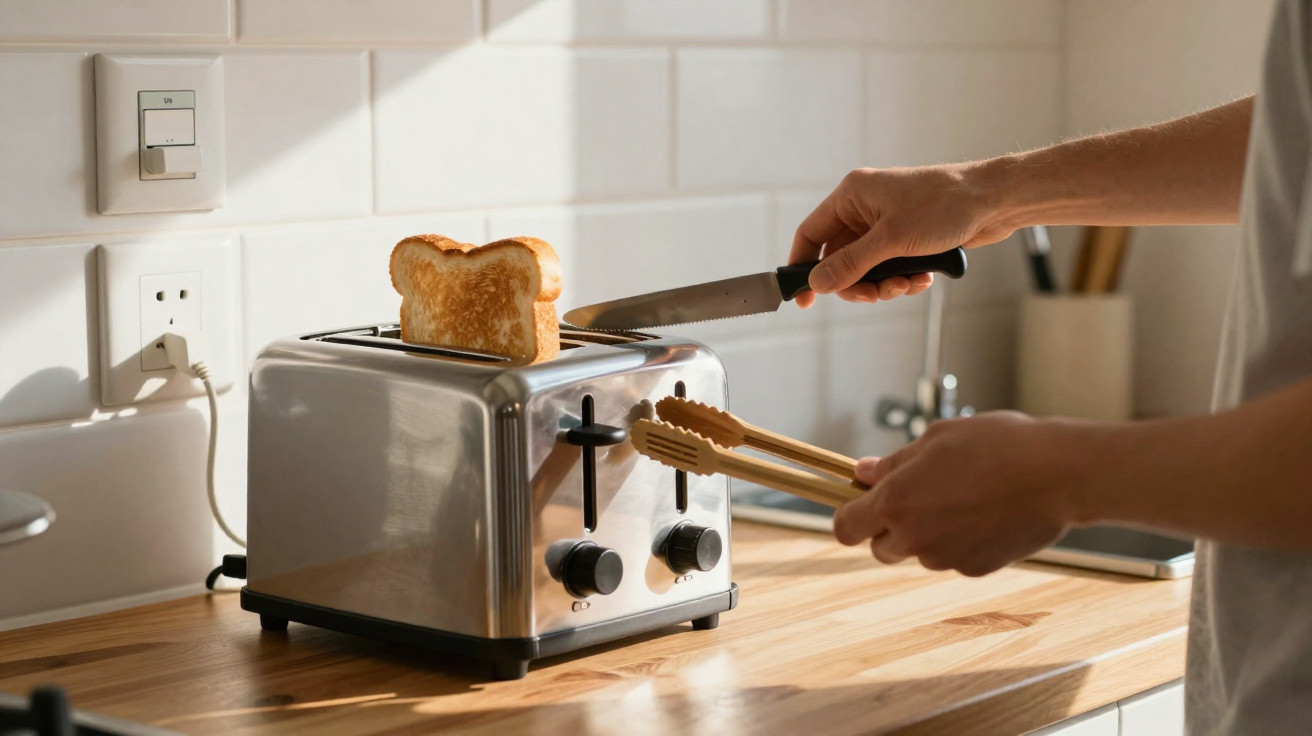
The toast has burnt while you were looking at your phone.
You catch the smell before you spot the problem: that light scent of “too late” wafting in from the kitchen.
When you get there and lift the lever, one slice rises out while the other remains jammed, charred at one corner.
Without pausing, you reach for the closest knife on the draining rack. It is metal.
The toaster appears perfectly innocent, resting quietly on the worktop.
It is switched off, its lever is raised and none of the heating elements are glowing.
Your hand moves towards the slot.
Then, just two centimetres away, a thought flashes through your mind: “Wait… is this actually safe?”
That brief pause could save your life.
Why a toaster can still shock you when it looks “off”
At first glance, a toaster appears no more dangerous than a loaf of bread.
There is no hum, no obvious movement, only two slots and a lever.
That apparent simplicity is precisely why it is so often underestimated.
What many people overlook is that its interior is a tightly packed metal network connected directly to your household electrical supply.
While the plug remains in the socket, live electricity may be present behind those harmless-looking slots.
You cannot see or hear it, but it is still there.
The toast itself is not the risk.
The danger is the route a metal knife could create for electricity to travel directly into your hand.
Electricians and A&E doctors tend to give the same warning: kitchen accidents seldom seem dramatic until something goes wrong.
One British safety campaign found that thousands of people are hurt each year while carrying out everyday tasks involving small appliances, including trying to retrieve toast from toasters.
One incident frequently cited in safety training involved a teenager running late for school who pushed a butter knife into a plugged-in toaster to release a stuck crumpet.
The toaster was “off”, yet the socket was live.
The electric shock flung him backwards, burned his fingers and tripped the circuit breaker.
He survived.
Not everyone has been so fortunate, particularly where water is close by, people are barefoot on tiled floors or a home has ageing electrical wiring.
The fundamental issue is straightforward: electricity does not care that you have finished breakfast.
When a toaster is still plugged in, its internal parts may remain energised.
The on/off lever generally controls the heating circuit rather than disconnecting the appliance from the mains.
A metal knife conducts electricity extremely well.
If it goes far enough into a slot, it may touch energised components and connect them to you.
Your body can then become part of the circuit, with current potentially travelling from hand to foot or from hand to hand, through your chest.
That is how a quick, careless movement can turn into a heart-stopping incident.
Even low-voltage household electricity can interfere with your heartbeat or cause your muscles to seize, preventing you from letting go.
Safer ways to rescue your toast (without risking your life)
The safest response to stuck toast begins before you attempt to remove it.
Your first action should always be to unplug the toaster from the wall.
Do not rely merely on the raised lever or the appliance being switched off at the socket - remove the plug physically.
After unplugging it, allow the toaster to cool for a minute, particularly if it has been set to a high setting.
Next, carefully turn it upside down over the sink or bin and give it a gentle shake.
Gravity, along with a few light taps on the side, will usually dislodge trapped pieces of bread.
If you still need to reach inside, use a dry wooden or plastic utensil with a long handle.
Wooden skewers, chopsticks or bamboo toast tongs are suitable; metal tools are not.
Safety leaflets repeat this guidance in large print for a reason.
In everyday life, people are hungry, tired and in a rush, so they take shortcuts.
We have all experienced that moment of telling ourselves, “It’ll only take a second.”
This is the point at which many accidents begin.
Perhaps your hands are wet after washing up, you are barefoot on a slightly damp kitchen floor, or a cheap extension lead is sitting on the worktop.
Each factor quietly increases the chance of an electric shock, changing the risk from “unlikely” to “very possible”.
Honestly, few people unplug every small appliance after every use.
However, with a toaster, that small additional action - taking out the plug - could genuinely separate a minor inconvenience from a visit to A&E.
“People think of high-voltage power lines as dangerous and kitchen appliances as harmless,” explains a hospital emergency nurse.
“But the human body doesn’t care what the source is. A strong enough shock in the wrong path can stop your heart, even if it comes from a toaster.”
- Always unplug first
Remove the plug from the wall before touching the slots, every time. - Use non-metal tools
Only reach inside with wooden or plastic utensils, and only after the toaster has cooled. - Keep the area dry
Dry your hands and the worktop, and do not stand in water or on a wet floor. - Clean crumbs regularly
Accumulated bread crumbs can cause internal scorching, short circuits and even small fires. - Retire old, damaged toasters
Replace the toaster if its lead is frayed, its casing is cracked or it smells of burning plastic.
Living with risk… and choosing which shortcuts are worth it
Most people are surrounded by quiet hazards that barely register.
A phone charging on the bed, a power strip beneath a layer of dust, a toaster that is older than your children.
We rely on them because they have “always worked fine”.
Putting a metal knife into a toaster is one small instance where habit meets physics.
When your toast is stuck and you are late for work, amps, volts and conductivity are not likely to be on your mind.
Your only thought is: “I just need this thing out.”
But this is one of those minor decisions where awareness truly makes a difference.
Once you have seen what household current can do to skin, muscle or a heartbeat displayed on a hospital monitor, that quiet toaster never looks quite the same again.
The next time something gets trapped, imagine yourself calmly unplugging the toaster, holding it over the sink and tapping out the crumbs.
No sparks, no drama and no “what if” tale to recount later.
Just safely recovered breakfast and a small reminder that certain shortcuts are simply not worth it.
| Key point | Detail | Value for the reader |
|---|---|---|
| Unplug before touching | A toaster can stay energised even when the lever is up | Reduces the risk of electric shock during everyday use |
| Never use metal tools | Metal knives and forks conduct electricity directly to your body | Helps readers avoid a common, dangerous reflex gesture |
| Adopt safer habits | Use wooden/plastic tools, keep the area dry, replace damaged toasters | Creates a simple, realistic safety routine in the kitchen |











Comments
No comments yet. Be the first to comment!
Leave a Comment