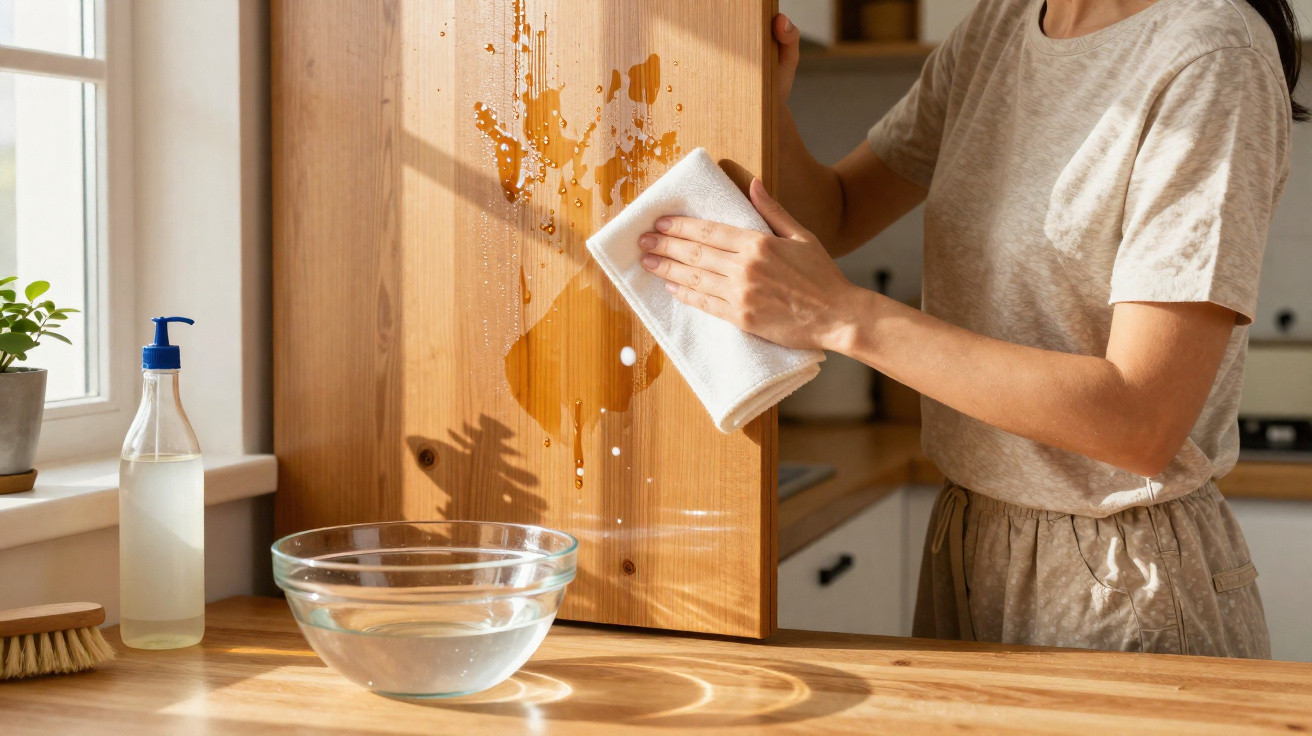
You can spend evening after evening tackling the same sticky cupboard doors, moving from one high-tech spray to another, yet that dull coating refuses to budge. The answer may already be in your cupboard: a humble bottle your grandmother would have used without a second thought. It takes only a few simple moves and costs less than a coffee.
I had tested the citrus-fragranced spray, a foaming cleaner and the “pro-strength” bottle with the awkward cap that digs into your hand. The grease was completely unmoved.
Then a neighbour stopped by, glanced at the doors and gave the knowing laugh shared by people who cook at home. She looked beneath my sink, ignored the glossy products and picked up the plain, overlooked bottle with its uncomplicated label. She did not even bother with gloves.
After one wipe, then another, I watched the dull layer lift away as though it had never settled in. There was no hard scrubbing, no fuss and no harsh fumes. Then she reached for a bottle that seemed more at home in a pickle jar than a cleaning kit.
White vinegar: the overlooked kitchen degreaser
White vinegar. Nothing more. This traditional liquid, usually kept beside the oil and salt, outperforms many modern degreasers when cupboard doors are covered in sticky film. Grease is difficult to shift because it sticks like softened wax. The gentle acidity of vinegar helps release that grip, allowing the cloth to lift it rather than simply spread it about.
I have seen it work in kitchens producing three meals a day, where a week of cooking is visible around every door handle. Put a warm vinegar solution on a microfibre cloth, wipe slowly once, and the tacky surface becomes smooth beneath your fingertips. There is even a faint squeak - the satisfying kind. In the space of a breath, the door changes from waxy to clean.
It can seem almost too easy. Shop-bought sprays frequently leave behind a residue that appears clean but attracts dust again. Vinegar breaks the greasy bond and evaporates without leaving a film. The effective combination is a little warmth from the water, a small amount of surfactant from the washing-up liquid, and the quiet action of that familiar acid - noticeable not by sight, but by the way your hand moves smoothly over the surface.
How to make greasy cupboards smooth again in minutes
Prepare the cleaner in either a spray bottle or a bowl: 1 cup of hot water + 1 cup of white vinegar + 1 small squirt of mild washing-up liquid. Spray sparingly, or dip in a folded microfibre cloth and wring it out well before wiping in long, steady strokes. To clean handles and edges, wrap the cloth around your finger and follow the line. Rinse the cloth in hot water, wring it out and wipe once more. Finish by drying with a clean towel.
For carved details or wood grain that traps dirt, use a soft toothbrush lightly moistened with the same solution. Clean gently and wipe straight away so that moisture does not remain on the surface. If the doors appear dry afterwards, polish them with a drop of food-safe mineral oil on a clean cloth to create a soft sheen. Realistically, no one does this every day. Start with the doors touched most often, then stop while the task still feels manageable.
Many people soak the doors or scrub as if they are sanding furniture. A light approach is better. Too much water can cause wood to swell, while abrasive pads may dull the finish. Test the mixture on a concealed area, leave windows slightly open for ventilation, and never combine cleaning products with bleach. Use soapy water only on stone splashbacks.
“Hot water + vinegar + a whisper of soap. I spend less time scrubbing, and the doors stay clean longer.”
- Toolkit: spray bottle, two microfibre cloths, soft toothbrush, dry towel
- Mix ratio: 1:1 hot water and vinegar, plus a teaspoon of washing-up liquid
- Motion: long strokes with gentle pressure, followed by a dry polish
- Finishing touch: a pea-sized drop of mineral oil on wood for shine
Why white vinegar outperforms shop-bought sprays in real kitchens
Start with the cost: one bottle of vinegar costs less than a latte, lasts for months and needs no elaborate marketing to do its job. Then there is the smell: it is sharp for a moment, but quickly disappears - unlike the lingering kitchen haze caused by certain aerosols. Many degreasers use more fragrance than cleaning strength. Vinegar does not mask the problem; it removes it.
The finish also matters. Painted cupboards, laminate, melamine and modern lacquer generally respond very well to a diluted solution. For genuine wood with aged shellac or wax, reduce the vinegar to a 1:3 ratio with hot water, then apply a light oil polish. We have all experienced the moment when unexpected visitors arrive and the cupboard doors expose us with a sticky shine around their handles. One unhurried wipe can rescue both your evening and your deposit.
There is also the air in your home. Using fewer products means fewer residue layers and a kitchen that smells of your cooking rather than a factory. You bring home less plastic and keep fewer bottles in storage. Small rituals keep a house in motion. This one needs six minutes and a cloth you already own. Your hands will not resent it afterwards, either.
Keep your cupboard doors feeling clean
Treat this as a small reset for an area touched throughout the day. Clean two doors while the kettle boils, then tackle the drawer fronts next time. If sauce splashes onto a door, deal with it while it is fresh using the mixture, and it will not become a slowly baked-on varnish.
Grease builds up quietly: a fine mist from frying, a hand reaching for a cupboard mid-recipe, or steam carrying tiny droplets. You are not untidy; your kitchen is simply lived in. The vinegar mixture suits that reality without making cleaning feel like another job. It cuts through grease, lifts it away and leaves no sticky layer behind.
For painted wood, make sure the cloth is damp rather than wet. On high-gloss fronts, dry with a fresh microfibre cloth to prevent streaking. When a door has been seriously neglected, apply the mixture first and leave it for two minutes before wiping. For gummy adhesive left by old bumpers, loosen it with a fingertip of cooking oil, then remove the oily smear using the vinegar solution. Small techniques like these add up to a calmer kitchen.
| Key point | Detail | Benefit for the reader |
|---|---|---|
| The liquid | Plain white vinegar diluted with hot water | Inexpensive, suitable for most finishes and quick to cut through grease |
| The method | Spray lightly, wipe with microfibre, dry polish; optional oil finish | Few steps, no heavy scrubbing and professional-looking results |
| Safety warnings | Keep away from natural stone; do not soak wood; Don’t mix vinegar with bleach | Helps protect surfaces, lungs and peace of mind |












Comments
No comments yet. Be the first to comment!
Leave a Comment