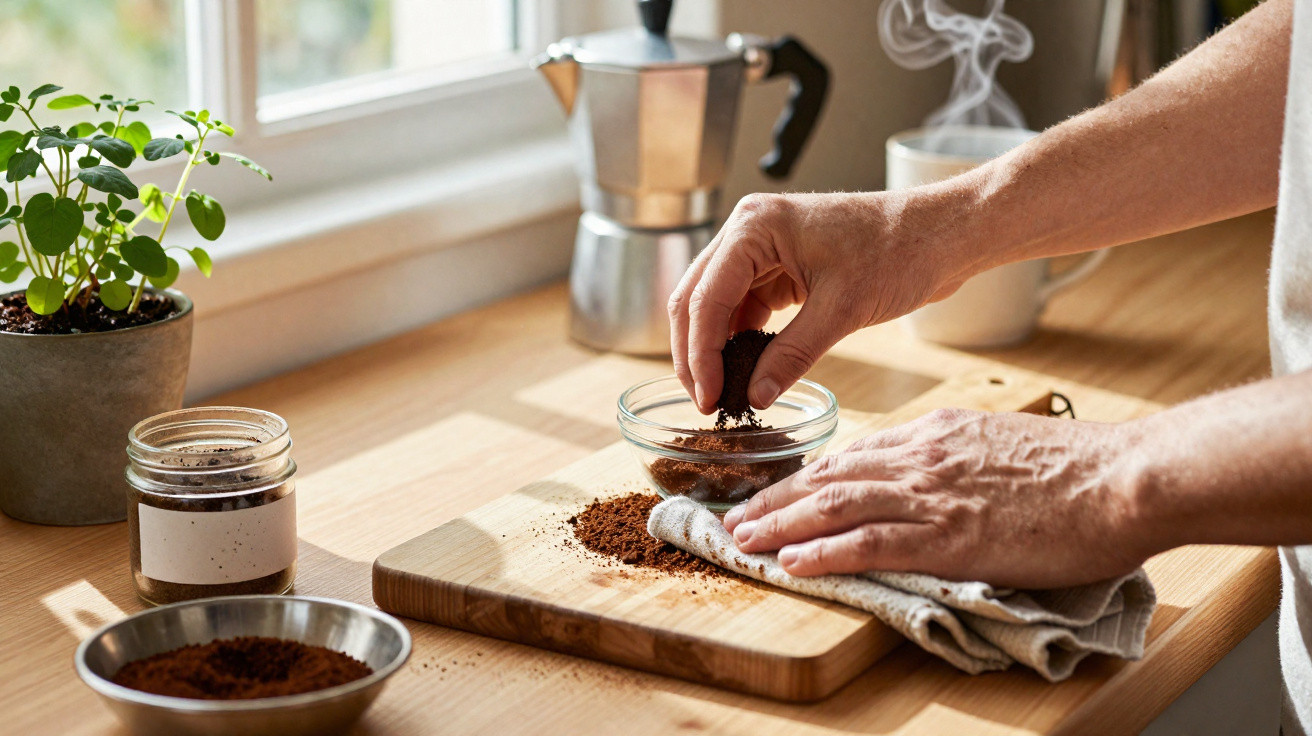
The morning coffee is finished, the kitchen still carries the aroma of espresso, and the filter is full of lukewarm coffee grounds ready to be thrown away without a second thought. We all know the routine: into the bin they go, followed by a slight sense of guilt that this dark residue might still be useful. On the worktop, a saucepan bears the marks of a gratin, the sink has lost its shine, and the smell of onion clings to your fingers. Coffee grounds are far from a replacement for every cleaning product, but in a few very specific situations they can prove surprisingly effective. The key is to use them in the right place, without attributing magical powers to them. In the kitchen, the simplest tips are often the ones we actually keep using. These are the ones worth keeping beside the sink.
Coffee grounds: a subtle helping hand for stubborn surfaces
Picture a familiar situation: a saucepan left on the hob a little too long, with a thin brown crust that refuses to shift with a sponge. Dampen the coffee grounds and mix them with a drop of washing-up liquid to create a mild scrub for lifting greasy or lightly burnt-on residue. Their texture provides gentle abrasion, which can be useful on stainless steel, thick glass or certain ceramic dishes. Rub calmly with a soft sponge or damp cloth. It is a straightforward, almost satisfying task. Delicate non-stick coatings, however, are best avoided: neither abrasive powders nor overly enthusiastic scrubbing are kind to them.
In a compact kitchen, the base of a frying pan can sometimes reveal last night's meal before breakfast has even begun. A handful of still-damp grounds, a small amount of washing-up liquid and a few circular movements will often remove a greasy film from a stainless-steel sauté pan. A Lyon resident recently said she had adopted this habit after a raclette: the pan was not miraculously made as good as new, but it looked noticeably cleaner without using repeated doses of degreaser. Coffee grounds work mainly as an exfoliant, rather than as a chemical product able to dissolve all grease on their own.
That distinction matters. When degreasing saucepans, hot water and soap do most of the work; the grounds provide a little mechanical assistance on stubborn patches. They can also be useful for cleaning a cold cooking rack or the base of an oven dish, after soaking it for fifteen to twenty minutes first. Honestly, nobody really does this every day. Yet after particularly generous meals, when the sponge seems ready to give up, saving the morning's coffee grounds can spare you from reaching for a whole collection of products from beneath the sink.
Six useful kitchen uses, without treating coffee grounds as a miracle product
A second use concerns unwelcome lingering smells. A small bowl of thoroughly dried coffee grounds placed at the back of the fridge or near the bin can help absorb certain persistent odours. To make this genuinely practical, spread them on a plate for a few hours beforehand, preventing dampness and mould. Coffee grounds will not eliminate a smell caused by spoiled food: the source needs to be cleaned, anything that must be discarded should be thrown away, and the compartments washed. They offer modest but welcome support when cheese, fish or onion has left its mark.
A third option is to rub damp hands gently with a small pinch of coffee grounds after chopping garlic, fish or onions, before washing them with soap. The grains help loosen the odorous residue, while rinsing washes it all away. A fourth possibility is to use them on an untreated wooden chopping board, rubbing very lightly before rinsing and drying it immediately. Care is needed with pale, porous woods, as they may stain. If a board is deeply scored or has smelled unpleasant for a long time, it primarily needs a thorough clean, or perhaps replacing.
The final two uses call for just as much common sense as a desire to reuse something. Dry grounds can scrub a stainless-steel sink and help deodorise a small food container after it has been washed; they may also be used to rub a completely cooled barbecue grill, alongside a suitable brush.
“The right habit is not to use more coffee grounds, but to use them where their texture can genuinely help.”
- Use no. 1: lift marks from a stainless-steel saucepan or dish.
- Use no. 2: temporarily absorb odours in the fridge.
- Use no. 3: reduce the smell of garlic, onion or fish on your hands.
- Use no. 4: gently clean a non-delicate chopping board.
- Use no. 5: make a stainless-steel sink shine with a soft sponge.
- Use no. 6: assist with cleaning a cold grill or a heavily soiled dish.
The small morning leftover that can sometimes change habits
Coffee grounds are a reminder that an everyday kitchen relies on small adjustments, not perfect solutions. A leftover can be useful, provided it is not left for several days in a damp corner and is never poured down the sink. This last mistake is common: mixed with grease and debris, grounds can contribute to blocked drains. It is better to throw them away after use, or add them to compost if you have it. Between complete waste and a supposedly revolutionary trick, there is a much more realistic approach: use what you have when it genuinely helps.
| Key point | Detail | Added value for the reader |
|---|---|---|
| Scrub without overdoing it | Damp coffee grounds help scrub stainless steel, ceramic and sturdy dishes. | A useful extra solution for greasy or lightly burnt-on marks. |
| Reduce odours | The grounds must be thoroughly dried before being placed in a bowl in the fridge. | A simple step for everyday odours, alongside proper cleaning. |
| Avoid mistakes | Do not put coffee grounds down drains or use them on delicate or non-stick surfaces. | Use this tip without damaging the kitchen or blocking pipes. |














Comments
No comments yet. Be the first to comment!
Leave a Comment