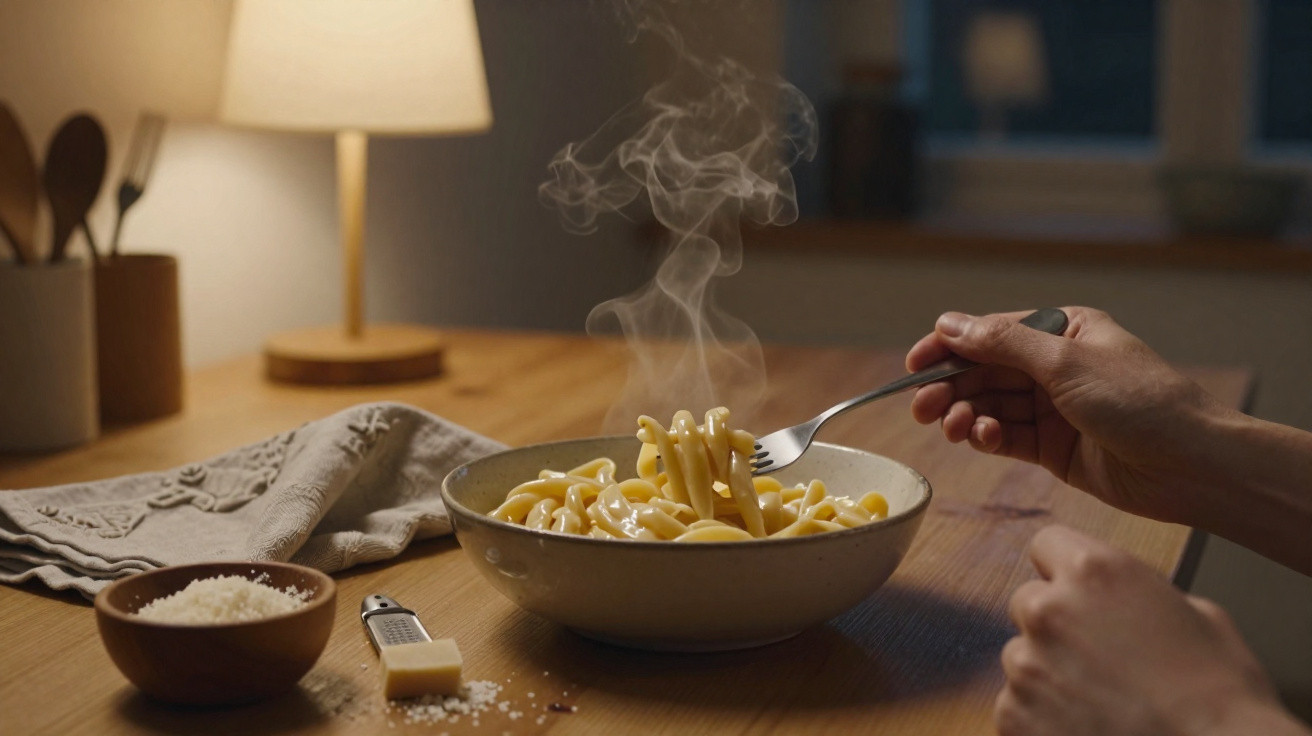
The kitchen felt unnaturally silent for a weekday evening. There was no podcast playing in the background, no notifications flashing across the worktop-only the fridge’s muted hum and the faint, persistent sizzle of a saucepan warming on the hob. I had not intended to make anything special: merely an abandoned packet of pasta, half an onion and a carton of cream edging perilously close to its use-by date.
Yet, when the butter began to melt across the pan and garlic scented the air, the atmosphere changed. I slowed down and picked up my favourite wooden spoon, the one marked by a burn near its handle.
Beyond the walls, the usual end-of-day chaos carried on. In the kitchen, I stirred, tasted and added salt, while this uncomplicated creamy dish started to feel like a private secret I was keeping to myself.
What was strange was the sense of safety it gave me.
The unusual comfort of one quiet, creamy dish
Some evenings arrive without warning. Nothing terrible has happened and nothing is especially dramatic, but the house is just too silent, every sound carrying a little too far. You scroll for a while, linger in the kitchen doorway without knowing what drew you there, then spot something easy to cook and hear your mind say, “Do that.”
That was how this dish came about: one pan, a little fat, some starch and a swirl of cream. Steam clouded the window above the sink while, outside, the world continued for a few minutes without requiring anything from me.
It was not an occasion. There were no visitors, no attractive plates and no carefully arranged social-media lighting. There was simply me, a bowl and the surprising feeling that something warm and silky was holding me together.
Anyone who has cooked creamy pasta or a smooth risotto alone late at night may recognise it: the unhurried way a spoon moves through the sauce, and how the sauce clings as though it does not want to release the pasta.
One reader told me she began making “emergency carbonara” on her worst days, not because it was healthy or photogenic, but because beating eggs into cheese and hot pasta forced her to stand still for ten minutes. Someone else wrote about a wet Sunday when rice, stock and Parmesan were all they had, and how it somehow became “the night I realised I was going to be okay”.
We do not often discuss these modest, personal dishes-the ones that appear unremarkable but land somewhere far beneath the ribs.
There is a gentle logic to why this sort of food can be so reassuring. Creamy dishes coat every component in one shared texture, rather like a blanket thrown over an untidy bed. The mind interprets that smooth consistency as familiar, secure and forgiving. There are no hard edges or unexpected crunches, only softness from the first bite to the last.
Stirring plays its own part. Repeated movements can reduce stress hormones, and cooking is built around small rituals: stir, taste, adjust, then stir once more. It offers you a little control in a world that rarely asks what you would prefer.
You start with random leftovers and end up with something unified, edible, and yours. On evenings when everything else feels slightly beyond your grasp, that change can feel like a quiet form of power.
How to create comforting creamy pasta, step by step
That silent evening, the process could hardly have been simpler. I cooked half an onion in a knob of butter until it became translucent and gently sweet. There was no need to hurry-only low heat and occasional, lazy stirring. Next came a garlic clove, more crushed than finely chopped, for a brief sizzle.
I added a splash of white wine-the sort that is “fine for cooking” and only occasionally pleasant to drink-and allowed it to bubble down. Once its aroma had softened from sharp to mellow, I poured in the cream: enough to generously cover the base of the pan, but not so much that it flooded it.
As the sauce reduced gently, I boiled short pasta in salted water until it was just tender. I added a ladleful of starchy pasta water to the pan, tipped in the pasta and tossed it over the heat until everything became glossy and yielding, as though it had let out a breath.
The best part is that you do not need a recipe stuck to the fridge to make it work. A few comforting principles, plus permission to be a little imprecise, are enough. Salt the water “like the sea”. Taste the sauce before deciding it is ready to serve. Stop cooking when it looks right to you rather than when a timer announces the end.
A common pitfall is making cream-based dishes dense, sickly and heavy. This can happen when the heat is too fierce, the cream reduces excessively or all the cheese is added at once and turns clumpy. It is also unwise to use cream as a remedy for every earlier mistake. Over-browned onions and burnt garlic will not become wonderful merely because liquid has been poured over them.
Honestly, no one makes food like this every day. It is “sometimes food”, precisely because it can feel mildly luxurious and slightly unnecessary.
Somewhere between stirring and tasting, an unexpected thought occurred to me: perhaps this was what looking after yourself meant tonight. Not an elaborate routine or a ten-step wellness programme-just this bowl.
That’s the thing about comfort dishes: they are rarely impressive, but they are almost always honest.
I eventually noted down what made this particular bowl work for me, like a small checklist scribbled on the reverse of an envelope:
- A warm, soft base: pasta, rice, gnocchi or even bread
- A gentle fat: butter, cream, olive oil or cheese
- A subtle aromatic: onion, garlic, leek or shallot
- One welcome extra: peas, mushrooms or leftover chicken
- Something sharp to finish: lemon, black pepper or grated hard cheese
These are not fixed rules, only a flexible guide that can be adapted to whatever is in the kitchen. On a tiring evening, ticking only one or two boxes is already sufficient.
Why a small, creamy bowl can remain with you
Several days later, I was still thinking about that evening, which is revealing when most weekday meals vanish from memory so quickly. The dish itself was unexceptional: creamy, slightly peppery and eaten partly standing at the worktop. There was no garnish or flawless snowfall of Parmesan, only a fork reheated midway through because I had become distracted by my own thoughts.
Even so, the moment felt like a pause that genuinely did its job. The noise in my mind lowered by a few degrees and my shoulders relaxed. I was not suddenly joyful or entirely changed, but I felt… less jagged.
At times, a comforting meal is not about explosions of flavour. It is about being able to experience one simple, completely understandable thing from beginning to end.
| Key point | Detail | Value for the reader |
|---|---|---|
| Build creaminess in layers | Begin with onion/garlic cooked in fat, deglaze with a splash of liquid, then add cream and starchy water | Helps anyone make a silky, forgiving sauce using basic cupboard ingredients |
| Use a simple “comfort structure” | Soft base + gentle fat + subtle aromatic + one extra + sharp finish | Offers an easy mental formula for improvising soothing dishes on low-energy evenings |
| Prioritise ritual over perfection | Stir slowly, taste as you cook and make food for yourself without pressure | Turns an ordinary dinner into a grounding moment that relieves stress and loneliness |
FAQ:
Question 1 What creamy dish can I make if I only have pasta and cream?
Begin by bringing salted water to the boil for the pasta. As it cooks, melt a little butter in a pan, add any onion or garlic you have, then pour in some cream. Thin it with a spoonful of pasta water, season with salt and plenty of black pepper, and toss the pasta directly into the pan. A grating of any hard cheese you own is an extra, rather than a necessity.Question 2 How do I stop a creamy sauce from feeling too heavy?
Use less cream than you first think you need, extend it with pasta water or stock, and add something bright at the end, such as lemon juice, grated cheese or pepper. Serving it in a smaller bowl than usual may also change the feeling from “too much” to “just right”. Eat at an unhurried pace and pause between mouthfuls.Question 3 Can a creamy dish still be comforting if I am trying to eat lighter?
Yes. Replace part of the cream with milk or stock, use sautéed vegetables to add bulk and keep servings moderate. Much of the comfort comes from warmth and texture rather than sheer richness. Aim for that soft, cohesive quality instead of trying to produce a restaurant-standard sauce.Question 4 What can I add for more flavour without making the recipe complicated?
A spoonful of mustard, a squeeze of lemon or a handful of frozen peas can transform the dish. Nutmeg is a subtle classic in cream sauces, particularly alongside spinach or mushrooms. One or two small adjustments are plenty; there is no need for an entire spice cupboard.Question 5 Is it strange to cook a “nice” creamy meal solely for myself?
Not at all. Making something a little indulgent for one person can be a meaningful act of self-respect. It tells you that you are worth washing a pan and using the “good” ingredients, even when nobody else is there to see it. That quiet message often settles more deeply than we expect.














Comments
No comments yet. Be the first to comment!
Leave a Comment