In a nutshell
- 🧊 When cooler outdoor air is heated indoors, its relative humidity falls, lifting surfaces above the dew point and lowering the likelihood of condensation and mould.
- 🌬️ Use brief, purposeful purge ventilation after dusk: create cross-ventilation for 10–20 minutes, use the stack effect, leave trickle vents open and micro-vent bedrooms.
- ⚖️ Pros vs. cons: substantial benefits for RH reduction, indoor air quality and building fabric, balanced against possible heat loss, noise and security concerns, and smaller benefits on very humid nights.
- 📊 Real-world test: a Salford flat fell from 67% to ~50% RH and reduced its dew point by ~5°C after an 18-minute night purge, while cooling by only ~1.4°C-a minimal energy penalty.
- 🛠️ Let data guide you: check a hygrometer, schedule purges after cooking or showering, use extractors and do not dry clothes on radiators to avoid moisture accumulating overnight.
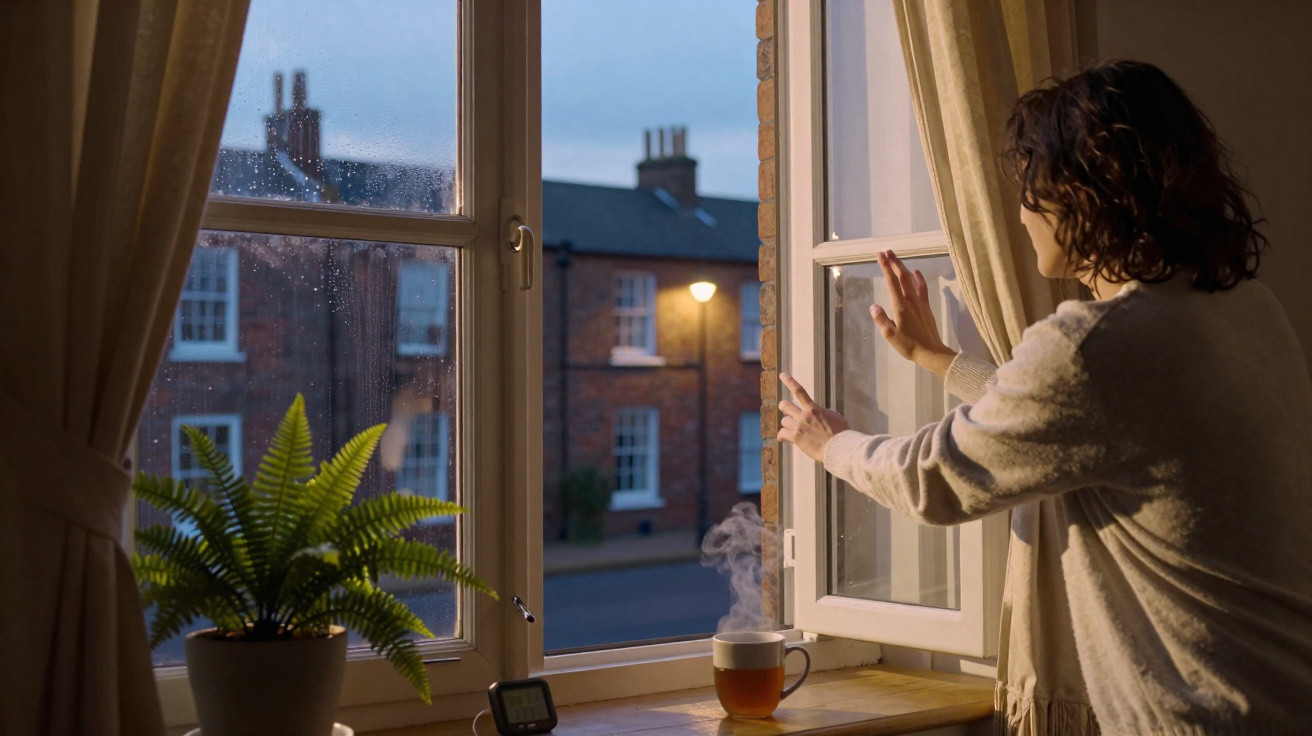
As evenings become darker across Britain and radiators settle into their regular hum, many households encounter a familiar problem: condensation that encourages mould, damages paint and can worsen asthma. One low-key solution is remarkably simple. Opening a window after dusk, when outdoor air is cooler, brings more than fresh air; it changes the indoor physics. Once that cooler outside air enters and warms up, it can have a lower relative humidity, helping moisture evaporate from damp surfaces more quickly. Brief, carefully timed night ventilation can reduce indoor moisture without wrecking comfort or energy bills. This is the science behind it, how to use it in each room and why simply choosing “more ventilation” is not invariably the right approach.
Why Cooler Night Air Reduces Condensation
The amount of water air can hold rises as its temperature increases. This is why relative humidity (RH)-the proportion of moisture in the air compared with the most it could hold at that temperature-is considered alongside absolute humidity, meaning the actual grams of water in each cubic metre. Outdoor temperatures decline after dusk. When this cooler air comes inside and is warmed by several degrees, its moisture-holding capacity increases while its RH decreases. With lower indoor RH, wet walls, windows and fabrics release moisture more easily, interrupting the nightly condensation cycle.
A straightforward example illustrates the effect. Take a cool evening where the outside air is 10°C and 80% RH. That same air could warm to 19°C once indoors. It retains almost the same water content, but it can now hold considerably more. Consequently, its RH drops as it warms, creating drier-feeling air without chemicals or a dehumidifier. The table shows why this affects condensation risk and the dew point, the temperature at which air reaches saturation and moisture condenses.
| Scenario | Temp (°C) | RH (%) | Approx. Absolute Humidity (g/m³) | Resulting RH if Warmed Indoors to 19°C (%) |
|---|---|---|---|---|
| Cool evening air | 10 | 80 | ~7.5 | ~46 |
| Mild evening air | 12 | 75 | ~7.9 | ~48 |
| Damp night air | 8 | 90 | ~7.3 | ~45 |
The headline: cooler outside air, once warmed indoors, often ends up “drier” by RH-enough to flip surfaces from condensing to evaporating. This shift helps control moisture gathering overnight, particularly on single-glazed windows and at thermal bridges behind wardrobes.
How to Ventilate After Dusk Without Losing Too Much Heat
The effective method is focused, brief and considered. Treat it as a “purge, then seal” routine. The objective is a quick influx of low-RH air that removes moisture, rather than leaving the home open until it becomes uncomfortably cold. When managed properly, the loss of heat is limited and condensation control can be significant. When it comes to results, timing and the route air takes are just as important as the length of time spent ventilating.
Practical measures suited to typical UK homes include:
- Purge ventilation: Open windows on opposite sides for 10–20 minutes after cooking, showering or doing laundry. The crossflow rapidly draws humid air outside.
- Stage the night: Vent just after dusk, or as the outdoor temperature starts to fall, then repeat before bed if you have produced additional steam.
- Use the stack effect: Leave a downstairs window and an upstairs window slightly open; warmer moist air escapes from high level while cooler air enters below.
- Shut internal doors during purges to keep moisture within wet rooms, then open them for a whole-home equalise pass.
- Trickle vents and fans: Keep trickle vents open and operate extractor fans for 20–30 minutes after showering or cooking.
- Micro-vent bedrooms overnight: a narrow opening or tilt-and-turn position reduces heat loss while helping to control RH.
If your street is noisy or polluted, ventilate from the quieter side of the building and use kitchen/bath fans to extract from the other side. Where security is a concern, use top-hung or tilt-secure openings and keep overnight gaps small. During allergy season, mesh screens may help, alongside scheduling purges for lower-pollen periods. The goal is not to make the house cold, but to carry out a short exchange of dry air that resets humidity before condensation forms.
Pros and Cons of Night Venting
Night ventilation works alongside heating because it removes latent moisture that might otherwise settle at the first cold bridge, run down onto window sills and nourish mould. It is inexpensive, quick and feasible whatever your tenure or budget. Even so, circumstances matter. Opening a window is a tool, not a religion.
- Pros:
- Quickly lowers RH without the cost of a dehumidifier.
- Enhances indoor air quality by diluting CO₂ and VOCs.
- Focuses on the period when condensation risk is greatest.
- Helps protect the building fabric-paint, plaster and timber can last longer.
- Cons:
- Can lose heat if ventilation is excessive or windows remain open for hours.
- May bring street noise, pollution or security worries in certain locations.
- Offers limited improvement during very warm, humid nights or fog.
- Does not solve serious cold-bridge or rising damp issues on its own.
Why opening the window isn’t always better: when absolute humidity outdoors exceeds that inside-on humid summer nights or in mist, for example-ventilation can bring additional moisture in. Use a basic hygrometer: if outdoor air is cooler and has similar or lower RH than the indoor air, a short purge is likely to be useful. Combine this with simple practices-put lids on pans, run extractor fans and avoid drying clothes on radiators-and you can reduce the nightly moisture load before it settles on cold glass.
A Small Home Test: Data From a Damp-Prone UK Flat
I carried out a basic experiment in a one-bedroom upstairs flat in Salford that regularly suffered winter window drips, using two consumer data loggers. Following an evening of boiling pasta and a shower, the lounge registered 21.0°C and 67% RH, while the bedroom recorded 20.3°C and 64% RH. I opened the bedroom tilt window by 12 cm and the lounge top-light by 8 cm for 18 minutes, before closing both but keeping the trickle vents open.
- Before purge: 21.0°C, 67% RH (dew point ≈ 14.5°C).
- Immediately after: 20.0°C, 53% RH (dew point ≈ 10.2°C).
- One hour later: 19.6°C, 50% RH (dew point ≈ 9.3°C); no visible fogging on the coldest corner pane.
- Estimated absolute humidity drop: roughly 3–4 g/m³, enough to flip sills from wetting to drying.
During the purge, the flat cooled by around 1.4°C, although the boiler restored this over the following hour and there were no complaints about comfort. More importantly, the dew point dropped well beneath the temperature of the coldest glass. That widened safety margin is what prevents nightly wetting and the week-on-week creep of mould. This was not a peer-reviewed study, merely a reporter’s field note, but it reflects the experience of many energy advisers: short, sharp night ventilation arrests moisture build-up with minimal energy penalty.
For UK homes prone to damp, the post-dusk physics generally works in your favour: cooler outdoor air that warms indoors usually produces more favourable RH and drier surfaces. Combine swift cross-ventilation with disciplined extractor use and small everyday changes, and you address the causes of condensation rather than merely wiping away its symptoms. The key is to vent with intention-briefly, at the right times, and with an eye on your hygrometer. What does your evening routine currently involve, and how could a data-led, 15-minute night purge alter how your home feels-and smells-by morning?
















Comments
No comments yet. Be the first to comment!
Leave a Comment