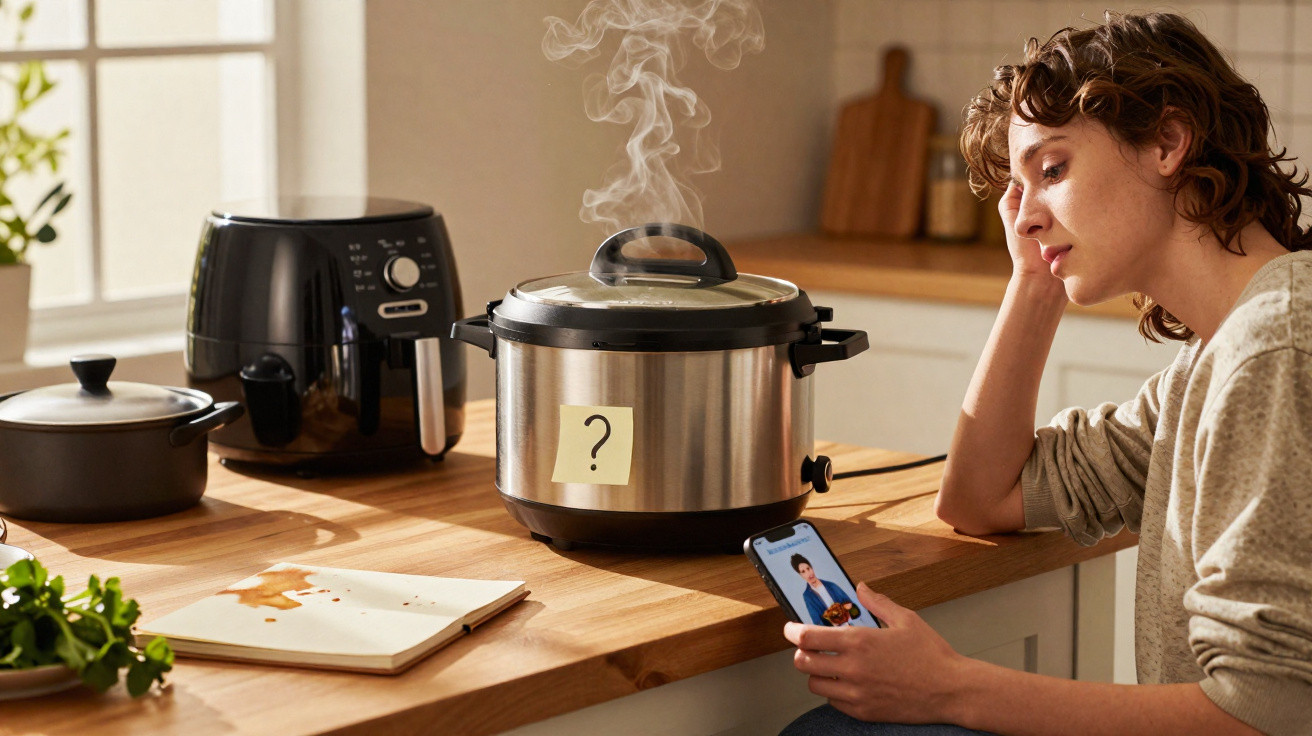
On a drizzly Tuesday at 18:47, dinner-time panic sets in. You are looking at a partly defrosted chicken breast, a grumpy child scrolling through TikTok at the table, and a worktop packed with appliances that once promised they would “change your life”.
This is often when somebody says, “We should just buy that new nine-in-one everyone keeps talking about.”
You have seen the glossy clips too: influencers tap a gleaming button and somehow turn out lasagne, yoghurt, dehydrated kale crisps and a whole roast chicken, while their kitchen remains immaculate.
The air fryer, once Instagram’s favourite appliance, suddenly seems boxy and dated beside this polished, multi-function “miracle”.
Yet an increasing number of home cooks argue that the miracle is largely marketing.
Some even say they have been properly conned.
From air fryer favourite to nine-in-one “miracle”: how did this happen?
Spend more than a minute scrolling social media and the formula becomes obvious: an identical worktop, the same overhead shot, and carefully arranged steam drifting from a bowl.
The air fryer had its moment, promising guilt-free crispy chips. It was followed by the blender boom, the juicing craze and sous-vide’s turn in the spotlight. Now the nine-in-one has become kitchen technology’s latest heir apparent.
It claims to pressure cook, slow cook, sauté, steam, air fry, bake, make yoghurt, cook rice and dehydrate, all in a single appliance.
Nine actions, one machine.
That is the sales pitch.
Consider Emma, 34, who lives in a one-bedroom flat whose kitchenette is barely wide enough for two people to walk past one another.
After watching a creator she follows produce a full three-course meal from one machine on Instagram Reels, she gave away her air fryer to “upgrade” to a nine-in-one.
The clip received 2.3 million views. Emma received a parcel the size of a small washing machine, plus an instruction manual long enough to pass for a novella.
During the first week, she tested everything: pressure-cooked chickpeas, air-fried potatoes and a banana loaf that was strangely wet in the centre.
By the third week, the nine-in-one had been moved to a corner of the worktop, its cable coiled up, silently reproaching her whenever she picked up an ordinary pan.
There is a reason this scenario keeps happening.
These machines are marketed as more than practical tools; they are presented as a route to a different identity: someone who meal preps on Sundays, eats “clean” and never burns the evening meal.
Brands and influencers push that idea hard because it speaks to a real need: we are tired and busy, yet we still want home-cooked meals without the mess.
The nine-in-one is not only competing with the air fryer on features.
It is competing on aspiration.
The backlash begins when that aspiration collides with tiny kitchens, frantic evenings and the steep learning curve left out of sponsored content.
Why some home cooks love the nine-in-one - and others call it a scam for the lazy
When used effectively, a nine-in-one can genuinely transform weekday evenings.
Its biggest fans usually rely repeatedly on only two or three main settings rather than trying to use all nine. Pressure cooking followed by air frying, for instance, is a strong combination: chicken thighs can be cooked until tender, then have their skin crisped in the same pot.
Alternatively, add rice, stock and vegetables, press a button and leave it to cook without standing over the hob.
The “secret” shared by many happy owners is unglamorous but practical: choose two modes that suit your routine, and regard everything else as an extra rather than a guarantee.
The anger has a different source.
It does not come from people who dislike gadgets, but from those who believe they were promised effortless healthy meals and were instead left with another oversized object.
One father of three told me he bought a nine-in-one to “stop ordering takeaway”, persuaded by a TikTok presenting it as a straightforward solution for busy families.
He attempted to cook everything in it: pasta, roasts and one-pot dishes. Some meals were excellent; others ended up oddly soggy or overcooked.
After a month, on chaotic evenings he had returned to the oven and microwave. In his words, the nine-in-one had become “a very expensive rice cooker”.
The phrase “scam for the lazy” appears in furious Reddit discussions and Facebook groups, but it conceals a more troubling reality.
People are not lazy; they are stretched too thin.
What frustrates them is the distance between the advertising-perfect meals, no effort and barely any washing up-and the real experience: working out cooking times, testing recipes, washing several components and finding room on the worktop.
Let us be realistic: almost nobody does all of this every day.
When you are worn out, even selecting the correct setting can feel like one more choice to make.
That is where the resentment lies: between the promised autopilot and the work the appliance still demands.
Is a nine-in-one useful for your kitchen, or simply more clutter?
A practical way to ignore the noise is to carry out a “typical week audit” before spending anything.
Use a piece of paper or your phone’s notes app to list what you genuinely cook from Monday to Sunday. Write down reality rather than ambition: frozen pizza, scrambled eggs, frozen vegetables, pasta, leftovers and perhaps an occasional roast.
Then review that list as though you were a mildly grumpy friend, and ask where a nine-in-one would actually be useful.
If you seldom cook dried beans, stews, large joints of meat or sizeable batches of grains, a pressure-cooking setting is unlikely to save much time.
If reheating and toasting make up most of your cooking, a conventional oven and a decent pan remain quietly dependable.
There is also an emotional element to this decision that technology-focused reviews rarely cover.
Some home cooks feel these “smart” machines judge them, as though needing help with basic cooking is a personal failing. Others are embarrassed when their appliance gathers dust, as if that proves they lack discipline.
That unspoken shame is burdensome and entirely needless. Kitchen tools are supposed to serve you, not the other way around.
One kind rule can help: if an appliance does not make your real life easier within a month, that is not a failure of willpower.
It simply is not the right tool for you.
There is no moral judgement attached.
The argument also has a cultural dimension: traditional cooks against gadget fans, skill against convenience.
Some experienced home cooks are sincerely offended by the marketing message. They feel that craft, instinct and patience are being displaced by presets and showy displays.
Others support anything that gets more people cooking, even if their starting point is a button rather than a knife.
As one food writer told me:
“I don’t care if you use a clay pot, a cast-iron pan, or a spaceship pressure cooker. If it gets you to feed yourself and the people you love, it’s valid.”
For anyone undecided, it can help to reduce the choice to a few simple questions:
- Do you already cook at home at least three evenings a week?
- Do you often prepare stews, broths, grains or batch-cooked meals?
- Do you have worktop or cupboard space that will not make you feel stressed?
- Are you prepared to learn one or two functions properly over several weeks?
- Would you be happy if it becomes a “three-in-one” for you rather than a “nine-in-one”?
If most answers are no, the risk of frustration is high.
If you find yourself agreeing, the nine-in-one could quietly deserve its place in your kitchen.
Beyond the hype: what the nine-in-one debate says about modern cooking
The disagreement around the nine-in-one is not truly about steel and plastic.
It is about time, fatigue and the subtle pressure to perform even in our own kitchens. For some people, the appliance is a lifeline: a means of eating reasonably well between night shifts, commutes, children’s homework and everything else life brings.
For others, it represents a trend they have had enough of: technology arriving to “solve” something that was never really broken while pushing aside basic abilities such as chopping an onion or boiling pasta.
We have all had that moment of looking at a gadget and wondering whether we bought a useful tool or merely a promise.
The air fryer craze demonstrated how quickly one appliance can turn into a must-have status symbol before becoming a dust collector.
The nine-in-one may follow the same route, or it may settle quietly into the background as one more choice among many.
The more useful question is not “Is this a scam for the lazy?”, but “What sort of help do I actually want in my kitchen?”
Some people will stick with a dependable pan and oven, others will welcome the all-in-one future, and plenty will land somewhere between the two, choosing kitchen tools as selectively as recipes.
That middle ground, away from both hype and outrage, is probably where most real-world dinners are made.
| Key point | Detail | Value for the reader |
|---|---|---|
| Match tool to habits | Review a typical week of meals before buying | Avoid paying for gadgets that do not suit real life |
| Use a few functions well | Concentrate on 2–3 key modes rather than pursuing all nine | Lowers overwhelm and improves the time genuinely saved |
| Drop the guilt | Appliances are aids, not measures of discipline | Less shame and more freedom to keep or resell what does not work |












Comments
No comments yet. Be the first to comment!
Leave a Comment