You have probably witnessed this scene countless times.
The first cry does not come from the frying pan.
It comes from whoever is chopping tomatoes.
A friend, partner or parent hunches over a chopping board, forcing a stubborn knife through an onion when it simply will not glide. The blade skids, the onion shifts and their fingers tighten. A momentary lapse of concentration, and the fingertip pays the price.
The worktop ends up covered in juice, vegetable peelings and… a few spots of red.
The knife gets the blame, the board is cleaned, and cooking continues with a plaster and a dose of bravado. Hardly anyone stops to consider how ridiculous the situation is.
Here is the awkward reality: the problem was not that the knife was too sharp.
It was that it was not sharp enough.
Why a dull knife turns your kitchen into a minefield
Watch somebody use a dull knife and there is something subtly worrying about it.
Their shoulders tense, their jaw clenches and their hand bears down as though they are trying to crush the ingredients rather than cut them.
Instead of slicing, the blade slides about.
It shoves tomatoes aside, flattens bread and rips herbs rather than cutting them neatly. With every extra push, the knife looks for the easiest route through. Sometimes, that route leads directly to your fingers.
That is the odd contradiction lurking in the cutlery drawer. A knife that appears safer because it is blunt is statistically more likely to send you to A&E. It is not more aggressive; it is simply because you must wrestle it into doing what it is supposed to do.
Emergency department staff may tell you, quietly and over poor coffee, that kitchen knives are familiar visitors. Across many safety studies, dull knives appear as a well-known concealed hazard because they require greater strength, pressure and uncomfortable movements. The force you apply does not merely vanish into the chopping board. It is waiting for a slip.
Imagine trying to cut a bagel using a blunt blade. You push down, the knife rebounds and the bagel turns. Your hands edge nearer to “stabilise” it. Then one minor movement makes the knife break through suddenly, carrying all that built-up energy… to somewhere your skin would rather it did not go.
A US study of hand injuries in domestic kitchens found that a large proportion of cuts happened during everyday jobs: chopping vegetables, slicing bread and cutting fruit. These are the tasks we perform without thinking. The true danger is that most people do not realise their knife has become dull. They assume cutting food is meant to take effort.
From a practical perspective, this is logical. A sharp edge concentrates the same force over a very small area, allowing it to cut cleanly. A dull edge distributes that force and encounters greater resistance. In response, you use more muscle. Shoulders lean forward, wrists turn and arms press down.
Once the blade finally gives way through the food, that energy is released abruptly and forcefully. This is when knives skid over boards, burst through cling film or fly from cabbage leaves towards hands and wrists. By comparison, a sharp knife needs less downward pressure. Its motion is more restrained, controlled and quiet.
There is a psychological element too. We generally give a visibly sharp blade more respect. We concentrate, alter our grip and slow down slightly. A blunt knife makes us careless. “Oh, it barely cuts, it’s fine.” Our fingers move closer, and we carry on chatting as we chop. That is how a lazy blade can end up putting your name on a hospital form.
How to keep your knife sharp enough to actually be safer
One straightforward routine separates composed, controlled kitchens from tense places where fingers are at risk.
Sharpen the knife before it begins causing trouble.
Professionals do not wait until a knife feels like a saw. Before or after cooking, they make a few light passes with a honing steel, then occasionally sharpen the blade properly with a stone or through a professional service. The sessions are brief, take little effort and make a major difference.
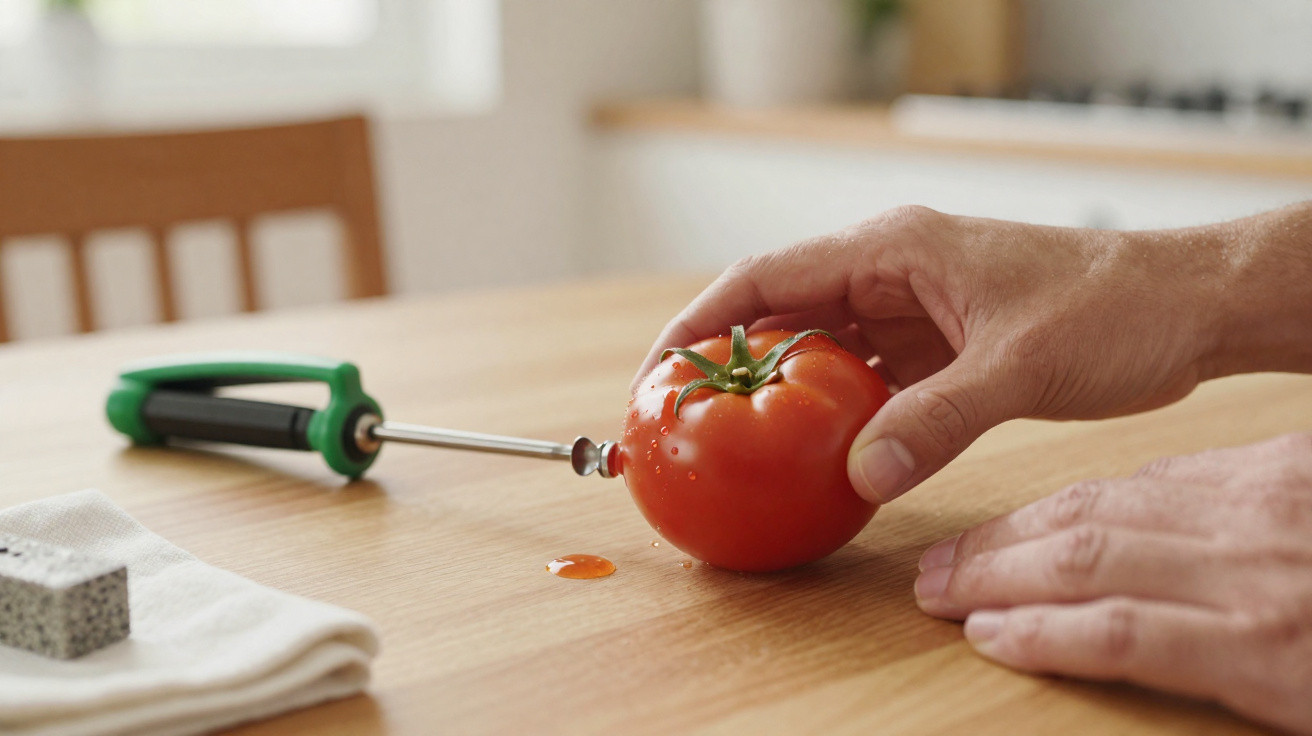
If equipment is not your thing, begin modestly. Get one good chef’s knife, one honing steel and one simple sharpener, or find a local sharpening service. That alone can transform the way you cook. Your knife ought to cut a tomato with virtually no pressure, pass through an onion without crushing its layers and slice fresh herbs without bruising them into pulp.
During a tiring weekday evening, most home cooks repeat the same habits.
They reach for the same old knife, the one that is “good enough”, and then struggle through carrots, squash, potatoes and frozen-pizza cardboard. It is already blunt, while every tough job dulls it further. By Sunday, it resembles a club more than a blade.
In practical terms, a dull knife makes every job slower. Chopping takes more time, and your hand becomes painful. You grip the handle as if it were a hammer and lean your full body weight into it. Mentally, preparation starts to feel daunting. A salad becomes a whole project, so you order a takeaway and leave the knife dull in the drawer. We know how that story ends for both your fingers and your food budget.
Sharpening changes that pattern. The very same jobs suddenly become smoother, quicker and almost silent. Carrots fall into tidy rounds. Onions become uniform cubes instead of crushed fragments that make you cry twice as much. Without making a conscious effort, your movements grow smaller and safer. Less force means less chaos on the chopping board.
A properly sharp knife brings a restrained kind of confidence.
You notice it in your posture, in the way your fingers tuck underneath and in the rhythm of blade against board.
“A sharp knife doesn’t make you reckless,” a chef once told me. “It makes you respectful. Respect and sharp steel is a safer mix than fear and a dull blade.”
You do not need a drawer filled with costly equipment to achieve this. One or two blades that you genuinely maintain will outperform ten neglected ones every time. Begin with the basics:
- Keep one “main” knife sharp and protected; do not throw it loose into a drawer.
- Choose a wooden or plastic chopping board, never glass or marble, which destroys the edge.
- Hone regularly, then sharpen properly once honing stops making a difference.
- Work with a stable, dry board and an uncluttered workspace.
- Stop immediately if you find yourself forcing the blade through food.
Let us be honest: nobody truly does all of this every day.
Even so, doing it monthly or having your knives professionally sharpened several times each year changes the whole feel of your kitchen. Your hands learn that they do not need to battle. Your mind learns that food preparation can be almost meditative rather than faintly hazardous.
The quiet power of respecting the edge
There is something almost personal about sharpening a knife.
It is one of the few occasions in modern life when you give an everyday object your undivided attention.
Rather than discarding or replacing it, you restore it to its intended state. There is the scrape of steel on stone, the gentle shhh of the honing rod and the first test cut through paper or a ripe tomato. You stop fighting the blade and start working alongside it. That small change in relationship alters how you move around your own kitchen.
At a deeper level, selecting a sharp knife rather than a dull one is a quiet sign of respect for your body: your fingers, joints, wrists and shoulders. Reduced pressure brings reduced tension. Reduced tension means fewer minor injuries, fewer unexpected slips and fewer “I don’t know how I cut myself, I barely touched it” incidents.
We have all experienced the moment when an ordinary evening suddenly goes wrong because of one careless cut. The pan is still hot, the meal is only half prepared, and somebody holds their hand beneath cold water while everyone else hunts for plasters and kitchen roll. That memory stays with us more than we tend to admit.
A sharp knife will not magically improve your technique, clear your cluttered worktop or cure your tendency to rush dinner. It does, however, remove one quiet saboteur: the persistent need to use force when precision would have done the work. Once you know how a sharp blade moves, returning to a dull one feels like choosing chaos over calm.
Perhaps that is the real question beneath the statistic about dull knives and injuries. It is not “Is my knife dangerous?” but “What kind of kitchen do I want to stand in every day?” One where you brace yourself against the blade, or one where everything flows? One where danger only occurs to you after an accident, or one where safety is built into the simple decision to keep the knife sharp?
| Key point | Detail | Why it matters to the reader |
|---|---|---|
| Dull knives need more force | A blunt edge resists food, so you press harder and lose control | Helps you see why knives that “look safer” cause more accidents |
| Sharp knives cut predictably | A keen edge glides with minimal pressure and a cleaner motion | Explains how sharpness reduces slips and unexpected movements |
| Simple habits protect your hands | Regular honing, occasional sharpening and suitable boards keep edges safe | Provides practical ways to make your kitchen calmer and safer |









Comments
No comments yet. Be the first to comment!
Leave a Comment