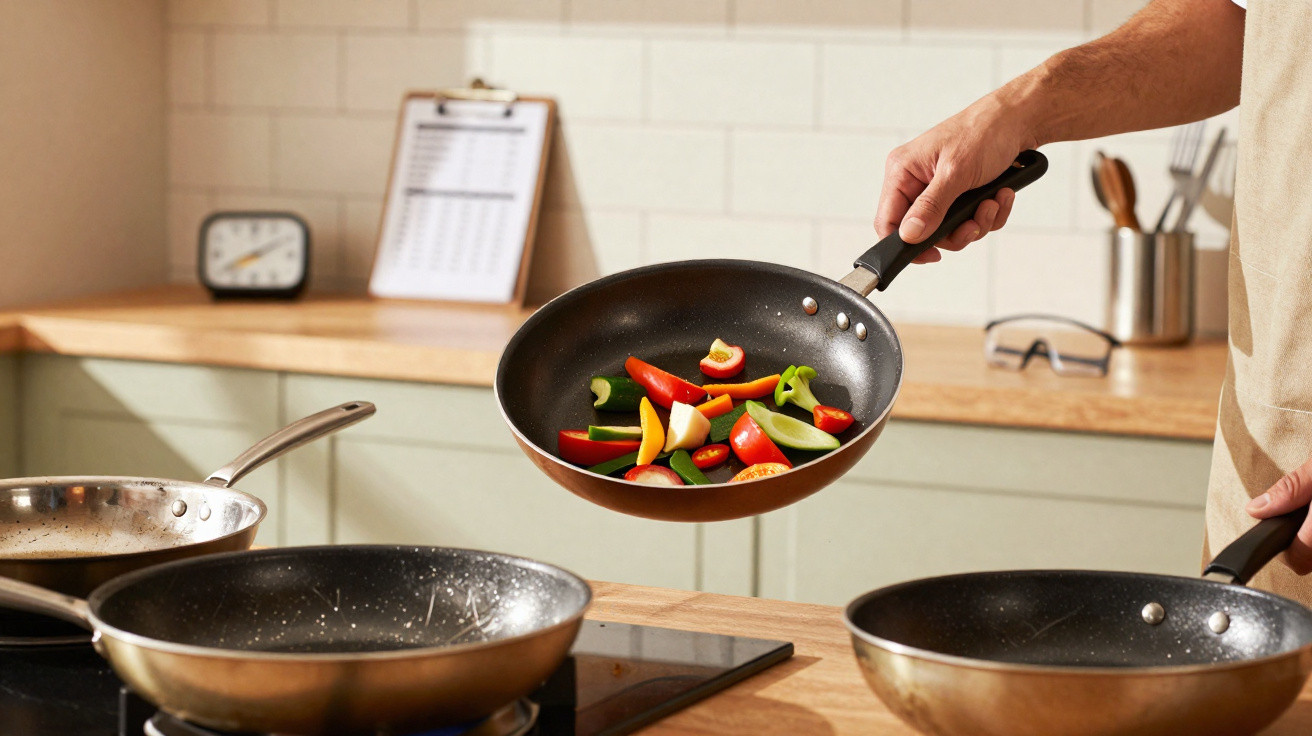
Many coated frying pans have come under scrutiny over potentially harmful substances – but an extensive comparison test has now brought greater clarity to home kitchens.
A respected consumer magazine put ten widely available non-stick frying pans through demanding laboratory testing. The assessment covered not only cooking performance and ease of use, but also the presence of potentially problematic chemicals. Somewhat unexpectedly, a Tefal model emerged as the clear winner, achieving a score that even impressed the testers.
Why non-stick frying pans are under increasing scrutiny
For years, non-stick frying pans have been seen as convenient kitchen essentials: they need little oil, prevent food from sticking and are quick to clean. At the same time, concern has grown about so-called ‘forever chemicals’ (PFAS), which are used in many coatings or at stages of their manufacture.
Particular attention has focused on PTFE, more widely known by the brand name Teflon. It is the material that allows fried eggs to slide effortlessly from a pan. For decades, PTFE was frequently associated with PFOA, a PFAS compound that is now banned in the EU. Although manufacturers have long since switched to other substances, public scepticism has remained.
This is precisely what the latest test set out to examine: how safe today’s non-stick frying pans really are, which substances may be released and how well their coatings withstand everyday use.
How the testers pushed the frying pans to their limits
Ten non-stick frying pans had to complete a punishing laboratory programme designed to replicate several years of use. The investigation concentrated on three areas: potentially harmful substances, coating durability and cooking performance.
- Chemical analysis: The laboratory specifically screened for 36 substances, including several PFAS compounds.
- Abrasion testing: Repeated abrasion cycles were used to mimic intensive use and the ageing of the coating.
- Realistic cooking trials: Under identical conditions, the frying pans were required to cook crêpes, among other foods.
The encouraging finding was that none of the pans exceeded the legal limits. However, laboratories detected traces of 6:2 FTS, a PFAS compound which environmental health specialists say may affect organs, in several models. These included products from well-known brands such as Cristel, Le Creuset, Zuofeng, Aubecq and Greenpan.
Labelling also raised concerns. According to the testers, two manufacturers promoted potentially misleading claims about their products being PFAS-free. In the assessors’ view, the promises made did not match the laboratory findings.
When coatings wear away: abrasion is a weak point
The abrasion test revealed substantial differences between the models. Several pans lost their protective layer relatively quickly. Beka, Aubecq, Zanetti and one model intended for professional use performed poorly in the simulated wear assessment.
Between stress cycles, the assessors regularly cooked crêpes in the pans. This made it possible to establish how long the non-stick effect would genuinely last in everyday use. In two cases, the metal beneath the coating was already visible after around 2,500 cycles – a clear warning that the pan would not remain usable for much longer in a real kitchen.
The final score combined several criteria:
- Non-stick performance and heat distribution (60%)
- Ergonomics and handling (10%)
- Transfer of unwanted substances into food (30%)
The winning frying pan: Tefal Excellence scores 17.5 out of 20
Tefal Excellence took first place in the rankings. Its 17.5 out of 20 score placed it clearly ahead of many more expensive competitors. The 20-centimetre model costs around €52 in shops and is clearly aimed at households that use a frying pan every day.
The testers praised the Tefal Excellence for its strong overall package of effective non-stick performance, a durable coating and laboratory results with no detectable PFAS.
The winning pan’s key advantages in the test were:
- No detectable PFAS: Laboratory testing found no measurable traces of these chemicals.
- Strong abrasion resistance: Its coating withstood the simulated wear cycles far better than those of many rivals.
- Reliable non-stick performance: Food continued to release almost without residue, even after numerous stress cycles.
- Good heat resistance: The pan does not warp and distributes heat evenly.
The testers regarded the Tefal Excellence as a genuine all-round frying pan. Searing steak, cooking crêpes, making scrambled eggs or braising vegetables all worked smoothly in the trials, using little or no fat.
How the other brands performed
Second place went, surprisingly, to an affordable model from the furniture retailer: the Ikea Hemkomst scored 17 out of 20. At around €20, it performed particularly impressively when making pancakes. It is therefore an interesting alternative for shoppers on a tighter budget.
The Cristel Excelliss+ is considerably more expensive, at just under €95. It achieved 15.8 points in the test. Although the pan delivered solid results, its value for money was markedly weaker than that of the top-ranked model.
At the other end of the scale were the Beka Mandala and Zanetti Pietra Rara. Both finished near the bottom, scoring 5.8 and 7.8 points respectively. The discovery of several PFAS compounds – five different ones in the Beka pan alone – was a particular concern in the laboratory.
| Brand / model | Score | Approx. price | Notable findings |
|---|---|---|---|
| Tefal Excellence | 17.5 / 20 | €52 | no measurable PFAS, highly durable |
| Ikea Hemkomst | 17 / 20 | €20 | very good for crêpes, affordable price |
| Cristel Excelliss+ | 15.8 / 20 | €95 | premium price, good overall performance |
| Beka Mandala | 5.8 / 20 | – | several PFAS compounds, poor durability |
| Zanetti Pietra Rara | 7.8 / 20 | – | metal becomes visible quickly after abrasion |
What the test results mean for everyday cooking
For many households, the test eases some of the concern surrounding coated frying pans. Those using a well-rated pan with no detectable PFAS can continue to cook with almost no fat, without constantly feeling uneasy when looking into the pan.
The consumer magazine compares the use of certain substances in manufacturing to an adhesive: it stabilises a fragile structure during production, but should have virtually no role in the finished product. This is exactly what the laboratory investigations examine: does this ‘adhesive’ later reach the food, or does it remain bound within the material?
For the Tefal Excellence, the measurements offer a clear answer: in the test, the substances examined did not migrate into food in relevant quantities.
How to care for the coating properly
Even the best frying pan will not last forever. Proper care can, however, extend its lifespan considerably. The test specialists offered several practical recommendations:
- Never heat the frying pan intensely while empty; always add a little liquid or oil.
- Avoid extremely high temperatures, particularly on gas and induction hobs.
- Use only wooden or plastic utensils, never metal turners.
- Do not pour cold liquid into a pan that is still extremely hot.
- Avoid scouring pads and strongly abrasive cleaning products.
Once deep scratches appear or the metal base begins to show through, the pan should be replaced. At that point the coating can start to come away, while its non-stick performance will already have deteriorated.
What PFAS are – and how consumers can protect themselves
PFAS is an umbrella term for a large group of chemicals known for their extreme stability. This is exactly why industry values them: they resist heat, grease and water. In the environment, however, they barely break down, accumulate over time and are attracting increasing criticism.
For consumers, two issues are crucial: the actual exposure associated with a product and whether alternatives are available without significant risk. The latest test shows that non-stick frying pans do exist in which problematic substances cannot be detected, or are found only in minimal traces.
Those who want to be especially cautious can consider the following when buying a pan:
- Clear manufacturer information about the type of coating used.
- Reliable tests from consumer magazines or independent laboratories.
- Avoiding exaggerated advertising claims that lack verifiable evidence.
It is also worth considering alternatives. Cast-iron and stainless-steel pans do not use conventional non-stick coatings, but they require more practice and usually a little more fat. Ceramic pans are also often presented as an option, although in everyday use they can have a noticeably shorter lifespan than high-quality PTFE models.
The current rating for the Tefal Excellence therefore sends a clear message: non-stick performance and responsible chemical use do not necessarily conflict. What matters is how conscientiously manufacturers produce their products – and how rigorously independent bodies assess the results.












Comments
No comments yet. Be the first to comment!
Leave a Comment