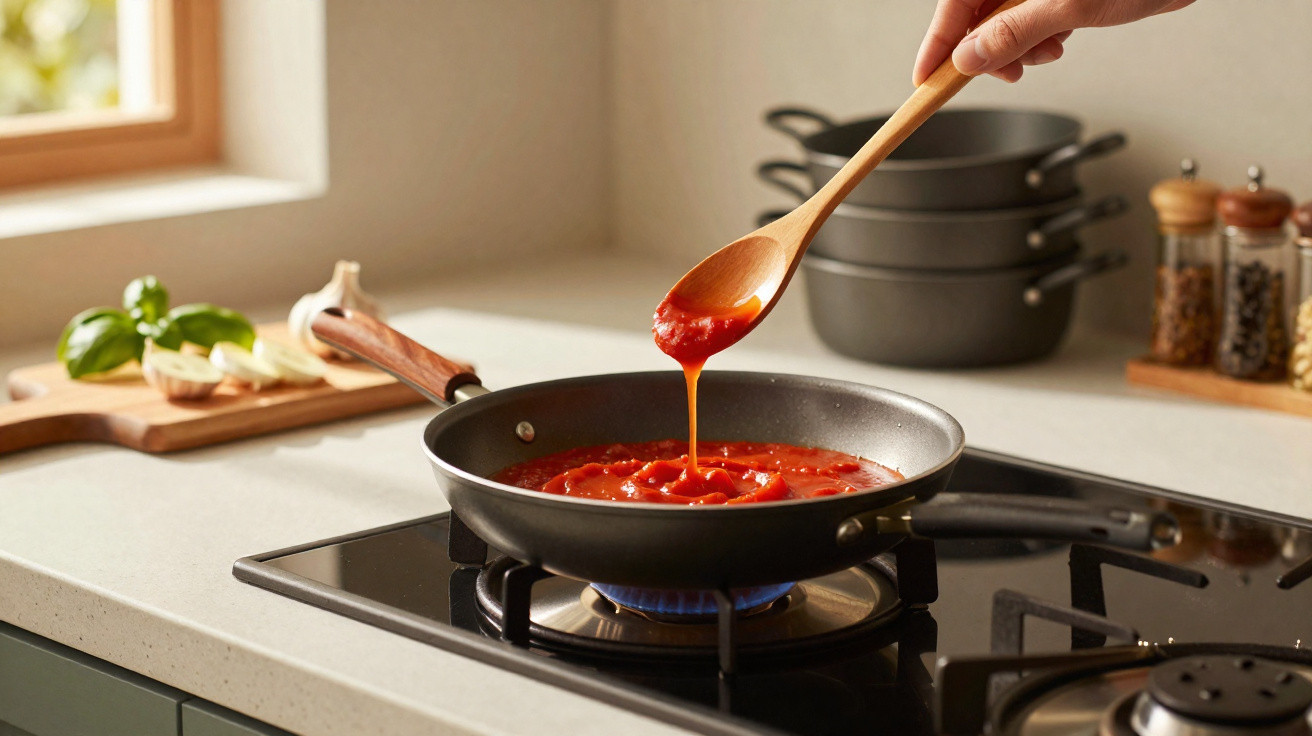
Look carefully at the pans in your cupboard and you will notice it: the little opening at the end of the handle. Most people simply use it to hang up cookware. However, that gap has a much smarter purpose built into it, and using it as intended can subtly improve your everyday cooking routine.
The often-missed feature on every pan handle
Ask someone what the hole in a pan handle is for and the usual response is: “So you can hang it up.” This is a practical answer, particularly where kitchen storage is limited. But cookware designers also intended it to tackle the clutter and mess that can quickly gather around the hob.
The opening can support another item that often lacks a proper resting place: the spoon or spatula used during cooking.
The handle hole doubles as a built‑in rest for wooden spoons and spatulas, keeping them above the worktop and over the pan.
Rather than putting a spoon on the counter, perching it on a plate or leaving it in the pan, pass the utensil handle through the hole in the pan handle. Its working end will then sit above the pan, allowing any drips to fall back into the food instead of onto the kitchen worktop.
Using the handle hole as a spoon rest
This method is most effective with the lightweight, everyday utensils already in your kitchen. It takes only a moment to arrange:
- Slide the handle of a wooden spoon or spatula through the opening in the pan handle.
- Position it at an angle so that the spoon head is over the pan rather than the worktop.
- Make small adjustments until the utensil is secure and does not upset the pan’s balance.
The result resembles a horizontal flag: the pan remains on the hob, its handle extends outwards, and the spoon is held safely in place between stirs.
Your utensil stays clean, close and supported, while the sauce, oil and steam stay where they belong: in the pan.
Why this small trick improves everyday cooking
Keeping the worktop properly clean
When preparing a meal, home cooks often manage several pans at the same time. Each time you stir, taste, pour in stock or alter the seasoning, the spoon has to be placed somewhere. A chopping board or plate soon becomes covered in residue. Put it directly on the worktop and you may create sauce marks and oily smears that can transfer to sleeves, tea towels or your phone.
Resting the spoon in the handle hole interrupts this pattern. Any drips return to the pan instead of landing on the counter. Once dinner is ready, you can clean the hob as normal rather than having to scrub dried curry or tomato sauce from the nearby worktop.
Reducing cross-contamination risks
Food safety specialists highlight the less obvious ways that bacteria can spread around the kitchen. Shared surfaces are a key source: juices from raw meat reach the worktop, a spoon touches the same spot, and that spoon is then returned to a sauce.
Holding the spoon above the pan instead of leaving it on the counter removes that stage. In effect, the handle hole provides a physical separation between your utensil and surfaces that may be unclean.
Keeping the spoon suspended over the pan limits contact with worktops and reduces the path for bacteria to move into your food.
This is especially relevant for meals involving raw chicken, pork or seafood. Separate utensils remain sensible, but the way those utensils are set down between uses can affect kitchen hygiene more than many people expect.
Greater speed and comfort while cooking
There is a straightforward convenience benefit too. On a busy weeknight, it is unusual to have a spare hand. Returning the spoon to the same spot each time creates a useful rhythm: stir, place it in the handle hole, season another ingredient, then pick it up again without searching.
You no longer face the minor panic of trying to find the spatula while a sauce begins to catch or onions brown too fast. The utensil stays precisely where the pan handle points, almost becoming an extension of the handle itself.
Which utensils fit best in a pan handle hole?
Some kitchen tools will not fit safely or effectively. Their handles may be too broad, too weighty or too smooth. The following are generally the strongest options:
- Wooden spoons for soups, sauces and stews.
- Wooden or bamboo spatulas for sautéed vegetables and stir-fries.
- Silicone spoons or spatulas with narrow handles.
Large metal ladles and bulky whisks may cause the pan to tip, particularly on a small burner. If inserting an utensil makes the pan wobble or lift, take it out and use a lighter option. Convenience should never come before safety.
| Utensil type | Suitability | Main benefit |
|---|---|---|
| Wooden spoon | Excellent | Light, stable, gentle on pans |
| Silicone spatula | Good | Heat-resistant, easy to clean |
| Metal spoon | Variable | Robust but can scratch and overbalance |
| Ladle | Poor | Often too heavy and awkward |
Protecting your pans with this technique
The pan handle hole technique is uncomplicated, but a little attention will help protect both your cookware and your utensils over time.
- Inspect the hole size before trying to push a handle through it. Forcing a tight fit can splinter wood or bend the metal pan handle.
- Do not use metal utensils around fragile non-stick interiors. Should they slip or swing, the coating may become scratched.
- Arrange the spoon so steam and splashes are not constantly hitting its handle, as this may reduce the lifespan of wooden utensils.
Use lightweight, heat‑safe utensils and a stable pan position so the added weight never threatens to tip hot food toward you.
Treat it as a similar habit to turning pan handles inwards or cleaning spills straight away: a minor action that discreetly makes cooking calmer and safer.
Other useful details on pots and pans
The opening in a pan handle is not the only feature of modern cookware that is often overlooked. Manufacturers build in various subtle details to solve everyday kitchen issues.
- Lightly curved rims allow sauces to be poured neatly into bowls or storage containers, without leaving a trail down the outside of the pan.
- Certain premium pans feature heat indicators on the handle, which change colour once the metal reaches a suitable searing temperature.
- Detachable handles let a frying pan fit into a compact oven or dishwasher, while also saving room in small cupboards.
Noticing these features can transform the way you cook. Rather than viewing pans as basic metal containers, you can use them as tools designed to handle heat, liquids, hygiene and space at the same time.
What this means for home cooks and compact kitchens
Many homes have restricted worktop space and little storage, particularly city flats and student accommodation. In these settings, multifunctional design features become especially valuable. An opening that can both hang a pan and hold a spoon, a detachable handle that turns a pan into an oven dish, or a rim that pours cleanly into a single-portion container can all make daily cooking easier.
For anyone beginning to cook more meals at home, features such as the handle hole can also increase confidence. When equipment supports you rather than creating obstacles, cooking feels more manageable. A small routine, such as always resting a spoon through the handle, removes a source of mess, a potential risk and one repeated tiny decision from an evening meal.
Professional kitchens depend on systems: organised stations, accessible tools and consistent movements. Using the spoon-in-the-handle technique brings a small part of that approach into the home. It falls somewhere between an ingenious kitchen hack and an understated design feature that has been waiting to be used.








Comments
No comments yet. Be the first to comment!
Leave a Comment