The sponge sweeps across the worktop, the mop goes over the tiles and the rubbish bin gets emptied. Everything appears clean, reassuring and under control. Then, one day, you spot a lone ant travelling along the wall. Or there is a slightly odd smell that cannot be explained by the evening’s pan of soup.
Your eyes follow the ant. It heads neither for the bin nor the sink, but darts into a corner that is hardly ever inspected: a kind of kitchen ‘non-place’ between the wall, skirting board and appliances. It is unobtrusive, dark and almost out of sight.
That is when you begin to wonder what is truly happening in this unseen nook.
The overlooked gap between your cooker and worktop
In plenty of kitchens, a narrow strip silently gathers the dirt we never notice. The slim space between the cooker and worktop, or between the fridge and cabinet, initially seems harmless. It is dark, difficult to access and generally concealed by shadows or side panels, so we mentally put it off until “later”.
Crumbs ricochet from the chopping board, drift over the counter and disappear into this slender, dusty ravine. A little rice here, a cornflake there, a smear of grease slipping down the side: day by day, it forms a miniature buffet. Not for people, but for pests.
When you eventually pull the cooker away from the wall, what you find can seem almost theatrical. There may be crumbs, sticky marks, the occasional dried pea and perhaps an old bread-bag twist tie: a small hidden world gradually assembled out of view.
Pest control firms are very familiar with this blind spot. Many say that one of the most surprising infestation hotspots is not beneath the sink or in the bin, but within the thin gaps beside large appliances. It makes sense: there is heat from the oven, oil residue, food particles and complete freedom from human interference.
A UK survey of household kitchens found that more than half contained a substantial accumulation of food debris in “hard-to-reach edges” after only six months without a deep clean. This happened despite no visible dirt on the main surfaces. Put simply, people believed their kitchens were spotless.
Just a handful of crumbs can draw in ants looking for a food trail or pantry moths seeking a sheltered corner. Add some moisture from cooking steam and the conditions become ideal for microbes to multiply. On a hectic weekday evening, nobody notices the quiet ecosystem developing between the cooker and worktop.
From a practical point of view, this forgotten gap is almost built to attract crumbs. Anything dry or round rolls or slides towards the smallest drop. The worktop lip acts as a natural ramp, while the side of the oven provides a wall. Gravity takes care of the rest. As the space is so narrow, air circulates poorly, resulting in lingering odours, spills that dry slowly and a cosy microclimate.
People are drawn to flat, visible surfaces. We clean wherever our eyes naturally land and overlook anything beyond the frame. This is why the concealed strip can remain untouched for years. The brain says, “too annoying, too small, not today.” Pests see it differently: to them, it is property with catering included.
The divide between looking clean and actually being clean begins right there.
How to properly clean this hidden crumb trap
The most effective first step is also the least glamorous: move the appliance out. Not daily, of course, but perhaps a couple of times each year, or following a major cooking period such as Christmas or a birthday. It is much like shifting a sofa and seeing what has been living beneath it.
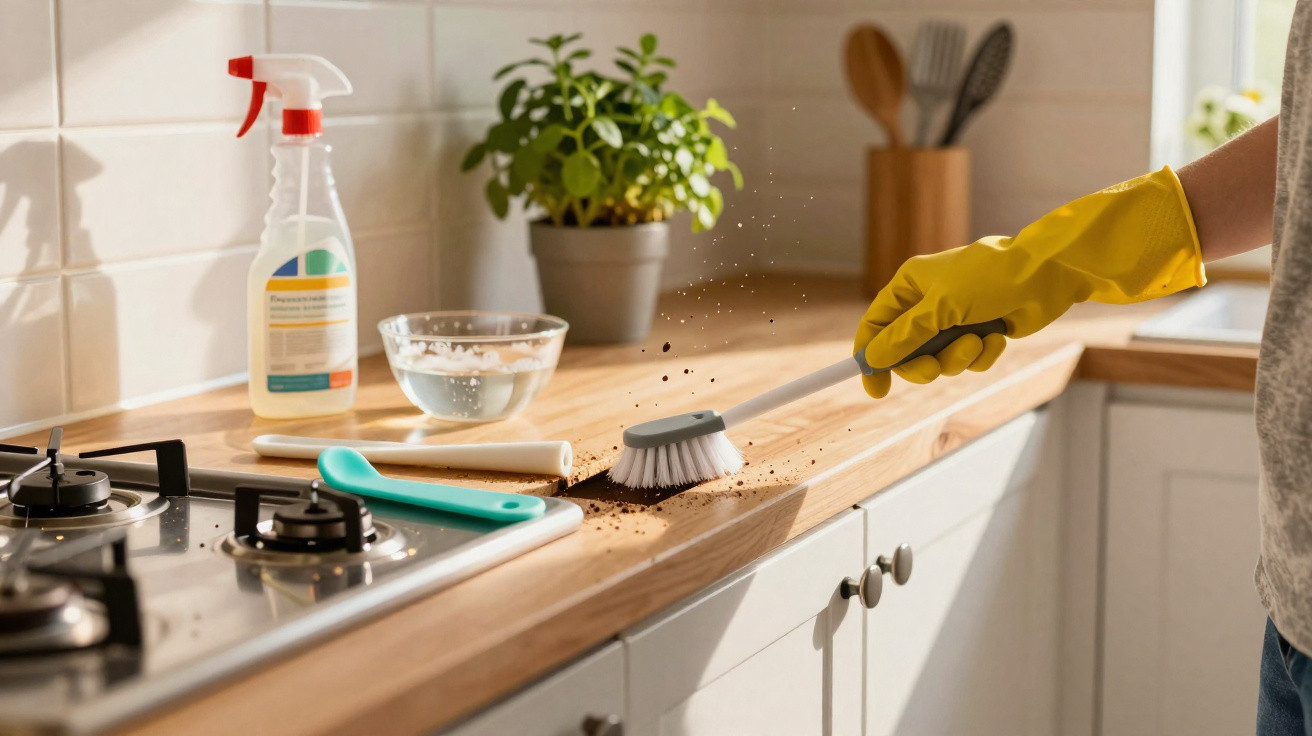
After pulling out the cooker or fridge, begin with dry cleaning. Vacuum the gap with a narrow nozzle, or use a long-handled brush to collect crumbs and debris before they become smeared around. Then use a lightly dampened cloth and a mild degreaser on the greasy streaks stuck to the side panels.
Complete the task by cleaning the wall, skirting board and floor edges. Sticky splashes often dry there unnoticed, becoming lasting bait. A final wipe with a dry cloth removes moisture that could otherwise keep the area appealing to pests.
Most people tackle this spot only once something has already gone wrong: ants are on the worktop, a strange odour appears, or mouse droppings are found behind the bin. What could have been a quick routine then becomes a stressful emergency. Let’s be honest: nobody really does this every day.
A more relaxed option is to establish small habits. Every few weeks, slide a thin flexible spatula, or an old gift card wrapped in a cloth, along the edge of the gap. It will not be perfect, but it will prevent crumbs accumulating into a proper buffet. There is no need to take apart the entire kitchen.
One frequent error is spraying lots of cleaner into the gap and hoping it will solve everything. This often leaves behind a damp, sticky residue that traps even more dust and food. Another mistake is overlooking small spills along the cooker’s side because “no one sees it”. Pests are not concerned with appearances.
“The dirtiest parts of a home are rarely the ones people complain about,” notes one London-based pest technician. “It’s the forgotten edges, the gaps behind, under and between. That’s where infestations quietly start.”
To make the task easier on busy days, keep a small “gap kit” ready. It need not be anything elaborate:
- A narrow vacuum nozzle or crevice tool
- An old toothbrush or long-handled washing-up brush
- A reusable cloth wrapped around a ruler or spatula to wipe edges
- A mild degreaser in a small spray bottle
Once you have this kit, the task no longer feels like a major project and becomes more like a five-minute favour for your future self. It is a simple step that prevents you having to deal with an ant invasion in the middle of June later on.
Managing the gap: making your kitchen future-proof
The aim is not to fight every speck of dust. It is to prevent one small unseen corner becoming a long-term invitation to pests. This involves thinking about both cleaning and prevention. Some households opt for gap covers between the cooker and worktop: slim silicone or metal strips that stop crumbs falling in altogether.
Others would rather leave the gap accessible but keep it visible. A brief monthly check with an LED torch shows whether crumbs are beginning to gather again. A 20-second look can save a weekend of scrubbing later. It is less about perfection than paying attention.
We have all experienced the moment when a friend or guest is helping in the kitchen and drops something that rolls straight into the dark slit beside the oven. Everyone laughs awkwardly, somebody mutters “oh, it’s gone forever”, and the conversation moves on. Yet that tiny incident reveals something bigger about how homes really function.
| Key point | Detail | Benefit for the reader |
|---|---|---|
| Hidden crumb gap | The space between the cooker/fridge and worktop catches food and grease | Identifies a high-risk area most people overlook |
| Simple deep-clean routine | Pull the appliance out a few times a year, vacuum, then wipe | Provides a realistic method without daily effort |
| Prevention tips | Gap covers, quick edge wipes, small “gap kit” | Lowers the long-term risk of pests and unpleasant smells |















Comments
No comments yet. Be the first to comment!
Leave a Comment