You tend not to think about your cutting board until it starts looking rather tragic: gouges across the surface, stubborn mystery marks and that slight onion scent which persists despite three washes. Then, while making dinner, you cut into a tomato and its juice seeps into old knife cuts already coloured by previous meals. It is hard not to wonder what might be lurking in them.
You turn on the hot tap, add washing-up liquid, scrub quickly, rinse and do it all again. Yet it still looks worn out. It still carries the smell of dinners gone by.
Then somebody offhandedly says, “Just rub it with lemon and salt.” You might laugh, but try it once and see the board transform before your eyes.
That is when it becomes clear that the kitchen tool you use most heavily may need a more traditional kind of care.
Why your cutting board looks tired (and a little suspicious)
A cutting board is the kitchen’s uncomplaining workhorse. It absorbs the chopping, staining, onion juice and beetroot offences, then waits patiently for the next task. As time passes, deep knife marks become miniature channels where moisture and bacteria can settle. Even after it has been “cleaned”, the board may feel faintly tacky.
There may be no visible grime, but a dull coating remains, along with a slight smell and a colour that never quite returns to its original shade. This is usually the point at which people consider binning the board and replacing it.
In many cases, though, the board does not need extra soap. It needs a reset.
Imagine Sunday brunch preparations with guests due shortly. You bring out your wooden board to cut lemons for drinks, but it is marked from chopping chicken the night before. There is also a lingering garlic smell you would rather not introduce to your guests. A lengthy cleaning routine is out of the question, yet serving fresh food on a board that smells of last week’s stir-fry feels equally unappealing.
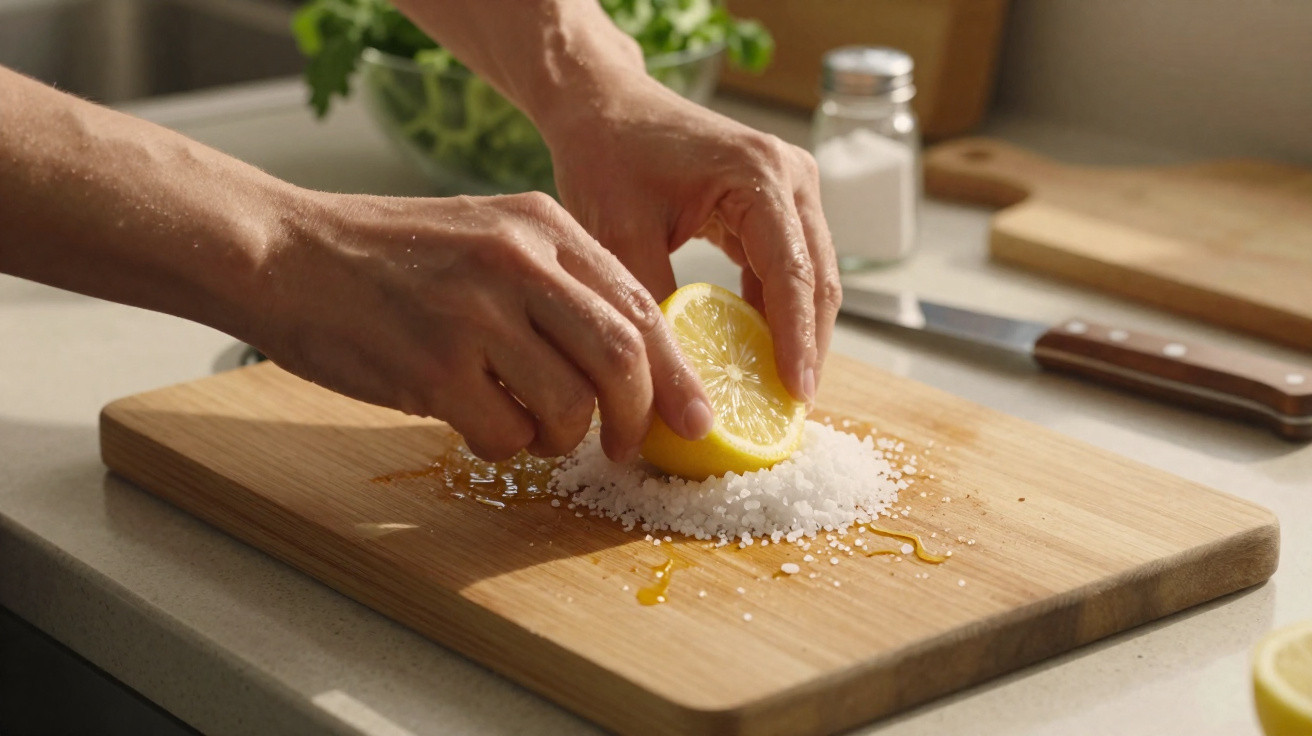
Someone nearby asks: “Got a lemon? Got salt?” Cut the lemon in two, scatter coarse salt over the board, rub it with the cut face of the lemon and leave it for a minute. Then rinse and dry it.
The odour disappears. The surface seems paler, almost renewed. Looking at the now-brown, spent lemon half, you realise just how much residue ordinary washing had left behind.
There is a straightforward reason this pairing works so effectively. Lemon is naturally acidic and mildly antibacterial, helping to break down greasy films and some surface bacteria. Salt provides abrasion: its small crystals work into knife marks and draw out trapped stains and odours.
Washing-up liquid mainly tackles surface dirt, particularly on plastic. Wooden and bamboo boards react differently, absorbing and retaining smells and pigments before gradually releasing them. Lemon and salt act as a mild peel for the board, exfoliating and disinfecting at the same time.
You are not merely washing the board; you are restoring its surface to one you can trust.
The lemon and salt cutting board routine: a little patience required
Begin with a dry board. This is important because the salt needs to stick to the wood rather than dissolve immediately. Cover the full surface with a generous amount of coarse salt, concentrating on stained areas and heavy knife marks.
Halve a fresh lemon and use its cut side as a scourer. Push it into the salt, then rub in small circular movements across the entire board. The lemon juice combines with the salt to make a grainy paste that gradually becomes cloudy. That cloudiness is the oils, dirt and stains being released.
For boards with everyday use, leave the salty lemon mixture in place for around 5 minutes. For deep stains or persistent odours from garlic, onion or raw meat juices, leave it closer to 10 minutes. Rinse thoroughly under warm water, lightly rubbing with your hand to clear away every trace of salt.
Blot the board dry using a clean tea towel, then stand it upright to air-dry rather than laying it flat, allowing moisture to escape. For additional care, rub in a little food-safe mineral oil once the board is fully dry to condition the wood. In reality, hardly anyone does this every day. Still, using the lemon-and-salt method once or twice a month can make a real difference.
There are a few common mistakes to avoid. Soaking a board in water makes the wood swell and warp, and can cause splits to develop, creating even deeper spaces for bacteria. Regular use of harsh products such as bleach can also dry wooden boards out and leave residues you do not want near food.
Then there is the thought, “I’ll just throw it in the dishwasher”. That is fine for plastic boards, but a gradual disaster for wooden ones. Extended exposure to water combined with high heat will eventually crack and distort the wood. Treat your board kindly and it can serve you for years.
“People think their cutting board is ‘dirty by nature’,” says a home cook friend of mine who runs a small supper club. “Once they see what lemon and salt can do in a few minutes, they stop hiding their boards when guests come over.”
- Choose coarse salt instead of fine table salt for more effective scrubbing.
- Rub the lemon along the wood grain to achieve a smoother finish.
- Stand the board upright to dry so that air reaches both sides.
- Do not use powerful chemical cleaners; they are not made for porous wood.
- Repeat the lemon-salt treatment monthly or after preparing heavily staining foods such as beetroot or turmeric.
A simple kitchen ritual that changes how you cook
After trying this approach, a cutting board becomes more than a battered piece of wood on the worktop. It starts to feel like a tool you maintain rather than merely use. You begin to notice changes in its scent and when its surface turns dull, and the process becomes a small, almost meditative routine: sprinkle, scrub, wait, rinse.
There is a quiet pleasure in seeing old marks fade without harsh or complicated products. It costs very little and takes only a few minutes, leaving you with a board that looks and smells prepared for another batch of fresh vegetables, crusty bread or herbs.
The emotional change is understated, but genuine. When the board feels hygienic and safe, you are less reluctant to prepare food directly on it or to use it for serving cheese and fruit when friends visit. You have more confidence in it. You also feel more assured in the kitchen, having found a low-effort habit with a high impact on freshness.
There is a deeper satisfaction, too, in using what is already to hand: lemon, salt, water and your own hands. No expensive bottle or elaborate spray is needed. It is simply an old-fashioned technique that has quietly endured beyond trends and product launches.
Perhaps that is why the method is so satisfying. It is not a hack and it is not going viral; it is simply effective, time after time. It is the kind of advice shared around the dinner table or shown to a friend just before guests arrive, when the cutting board looks tired and time is short.
You do not need an entirely new kitchen to feel more comfortable when cooking. Sometimes all it takes is one board, one lemon, a handful of salt and the decision to give everyday tools a little more care.
| Key point | Detail | Value for the reader |
|---|---|---|
| Lemon and salt clean deeply | Acid disinfects, salt scrubs knife grooves | A safer, fresher board without harsh chemicals |
| The method is quick and inexpensive | Uses everyday kitchen ingredients in under 10 minutes | An easy habit to repeat regularly |
| Proper drying prolongs board life | Standing it upright to dry and avoiding soaking prevents warping | Saves money by keeping boards usable for years |












Comments
No comments yet. Be the first to comment!
Leave a Comment