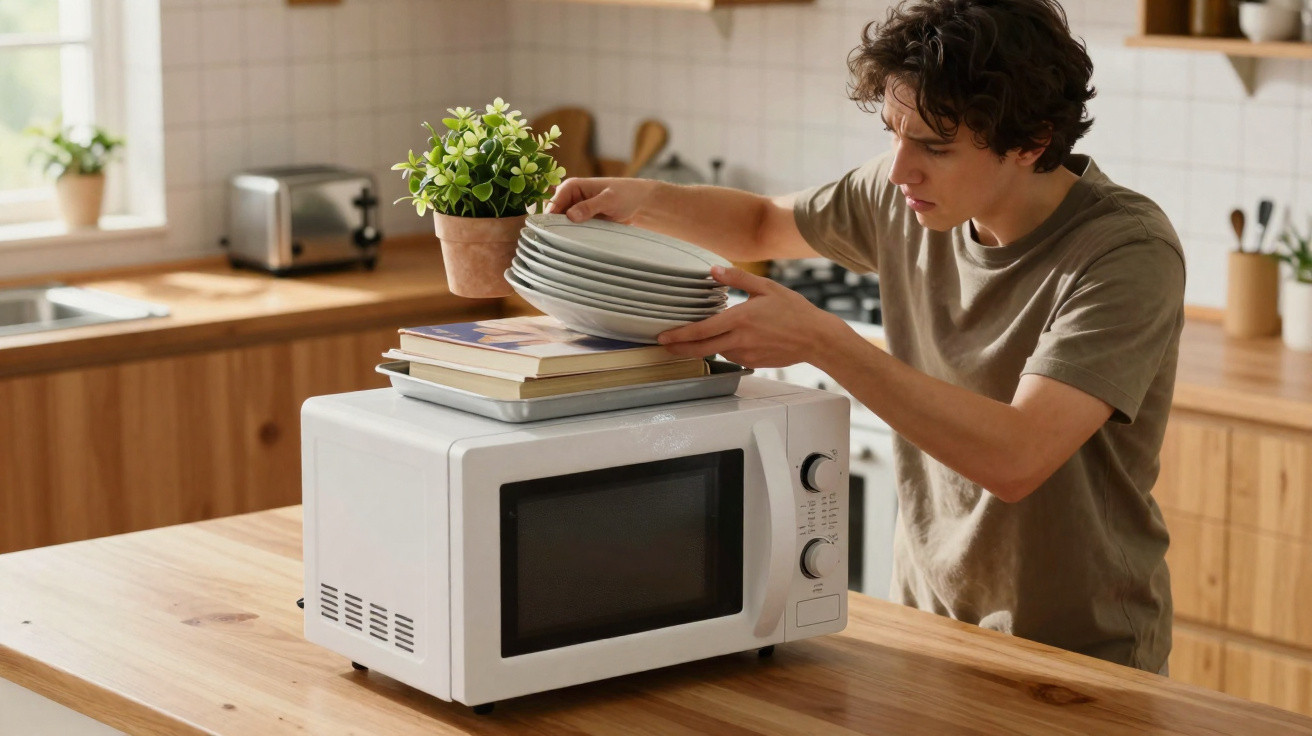
In a compact kitchen, every centimetre matters. It is easy for a coffee machine, air fryer or pile of bowls to end up on top of the microwave. It looks sturdy and has a flat surface, so why leave it unused? Yet this everyday habit can damage the appliance, shorten its service life and, in extreme cases, create hazardous situations.
Why a microwave is more than a storage surface
The microwave is now as familiar a kitchen essential as the cooker and fridge. It reheats yesterday’s lunch, defrosts frozen bread, melts chocolate for a cake or quickly brings butter to room temperature. Many models can also grill food or give it a crisp browned topping.
Especially in one-person households or student flats, it often takes the place of several other appliances. It is compact, relatively affordable and can be positioned almost anywhere: on the worktop, on a shelf or, in some cases, even on top of the fridge.
A microwave is a complex electrical appliance with sensitive technology inside – not a sturdy kitchen unit designed to hold items.
Although it appears to be a solid metal box from the outside, it contains components that depend on airflow and stable operating conditions. Problems begin when items are placed on top of it or positioned too close to the appliance.
Microwaves need airflow: why ventilation slots must remain clear
When food is heated in a microwave, heat as well as radiation is generated inside the appliance, and that heat has to escape. This is the purpose of the ventilation slots, which may be located at the sides, rear or top, depending on the model.
Covering these openings can cause the appliance to overheat. Its electronics then have to operate at temperatures they are not designed to withstand over long periods.
- Higher internal temperatures speed up wear on components.
- The overheating protection may switch the appliance off unexpectedly.
- In the worst case, cables or circuit boards may suffer heat damage.
Many modern microwaves do have safety systems that activate when temperatures become excessive. They may switch off or reduce the power output. While this usually prevents an immediate danger, it almost always reduces the appliance’s lifespan.
Blocked ventilation slots make the appliance effectively run “in its own heat” – every reheating cycle becomes a thermal strain.
A common mistake is squeezing a microwave into a narrow shelf space, with cookbooks placed on top and chopping boards or trays leaning against its sides. Air that should be able to circulate then becomes trapped. Nothing may appear to happen at first, but the strain builds up over months and years.
Why nothing should be placed on the microwave casing
Even if all ventilation slots remain unobstructed, strictly speaking, nothing should be stored on top of a microwave. Many manufacturers explicitly state in their instruction manuals that the top of the appliance must not be used as a storage area.
Typical items that become permanent fixtures on top include:
- Coffee machines or kettles
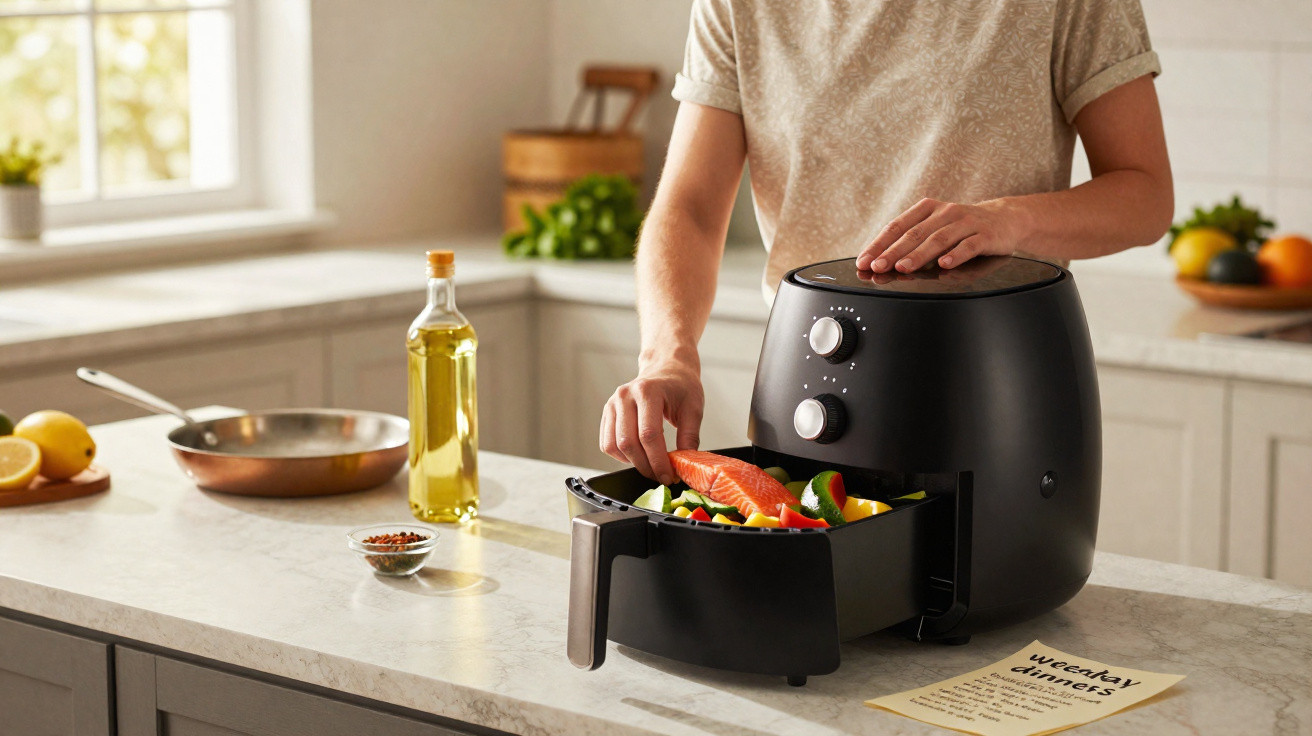
- Air fryers, toasters or compact grills
- Stacks of plates, bowls or mugs
- Food containers, groceries or spice racks
- Cookbooks, magazines or decorative items
Most microwaves are built to support their own weight and the vibrations created during operation, rather than any additional load. Over time, the casing can distort slightly, especially where weight is concentrated on small feet or edges.
Even an apparently harmless extra load can eventually deform the metal casing and place internal components under stress.
Possible consequences include:
- The door may no longer close precisely, which can impair shielding while the microwave is operating.
- Internal mountings and brackets may be subjected to continuous pulling or pressure.
- Electronic and mechanical parts can be affected by vibrations from appliances placed on top.
The situation becomes particularly risky when another heat-producing appliance, such as an air fryer or toaster, is used on top of the microwave. Two heat sources then warm the surrounding area at once while air circulation is reduced.
Common misconceptions about microwave storage
“A few plates will not cause any harm”
A stack of plates may look light and harmless, but the combined weight is often greater than expected. There are also vibrations whenever the door is opened and closed. In the long term, the casing may distort as a result, even if the change is only a few millimetres.
“It is only touching another appliance for a short time”
Many people leave a coffee machine or kettle on the microwave, reasoning that the two appliances are not used simultaneously. The issue is that weight alone creates a constant load. Heat and steam produced during use can make matters worse if they are drawn into the ventilation slots.
“The appliance looks sturdy enough”
The microwave’s surface is hard and its metal panel barely flexes, which creates an impression of strength. However, its load capacity was not designed for extra appliances; it is based on the microwave’s own construction. Its reserves are far smaller than those of a kitchen base unit.
How to position a microwave correctly
Anyone wanting their microwave to last should give it a dedicated space that is as clear as possible. A few simple measures can help:
- Allow at least a few centimetres between the appliance and the wall at the sides and rear.
- Keep the top completely clear: no appliances, stacks or decorations.
- Do not place cloths, covers or film over the appliance.
- Set it on a stable, level surface that can comfortably support its weight.
- Check regularly that ventilation slots are not dusty or blocked by objects.
Giving a microwave room to “breathe” significantly reduces the likelihood of faults and helps avoid expensive replacements.
In very small kitchens, it can be worthwhile fitting a dedicated shelf for the microwave. Storage can be created below it and above it, but nothing should be placed directly on the appliance itself.
Risks that are often underestimated
Most damage develops gradually. Initially, there may only be a quiet humming sound, an unusual smell or longer heating times. Later, individual functions can fail or the appliance may stop working altogether.
When the purchase price and expected lifespan are considered together, the result is clear: every unnecessary strain that shortens its working life ultimately costs money. There is also a risk of overheated components scorching or blowing fuses.
Storing easily flammable materials such as paper, cardboard or plastic on top of the microwave increases that danger further. If something goes wrong inside the appliance, heat can spread to these materials more quickly.
Practical alternatives to using a microwave as storage
Simple options can make up for the lost storage space:
- A narrow wall shelf above the microwave for cookbooks or containers.
- A wheeled kitchen trolley for the coffee machine and toaster.
- Stackable baskets or hanging shelves for mugs and small kitchen tools.
- Magnetic strips on the wall for knives and metal utensils.
These alternatives make better use of the room’s vertical space while reducing strain on the appliance. People who consistently keep the microwave clear usually adapt quickly to the new look and benefit from a tidier kitchen overall.
Another point that is often overlooked is that many instruction manuals clearly state that the top is not a storage surface. Ignoring this may mean using the appliance outside its recommended conditions. That could cause difficulties in a warranty claim if a manufacturer can demonstrate that overheating or overloading was responsible.
Using a microwave responsibly does not require a major change: leave some space from the wall, keep the ventilation slots clear and do not put weight on the casing – that is all the appliance needs. A well-maintained microwave works more efficiently, which benefits electricity costs, while fewer early replacements are needed, benefiting your budget too.










Comments
No comments yet. Be the first to comment!
Leave a Comment