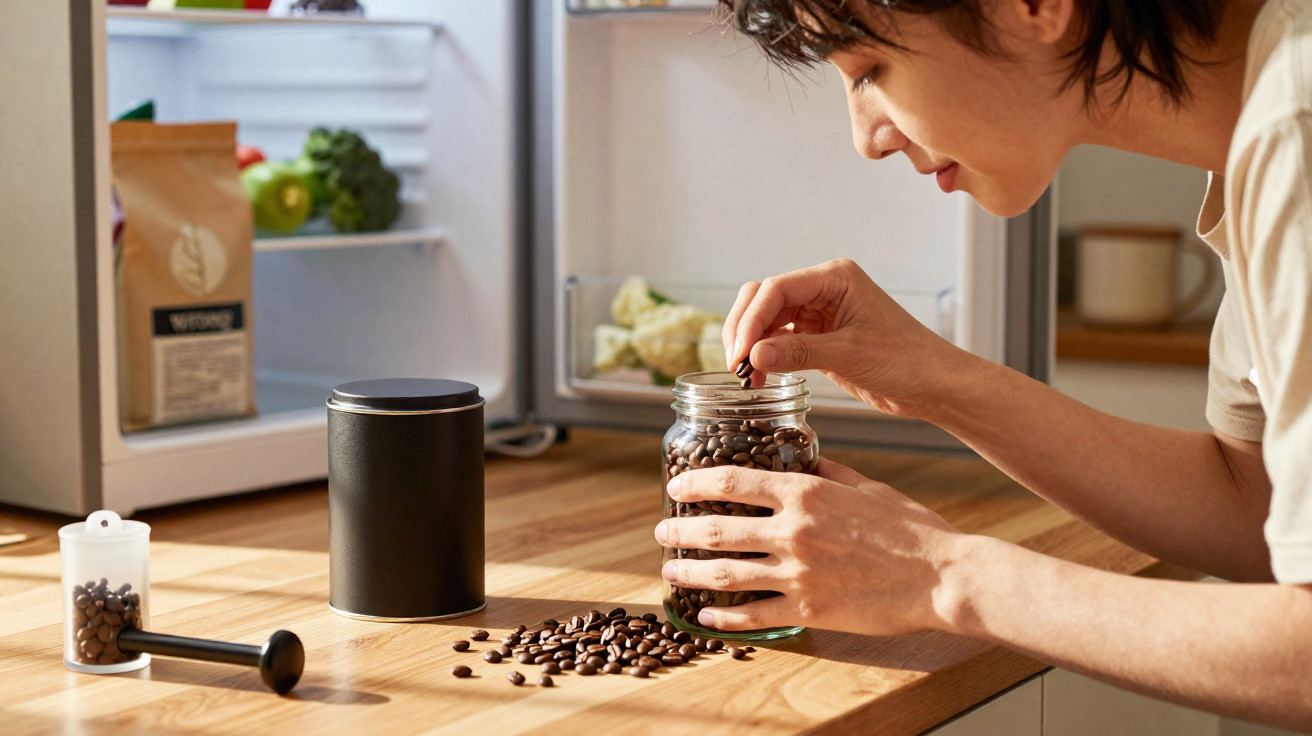
Whether filter coffee, espresso or capsules: many households struggle to function without a caffeine boost. It is therefore surprising how carelessly so many people store their coffee. In particular, the well-intentioned spot in the fridge can leave even expensive beans tasting flat, musty and old.
Why coffee loses its spark so quickly in the fridge
Coffee beans and ground coffee act like tiny aroma sponges. Their porous structure and large surface area absorb everything suspended in the air: odours, moisture and oxygen. The fridge offers precisely this combination in abundance.
“In the fridge, coffee encounters moisture, foreign odours and constant temperature changes – a toxic combination for aroma and freshness.”
Several things happen there at once:
- Foreign odours are absorbed: Cheese, cold cuts, onions and herbs all release strong aromatic compounds. Ground coffee and beans take these in. The cup then develops dull, unusual notes, while the coffee's own flavour becomes weaker.
- Aromatic compounds dissipate faster: Although a fridge is cool, it is not airtight. Oxygen and moisture continually reach the pack. This speeds up the breakdown of the delicate flavour components that give coffee its complexity and body.
- Condensation affects the beans: There is often a difference of 15 degrees or more between the fridge and room temperature. When the pack is removed, condensation forms on the beans or grounds. Their surface becomes damp, creating an ideal starting point for flavour loss and microorganisms.
Specialist websites and consumer organisations reach a clear verdict: storing coffee in the fridge is among the main causes of flat flavour and premature aroma loss, especially when the pack is repeatedly moved in and out.
What coffee manufacturers actually recommend
Looking at manufacturers' advice makes matters more interesting. The industry is not completely united, but it does agree on one point.
The fridge is only an option with sealed packaging
Some roasters consider the fridge acceptable under strict conditions: beans should remain in their unopened original packaging or in a genuinely airtight container that is moved as rarely as possible. Once it is continually opened and closed, temperature changes place substantial strain on its contents.
The key requirement is that neither oxygen nor moisture can reach the coffee. A glass or ceramic container is recommended, as these materials do not react with aromatic compounds. Thin plastic tubs or partially sealed bags are therefore largely unsuitable.
Room temperature for quick drinkers, cold storage for stockpilers?
One major Italian manufacturer advises that whole beans can simply be kept at room temperature if a tin will definitely be used up within a week. The fridge should only be considered for longer storage, and then only under clear rules:
- chill the container immediately after opening
- seal it as airtight as possible
- allow it to return to room temperature before brewing
This is intended to keep the aroma stable for longer. The problem is that few people follow these instructions consistently in everyday life. Many open the tin several times a day and keep moving it around, which again causes condensation and aroma loss.
Damp beans, major risk: mould in coffee
Hardly anyone associates coffee with mould. Yet the fridge can create an ideal environment for it: organic material, condensation and fluctuating temperatures. Fungi can consequently develop on bean surfaces or in damp grounds.
“Where condensation reaches coffee, not only does aroma loss increase – the risk of mould and mycotoxins rises too.”
Moulds can produce what are known as mycotoxins, or mould toxins. Even small quantities are considered problematic. Possible acute effects include gastrointestinal complaints, and sensitive people may sometimes react more strongly.
Anyone who notices visible mould patches on a pack, or detects a musty, dull smell, should discard the coffee without hesitation. “Cutting away” or “skimming off” the affected part is not enough, because the toxins may have spread throughout the product.
Freezer: a solution or simply the next trap?
As the fridge repeatedly comes under criticism, many people turn to the freezer. The idea sounds logical: cold slows chemical reactions, so coffee should stay fresh for longer. In practice, however, much depends on the packaging and how it is used.
When freezing coffee makes sense – and when it does not
For coffee used only occasionally, a freezer can genuinely help. Anyone buying speciality coffee but brewing only at weekends can freeze larger quantities. Clear rules are important:
- pack coffee under vacuum or in very airtight packaging
- divide it into portions that each last for around a week
- do not refreeze a portion once it has been removed
Some manufacturers state storage periods of up to two years for vacuum-sealed, frozen coffee. Without a vacuum seal, however, the realistic period of freshness falls to around half a year. In a normal kitchen cupboard, vacuum-packed coffee typically remains genuinely good for five to six months.
For coffee used daily, by contrast, the freezer is usually a poor choice. Every trip outside causes thaw water, which freezes again and then thaws again – creating constant stress for beans and grounds. The result is flavour loss, uneven extraction during brewing and, in the worst case, a renewed risk of mould.
How to store coffee properly
Rather than using the fridge or freezer, a simple, traditional approach is advisable: a cool, dry, dark storage spot. A pantry or kitchen cupboard away from the hob and dishwasher is usually entirely sufficient.
“Ideal coffee storage follows three simple rules: protected from light, airtight, dry and moderately cool.”
| Criterion | What it means | Practical solution |
|---|---|---|
| Protected from light | UV radiation speeds up aroma deterioration | Opaque tin; use a cupboard rather than the worktop |
| Airtight | Oxygen promotes oxidation | A well-sealing storage tin; valve bags only as an additional measure |
| Dry and moderately cool | Minimal temperature fluctuation, no moisture | Kitchen cupboard or pantry, not directly beside the hob or dishwasher |
Many experts advise leaving beans in their original packaging initially. These packs often have an aroma valve that lets gases escape without allowing much air inside. The entire pack can then be placed in an additional, tightly closing tin. This gives the coffee double protection.
Whole beans or ground coffee – which keeps longer?
The form coffee takes also matters greatly when it comes to storage. Compared with ground coffee, whole beans have a substantially smaller surface area. This makes them less vulnerable to oxidation and foreign odours.
Anyone with a grinder will generally get the best results from whole beans, ground only shortly before brewing. This keeps volatile aromatic compounds protected inside the beans until the very last moment. Pre-ground coffee loses its character far more quickly, even under ideal storage conditions.
Everyday advice for frequent coffee drinkers
People who drink coffee every day can follow a straightforward rule of thumb:
- buy only as much as will be used within four to six weeks
- finish the pack as promptly as possible once opened
- avoid constantly switching between different tins, so that nothing sits around unnecessarily for too long
Especially with bargain 1 kg packs, the saving often does not pay off in flavour if the coffee then remains open in the kitchen for months.
How to recognise bad or old coffee
Anyone unsure whether their coffee is still good can rely on their own senses. A few signs are fairly unmistakable:
- a musty, dull or “cardboard-like” smell
- very pale crema from espresso or a portafilter machine
- unpleasantly bitter, lifeless notes with no freshness
- visible discolouration or coating on the beans
With beans in particular, it is worth taking a close look: a glossy, oily appearance and an intense smell are not automatically bad. But if they seem dusty-dry, barely smell at all and taste flat, storage has taken its toll.
What “aroma” in coffee really means
The term aroma encompasses an entire group of chemical compounds. Many are extremely volatile and react sensitively to oxygen, light and moisture. Even brief storage mistakes can destroy or alter some of these substances, leaving coffee less complex and sometimes noticeably more bitter or acidic.
Careful storage, by contrast, gives you a surprisingly effective lever: the very same bean can seem like cheap mass-market coffee or a high-quality speciality, depending on how it is stored and how freshly it is brewed.
Anyone who tries different varieties, always grinds fresh and keeps coffee out of the fridge will quickly notice how much enjoyment lies in this seemingly everyday drink. Avoiding the fridge is one of the simplest and most effective steps – with no extra cost, just a different place in the kitchen cupboard.














Comments
No comments yet. Be the first to comment!
Leave a Comment