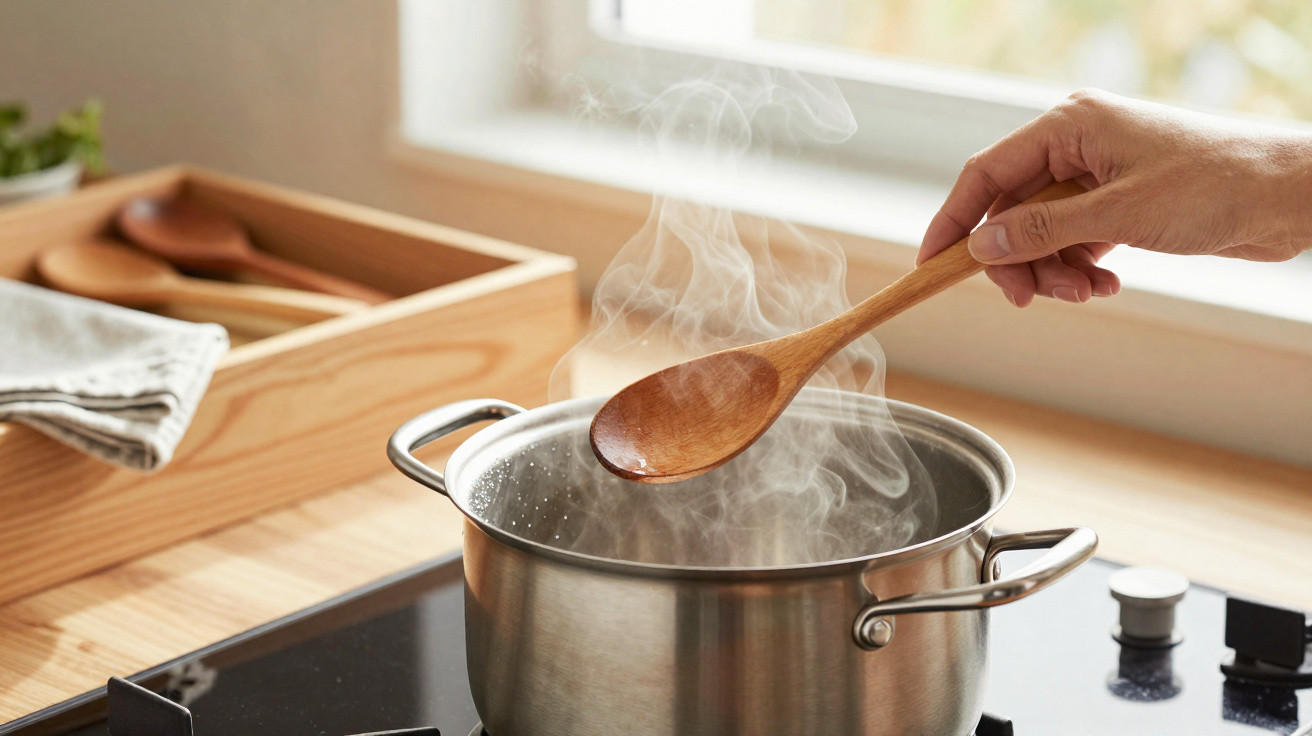
“I started using a wooden spoon under the lid because my grandma did it,” says Lena, a 62-year-old home cook from Leeds.
The lid rattles, the pan fizzes, and you are stuck choosing between two poor outcomes: keep it covered and invite a foamy eruption, or remove the lid and let valuable steam disappear. Pasta water looks ready to spill across the hob, sauce bubbles as though it has a personal grievance, and the wooden spoon lies unused beside the cooker.
Then somebody walks by and casually remarks, “You know you can use that spoon to control the steam, right?”
It sounds absurd. A spoon, taking on boiling water and persistent starch?
But a few minutes later, you find yourself studying the pan like a doubtful audience member at a magic show. The water rises, the bubbles swell and, at the point where the spoon sits, something changes in their behaviour.
It is a small adjustment and an understated move.
Yet cooking suddenly seems a little more manageable.
Why a wooden spoon should sit by the steam rather than in the drawer
Stand in a hectic family kitchen at 7 p.m. and the familiar soundtrack is everywhere: lids knocking, liquid boiling furiously and someone complaining that the pasta has “boiled over again”. Steam is the unseen force behind much of this disorder: there is too much of it, it builds too quickly and it has nowhere to go.
Oddly, most of us simply treat this as part of cooking.
We reach for a cloth, wipe down the hob and continue. The humble wooden spoon, a utensil used for generations, is usually reserved for stirring and scraping, rather than for the useful role it can quietly play in controlling heat and steam.
Look carefully and a clear pattern emerges. Food tends to cook more gently, splash less and taste better when steam has space to escape. When it is sealed beneath a tight-fitting lid, pressure accumulates, bubbles climb and the pan starts misbehaving. Put a wooden spoon in the right position and it works as a modest valve between these two conditions.
It hardly appears technical.
Still, it can alter the rhythm of an entire dish.
Take a pan of thick tomato sauce. With the lid tightly closed, it can spit like molten lava, scattering red marks over every nearby pale surface. Take the lid away completely and the sauce settles, but it may reduce too quickly and catch on the base.
A home cook in Manchester compared three arrangements using the same recipe and pan: a closed lid, no lid and a lid propped up with a wooden spoon.
With the lid fully closed, the sauce boiled over twice in 20 minutes. Without a lid, it did not spit at all, but almost a quarter of the volume evaporated and the base caught slightly. When the lid rested on a wooden spoon at one edge, steam had a narrow route out. The sauce remained thick, the surface was calmer and the hob stayed clean. She later noted: “That stupid spoon just saved my Tuesday night.”
The same principle is visible with ordinary pasta water. Leave the lid flat on the pan and, once the starch begins foaming, it can turn from peaceful to chaotic in moments. Make a small opening with a spoon and the froth reaches cooler air earlier, collapses more quickly and the boil is easier to control. There is no elaborate technique involved, only a managed escape path for steam.
Nothing mysterious is at work. Steam is simply water heated enough to escape as vapour. In a fully covered pan, it gathers beneath the lid and presses downwards. That pressure holds in heat, raises the temperature slightly and promotes larger, more energetic bubbles. Those bubbles pull starch and sauce upwards, and before long you are cleaning the cooker.
Now imagine the lid supported on one side by a wooden spoon. A slim, reliable channel lets steam leave, much like a small chimney. Enough heat remains to cook food efficiently, but the pressure inside does not rise as sharply. Boiling becomes more even, while steam continues moving instead of hitting the closed lid and falling back into the pan.
Wood is useful because it does not transfer heat as readily as metal. It does not become intensely hot or whistle like a specialist gadget; it simply creates the necessary space. That opening regulates the steam and, in turn, the temperament of your bubbling meal.
Where to position a wooden spoon to manage steam
The ideal method is straightforward: lay the wooden spoon across the pan rim, then set the lid on top so that it rests against the spoon on one side. You do not need to balance the lid precisely; the aim is only to make a narrow opening that releases steam steadily.
For a large pan of soup or stock, put the spoon near the side facing the extractor fan or the rear of the hob. The visible plume of steam will then drift away rather than clouding your face or glasses.
With starchy water for pasta, rice or potatoes, place it where boiling is most vigorous. The slightly tilted lid leaves sufficient room for steam to escape and calm those particularly lively bubbles.
For dishes that tend to spit, including curries and ragù, choose a shorter spoon and leave a smaller gap. If the opening is too wide, moisture will escape more quickly; make it too narrow and you will return to small eruptions. It is a modest balancing act between pan, lid and spoon, but after a few attempts your hands will begin to do it automatically.
There is something that many people do not openly admit: after work, you are unlikely to use complicated gadgets every evening. Let’s be honest: nobody really does that every day.
What you are likely to grab without even considering it is the wooden spoon already in your hand. That is why this technique works in real kitchens. It does not require you to overhaul your routine; it simply fits around the habits you already have.
One frequent mistake is treating a plastic or silicone spoon in the same way over very high heat. In a strong cloud of steam, these materials can soften, warp or develop a faint odour when left for too long. Wood remains stable for longer and generally feels like the safer option.
Another mistake is making the gap overly wide, particularly when cooking delicate grains or slow-simmered stews. The food may dry out more rapidly than expected, leaving a dish that is cooked but has an oddly flat texture.
At the other extreme, leaving no gap at all turns a lid into a small pressure dome. Sauces then spit, foam spills out and patience wears thin. The spoon offers a middle ground between speed and control.
“I thought it was just one of her quirky habits. Then I realised it was the reason her stove was always clean and her soup never tasted dull.”
That observation captures what small kitchen habits often provide: practical sense long before anyone explains the science. A few straightforward advantages sit behind that logic:
- Helps avoid messy boil-overs on busy weeknights.
- Allows steam out without removing all of a dish’s moisture.
- Limits fierce bubbling that may cause sauce to burn on the base.
- Helps maintain a steady simmer rather than dramatic fluctuations.
- Keeps the lid handle cooler and more pleasant to hold.
None of this turns you into a chef overnight.
It merely makes cooking feel a little calmer, as though the kitchen is cooperating with you instead of working against you.
How this small habit changes the way you understand your pans
After using the wooden spoon technique a few times, you begin to notice more: how steam twists from one side of the lid, and how the sound of a rolling boil softens as soon as you give it a route out.
You may also start listening in a different way. Rather than watching the clock alone, you pay attention to the sound of the bubbles, the movement of the lid and whether the steam is whispering or roaring. At that point, cooking becomes less about following instructions and more like a conversation with the contents of the pan.
Some people find that, with the spoon in place, they can increase the heat slightly without worrying. This can mean quicker weekday pasta, faster lentils or beans that finally soften without covering the hob. Others notice richer stews because the lid was neither sealed down nor removed entirely: it was simply raised a little, allowing steam to leave at its own rate.
More broadly, this small wooden support is a reminder that physical details make a difference. The lid’s angle, the route steam takes from a pan and the material touching the rim can all shape the result more than any dramatic “secret ingredient” could.
Among smart appliances and complicated kitchen hacks, one spoon under a lid can seem almost too basic to matter. But this is precisely the sort of quiet tip people enjoy passing to friends, sharing in group chats or teaching to a teenager cooking independently for the first time. It belongs to that kind of kitchen knowledge that feels old-fashioned yet unexpectedly fresh as soon as you see it work.
You might test it tonight with your next pan of pasta or soup, simply out of curiosity. If you find yourself smiling slightly as you watch the steam, aware that a wooden stick and a lid have tipped the odds in your favour, you will see why this small gesture has lasted through so many generations of cooks.
| Key point | Detail | Benefit for the reader |
|---|---|---|
| Spoon placement | Spoon across the rim, with the lid resting on one side | Creates a stable steam gap without specialist equipment |
| Managing the boil | A controlled release of steam settles bubbles and foam | Reduces boil-overs and messy cleaning |
| More even cooking | Less pressure builds up inside the pan | Helps sauces, soups and starchy foods cook more evenly |








Comments
No comments yet. Be the first to comment!
Leave a Comment