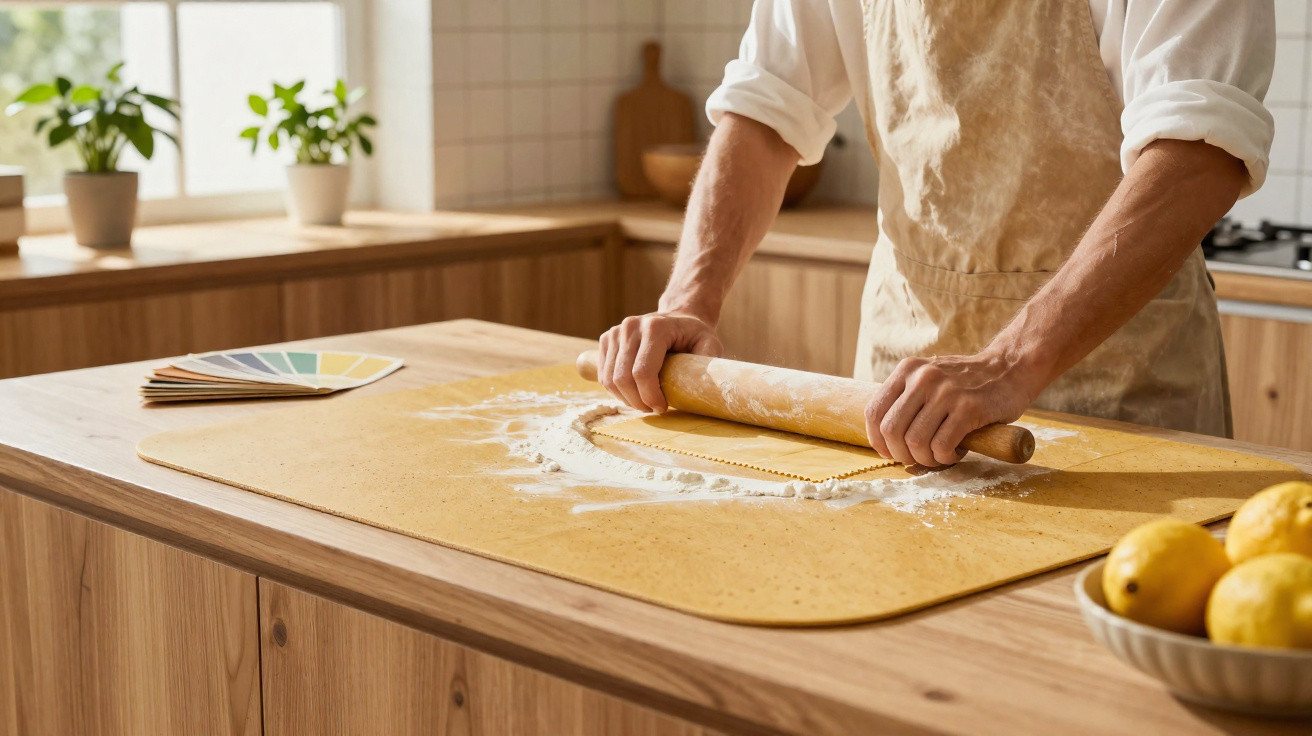
The kitchen was unmistakably 2026: matte-black appliances, a flush induction hob and concealed handles. Yet the surface beneath his hand could have come from a 1920s café. It was gently mottled, warm beneath the fingertips and neither glossy nor chilly. It had an easy, lived-in refinement. The homeowner laughed: “My grandmother had this in her house. I never thought I’d choose the same material.”
Against an Instagram feed full of marble veining and engineered quartz, it felt strikingly human: a little imperfect and a little nostalgic. You could almost imagine the clink of coffee cups and jazz playing through a crackling wireless. Designers’ enthusiasm is hardly the surprise; showroom data suggests homeowners are embracing it too. Some are even passing over reliably fashionable granite for it. The forgotten worktop is back, and it is making no effort to blend in.
The surprising return of linoleum countertops
Step into the most sought-after kitchen showrooms of 2026 and a subtle disruption becomes clear. Between stone slabs and gleaming composites sits a soft, matt finish in unexpectedly reassuring colours: rich forest green, inky blue and a caramel beige reminiscent of latte foam. You might touch it expecting plastic, but it is not. It is linoleum - more precisely, furniture-grade linoleum, often marketed as linoleum countertop or desktop linoleum.
This is a world away from the cracked, worn flooring many of us recall from school corridors. Made from a dense natural blend of linseed oil, wood flour and pigments, it has a tactile, almost velvety quality. Designers are taking it around curved edges, combining it with oak and incorporating it into ultra-modern schemes. The effect is at once forward-looking and oddly familiar, rather like a century-old diner reinterpreted by a Scandinavian architect.
The figures support what showrooms are seeing. Several European kitchen brands describe linoleum worktops as one of their quickest-growing categories for 2025–2026, fuelled by customers seeking “soft modern” rather than “showroom shiny”. At one German retailer, internal sales figures presented at a trade fair showed linoleum rising from a niche choice to almost 12% of bespoke worktop orders within two years. That is significant in a market led by quartz and laminates. Surveys repeatedly point to three motivations: comfort, colour and conscience.
Comfort concerns the way a material feels in everyday life. Colour delivers richness and depth without demanding attention. Conscience is the small internal question: do I really want another surface heavy in petrochemicals when there is an alternative? Not everybody acts on it - let’s be honest: most of us still pick what photographs well. Even so, there is something about this hundred-year-old formula that suits 2026’s preference for homes that feel “softer, slower, more human”.
Bringing this vintage material into a 2026 kitchen
The most sensible starting point is to consider zones rather than covering every centimetre with linoleum. Designers are selecting it for the areas people touch most: a breakfast bar where arms rest, a coffee nook, a baking area or a long, rounded island. When tougher materials such as stone are used around the sink and hob, linoleum becomes an accent rather than a vulnerability.
Next come the colour and the edge treatment. Deep blue, charcoal and similarly atmospheric shades create a cool, gallery-kitchen feel. Pale putty and mushroom tones bring warmth to minimalist rooms that might otherwise appear icy. Many of the strongest installations carry the linoleum over a substantial plywood edge before rounding the corners, making the piece feel like furniture rather than simply a slab. All at once, the kitchen island resembles a table where you want to spend time.
Most of us have experienced a kitchen that feels more like an appliance showroom than the centre of the home. Linoleum succeeds because it resists that impression. Its slight softness under the fingers, its subdued sheen in morning light and its ability to conceal tiny crumbs between cleans all make a room feel lived in rather than styled for display. That is also why some restaurateurs are adopting it again for bars and pastry counters. People settle in more quickly when a surface appears touchable rather than precious.
Living well with linoleum worktops
For linoleum countertops to work in daily life, the principle is straightforward: care for them as you would a treasured wooden table, not as though they were indestructible stone. Warm, soapy water is preferable to harsh cleaning products. Use a soft cloth instead of an abrasive sponge. Applying a recommended wax or care product a couple of times each year keeps the surface conditioned and gives it a little extra stain resistance.
Use trivets beneath hot pans and chopping boards beneath sharp knives. If you are used to dropping cast-iron cookware onto granite, this material will quietly encourage you to slow down. Many homeowners who opt for linoleum welcome that quality. It gently prompts everyone in the household to be slightly more considerate. And, of course, accidents happen: red wine, a splash of curry or a lemon slice left too long. New stains will usually come away, while a faint patina may occasionally remain. In 2026, that is not a flaw - it is character.
The main mistake is assuming linoleum behaves like plastic laminate. It does not. Strong bleach, steam cleaners repeatedly aimed at one area and regular water exposure around inadequately sealed sinks are the situations most likely to cause disappointment. Another frequent error is choosing a colour from a small online swatch alone. The material has visual depth, and its appearance can change considerably between daylight and warm LED lighting. Take large samples home, leave with them for several days, spill coffee on them and then wipe it away.
“People are tired of kitchens that feel like airport lounges,” says London-based kitchen designer Maya Hart. “Linoleum brings back that café-table warmth, but with a contemporary edge. It’s less ‘museum’, more ‘come in, sit, stay’.”
- Do: Combine linoleum with stone or stainless-steel zones if you cook extensively, rather than using it everywhere.
- Don’t: Expect a permanently factory-fresh appearance; a soft patina is part of its appeal.
- Do: Discuss edge detailing, moisture protection and the care kit for the particular brand with your installer.
- Don’t: Assume grey is your only option. The most impressive 2026 linoleum kitchens embrace rich, soulful colour.
Why this old-new worktop resonates in 2026
Linoleum’s revival is about more than changing design tastes. It speaks to a quiet weariness with flawless, ultra-hard finishes that reveal every crumb and make every photograph feel as though it must be perfect. Kitchens are once more places for remote working, children’s homework, sourdough trials and untidy shared dinners. A surface that offers a little forgiveness, visually and emotionally, feels unexpectedly radical.
There is also a sustainability aspect that whispers rather than shouts. Linoleum is produced from ingredients your great-grandparents would recognise: linseed oil, wood flour, natural resins and pigments. For some homeowners, that is what makes the decision. For others, it is simply an appealing extra alongside a material chosen largely because it looks beautiful on a rainy Tuesday at 7 pm.
Perhaps that is why its revival does not read as retro pastiche. There are no obligatory chequered floors or chrome stools. Instead, 2026 linoleum countertops fit into calm, pared-back interiors and gently relax them. They are the soft handshake in a room of hard surfaces. Whether this proves to be a lasting shift or merely a powerful cycle, the kitchens adopting it now make one thing clear: this is a place for living, not only for photographing.
| Key point | Detail | Benefit for the reader |
|---|---|---|
| A century-old material brought up to date | Natural, tactile, matt linoleum made from a recipe more than 100 years old | Discover a warmer alternative to conventional worktops |
| Use in strategic zones | Ideal for islands, bars and coffee corners, combined with stone near water and heat | Adapt the trend to real daily life without losing practicality |
| Care and patina | Gentle cleaning, occasional protection and a light patina that tells the story of the kitchen | Understand what everyday life with this material looks like before choosing it |







Comments
No comments yet. Be the first to comment!
Leave a Comment