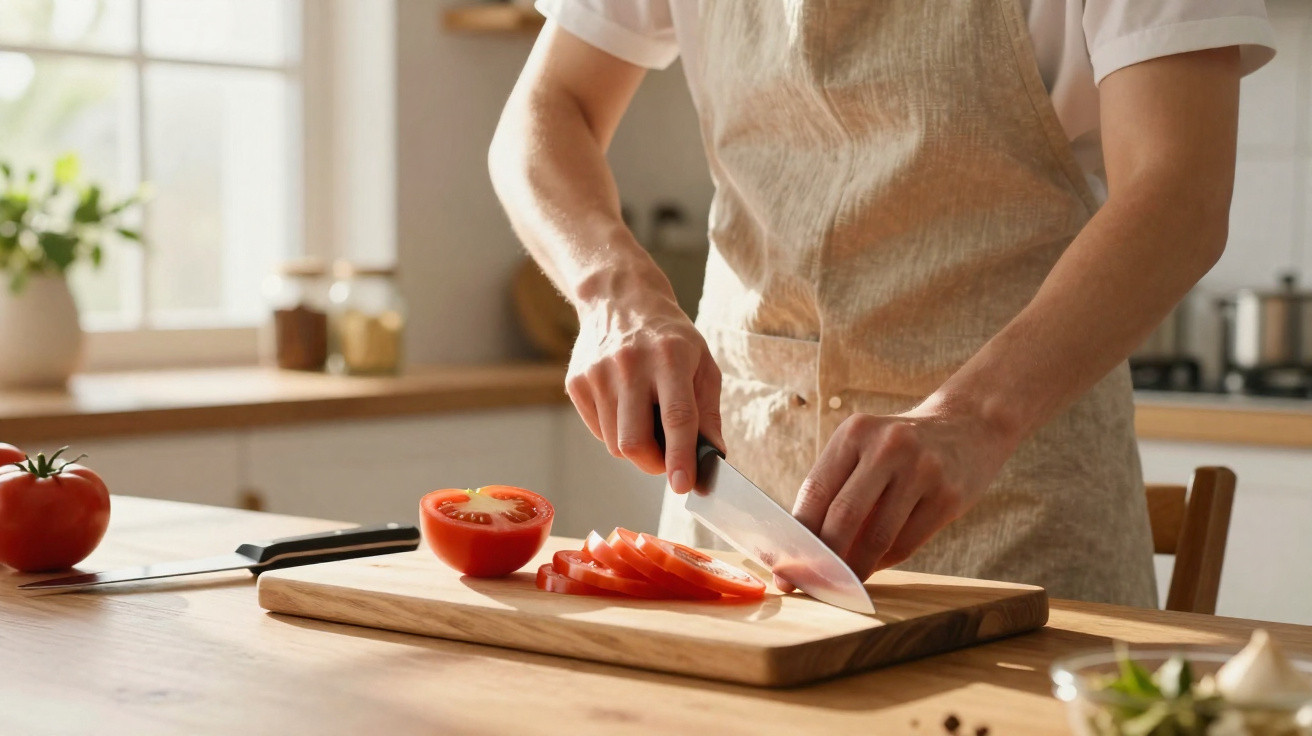
Sarah looked at her supposedly sharp chef’s knife as it skidded uselessly over a tomato’s skin rather than slicing it. She had just spent 20 minutes running the blade repeatedly along her honing steel, copying the method she had watched on countless cookery programmes. The metallic scraping had echoed around her kitchen, making her feel as though she was achieving something. But she was still crushing yet another perfectly good tomato.
The annoyance is a familiar one. Most of us have experienced the moment when a knife that has supposedly been “sharpened” seems blunter than before. That steel rod in the knife block appears professional and full of promise. For many home cooks, however, it is simply an expensive tool for making noise without producing any useful result.
The angle that’s damaging your knives
Watch somebody use a honing steel in almost any home kitchen and the same unfortunate routine tends to unfold. They hold the knife nearly at a right angle to the steel, producing an angle steep enough to cut glass. It may look forceful and assured, yet it is actually damaging the very edge they want to restore.
Many people hold the steel as though they are conducting an orchestra, sweeping the knife across it at roughly 45 degrees or more. They have picked up the habit from television chefs, who make the movement seem both easy and theatrical. What is rarely explained is that the fast, showy actions seen on screen are often just that: show. Professional chefs understand that the effective method is far more restrained.
The key measurement is 20 degrees on each side, giving an overall angle of approximately 40 degrees. That figure is not arbitrary: it is the point at which the knife’s metal can genuinely respond to honing. Work at more than 25 degrees per side and you are effectively filing away metal rather than straightening it. Your knife doesn’t need aggressive therapy; it needs gentle guidance.
The two-minute honing steel technique that works
Set the honing steel vertically, with its tip planted securely on your chopping board. Doing this immediately prevents the uncontrolled angles that cause the problem. Position the knife against the steel close to the handle, forming that essential 20-degree angle. Imagine you are shaving an extremely thin layer from the steel; that is the level of light pressure required.
Pull the blade down and across the steel in one controlled movement, keeping the same angle from heel to tip. In that single pass, the full cutting edge should make contact with the steel. Home cooks often hurry this stage, but speed sacrifices accuracy. No one is likely to love the repetitive task of knife care, yet taking your time changes the result completely.
“The honing steel doesn’t sharpen your knife-it realigns the microscopic edge that gets bent during normal use. Think of it like straightening a bent paperclip rather than making it thinner.”
Your full two-minute routine should involve:
- Five light, alternating strokes on each side
- Testing the edge on a sheet of paper
- Adding two further strokes per side when necessary
- Cleaning the blade before putting it away
Why this changes everything in your kitchen
A knife honed correctly can turn cooking from a frustrating task into a smoother process. Food behaves differently when it is cut neatly: tomatoes retain their shape, onions give off fewer tear-causing enzymes, and herbs are not crushed and turned black. The assurance that comes with reliable tools influences everything, from how quickly you prepare ingredients to how willing you are to attempt unfamiliar recipes.
This approach succeeds because it works with the knife’s construction rather than fighting against it. German and Japanese blades have different ideal angles, but the underlying principle is unchanged. The steel straightens the microscopic teeth along the cutting edge that become bent through ordinary use. Maintaining the right angle every time means those small corrections build into a major improvement in performance.
| Key point | Detail | Value for the reader |
|---|---|---|
| Proper angle | 20 degrees per side (40 total) | Prevents edge damage and maintains sharpness |
| Steel position | Vertical with tip on cutting board | Creates stable reference for consistent angles |
| Stroke technique | Smooth draw from heel to tip | Realigns entire edge evenly in single motion |









Comments
No comments yet. Be the first to comment!
Leave a Comment