The yoghurt was the first thing to point the finger at her.
Then came the rocket salad, slumped in a miserable, soggy heap at the rear of the fridge. When Emma opened the door that Tuesday evening, the odour explained everything before she even looked: food that ought to have remained fresh had already passed its best. There was half a cucumber, a punnet of berries and leftover chicken she had promised herself she would eat “tomorrow”. All of it was quietly deteriorating in the cold.
Emma was not a bad cook, nor was she careless about dates. She simply did what most of us do: piled things up, pushed them aside, squeezed them in and then forgot about them. Her fridge was perpetually full, but there was somehow still “nothing to eat”. One modest adjustment changed everything: a tiny difference in the way she arranged the shelves. It was so straightforward that it almost seemed ridiculous.
Yet it helped her food stay fresh for longer.
The hidden chaos inside a “normal” fridge
Look inside almost any fridge and it will seldom appear chaotic. Initially, it seems perfectly ordinary: jars in the door, vegetables at the bottom, leftovers in containers and milk wherever there is room. But observe how someone uses that fridge over the course of a week and another picture emerges. Items drift towards the back. Vegetables get buried beneath heavier food. Packs of ham slide behind jars, vanishing into the chilly darkness.
The fridge may not look untidy, but it is quietly disorganised.
That unobtrusive mess has genuine consequences. Food that might have lasted several more days is crushed, warmed up, overlooked or kept in the wrong place. A cucumber that ought to remain crisp for a week turns soft after three days. Fresh herbs go black overnight in the cold zone at the back. The appliance is working as it should; our habits are what undermine it.
During a rainy Sunday in Manchester, I watched a family of four clear out their fridge before the “big shop”. Out came a bag of spinach, blackened after being bought five days earlier. Strawberries covered in mould. Half a block of cheese that had hardened around the edges. Everything went directly into the bin, with one guilty plop after the next. Their youngest child asked, “Didn’t we just buy this?”
They had indeed. A week’s fresh food had been whittled down to one small corner of things that were still edible. The mother repeatedly said, “We’re so wasteful,” although their routine was much the same as that of most households. Nobody had intentionally abandoned the salad at the back. It had simply been put wherever there was available space. Statistical research across Europe reveals similar habits: households discard hundreds of pounds’ worth of food every year, much of it from the fridge and much of it before it has truly reached the end of its life.
What unsettled them most was not the smell or the slippery lettuce, but the discovery that so much of it could have lasted longer if it had been stored another way. It did not require extra containers or a larger fridge. It only needed one straightforward rule.
Fridges are not uniform storage boxes. They contain microclimates: colder areas, “gentle chill” sections and slightly warmer spots. Ignoring those zones can turn the coldest parts into graveyards for overlooked leftovers and delicate vegetables. High-moisture foods, including leafy greens and berries, suffer when they are dropped on whichever shelf happens to be free. Cooked meals deteriorate more quickly when they are crammed into the door beside the ketchup.
The reasoning is simple: temperature and air circulation influence how long food retains its texture, flavour and safety. Still, most of us arrange the fridge for convenience rather than longevity. Milk sits near the front. Yoghurts go wherever there is a gap. Vegetable drawers are packed so tightly that they barely open. That one organising rule - “where there’s room” - quietly costs money. A small adjustment can reverse the logic.
The fresh-first shelf: one visible change
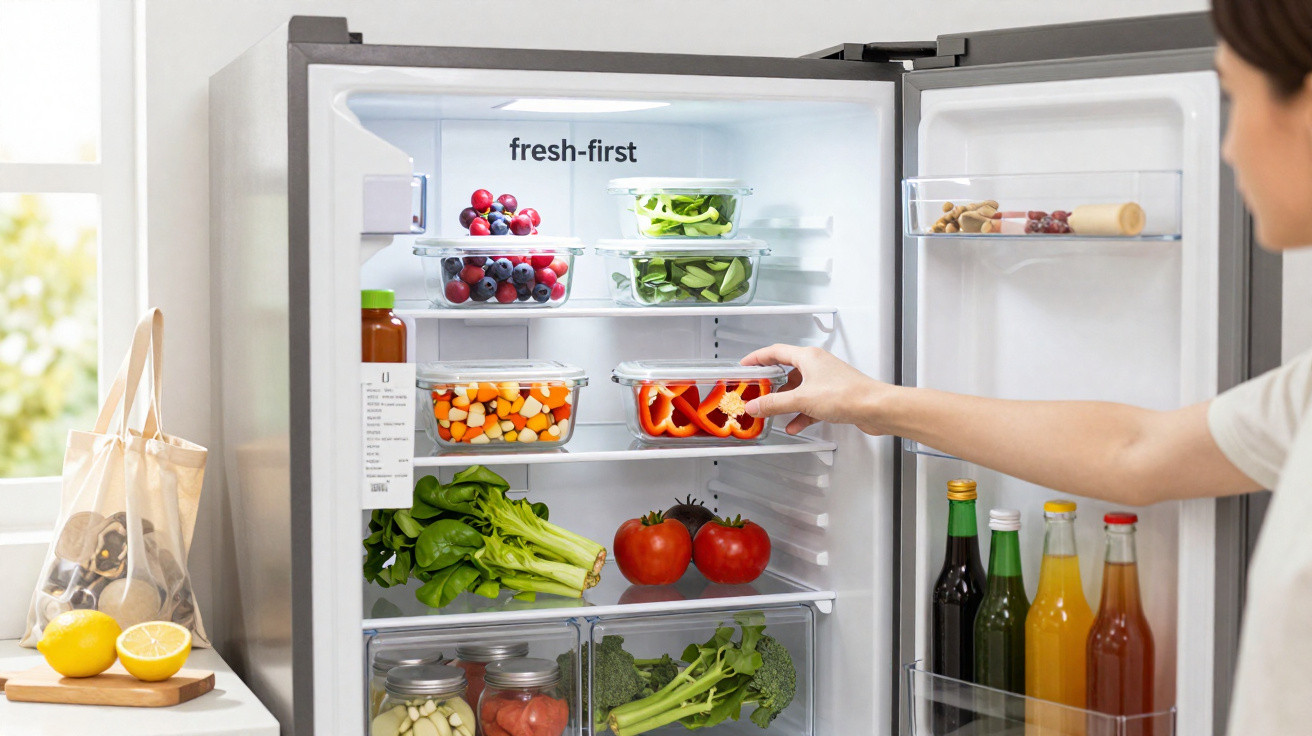
The solution is uncomplicated: designate one clearly visible “fresh-first shelf” and keep your most delicate foods there, at the front and centre. Do not scatter them around or mix them with sauces. Give one shelf one clear purpose: it should hold foods likely to spoil soon, at eye level, in the area of the fridge with the steadiest cool temperature.
This does mean changing a few routines. Rather than putting leftovers wherever they fit, place them on the top shelf or to one side. Put milk and juice in the door, where they belong. Shift jars and condiments down a level. Then clear a mid-level shelf, preferably the first one you notice on opening the door. That is your “fresh zone”.
Use this shelf for foods with a short, delicate lifespan: berries, herbs, salad leaves, opened packs of ham, cut vegetables and soft cheese. Nothing else belongs there. No mustard, no jam and no random bottle of sparkling water. All at once, the foods most at risk are directly in your line of sight whenever you open the fridge.
A couple in London I spoke with gave this a go for a month. They had been binning bags of salad every week, typically half-full and accompanied by guilt. Once they set up their “fresh-first shelf”, they noticed something unexpected: they started remembering to eat what they had bought. Spinach that had previously died at the back now sat directly in front of the milk, occupying valuable visual territory.
They began to base meals on what they saw upon opening the fridge. Lunch became “what’s on the fresh shelf” rather than “what’s easiest to grab from the cupboard”. One day, the husband made a speedy omelette simply because the mushrooms caught his eye every time he reached for the butter. That minor decision probably gave those mushrooms another two days of life.
It was not flawless. Some items still got missed. Let’s be honest: nobody really manages this every single day. By the end of the month, though, they had noticed less slimy veg, fewer sad yoghurt pots concealed in corners and almost no wasted berries. Their weekly food bin was visibly smaller. The fridge itself was unchanged; the rules were not.
Why is such a minor adjustment so effective? Firstly, it works with the way our brains function. We tend to eat what is visible. Out of sight means out of mind - and in a fridge, out of mind generally means out of date. Keeping all delicate food together in one eye-level area makes every opening of the door a gentle prompt: “Use this first.”
Secondly, it uses the fridge’s microclimates to your advantage. The middle shelf usually offers a consistent temperature: cooler than the door but less icy than the back wall. That makes it ideal for food that does not cope well with major temperature changes. Finally, it limits the “fridge Tetris” problem. When fragile items have a designated home, they are less likely to be buried beneath last night’s casserole or a crate of beer.
The principle is almost embarrassingly easy: assign a purpose to one shelf, then stick to it. However, the results influence your whole week. You shop in a different way. You cook differently. You waste less without having to obsess over it.
Making a fresh-first shelf work in daily life
Begin by clearing only one shelf, rather than tackling the whole fridge. Keeping the task that small makes it manageable. Take out the jars, stray bottles, leftovers and the solitary half lemon. Clean the shelf, then decide that it is now the “fresh-first shelf”: the place for everything that spoils rapidly. Think salad leaves, berries, opened packs, partly used vegetables and soft cheese. Keep everything easy to see and loosely grouped rather than piled up.
After that, relocate items with a long shelf life. Sauces, condiments and pickles can go in the door or on a lower shelf. Leftovers can be placed higher up, where they remain accessible without taking over eye-level space. The rule is both obvious and straightforward: if it is delicate or opened and likely to deteriorate quickly, it goes in the fresh zone. If it can last for weeks, it does not. Let that one choice become your default.
Then comes the proper challenge: keeping it up for a week.
You will probably slip up initially. One evening, you may place a takeaway carton in the centre of the fresh shelf “just for now”. You may put a bottle of sparkling water there because the side door is full. That is how old routines push back. The aim is not perfection; it is noticing when the shelf begins to become a general dumping ground again.
Whenever you open the door and notice an intruder, spend ten seconds moving it elsewhere. That small correction is where the real habit change happens. You are not styling a fridge like an influencer; you are simply preserving one shelf’s role. When you are exhausted, remember that the fresh shelf is a favour to your future self, who will not have to confront another slimy bag of salad on bin day.
During a rainy afternoon, a nutritionist I interviewed made a comment that stayed with me.
“Most people don’t need a bigger fridge. They need their fridge to tell them a clearer story when they open it.”
That is precisely the role of a fresh-first shelf. Opening the door becomes a mini briefing: here is what needs your attention today, before it dies tomorrow. The rest of the fridge becomes supporting cast rather than chaos. A few simple prompts can help you keep that story clear:
- Restrict the fresh shelf to a single layer - once you start stacking, you start hiding.
- Store loose pieces of vegetables or saved half onions in clear containers.
- Put berries and soft fruit in a small tray so they can be moved together.
- Carry out a 30-second “fresh check” whenever you put away a new shop.
- Be kind to yourself if something still goes off - learn rather than blame yourself.
A fridge that quietly prompts you every day
After using a fresh-first shelf for some time, you begin to spot other benefits. Opening the fridge feels less overwhelming. You immediately know where to find the vegetables for dinner. Leftovers are eaten before you start a new meal because they have not been shoved behind a row of jars. There is no need for labels or colour-coding. You just need one shelf to carry out one role, consistently.
At a deeper level, this minor change can alter your relationship with food. Rather than viewing the fridge as a cold box where things vanish, you begin to interpret it as a daily diary. What is on the fresh shelf today? What does it reveal about what you will eat, what you have forgotten or what you bought too much of? It is a gentle and honest feedback loop, not a telling-off.
In practical terms, food that once spoiled unnoticed now has a proper chance of being eaten. Herbs that would normally become slime end up in a quick omelette before they fade. Berries go onto morning porridge rather than sulking in a plastic punnet behind the margarine. This does not, of course, magically eliminate food waste. But it moves your week in a better direction, one day at a time.
Emotionally, there is relief in opening the fridge without feeling attacked by guilt. On a Sunday evening, checking that shelf and seeing that most of its contents have been used brings a quiet, almost old-fashioned satisfaction. You bought the food. You stored it more effectively. Your fridge helped it last a little longer. That small success reaches further: into your budget, your bin and your sense of being slightly more in control than you were last week.
| Key point | Detail | Benefit for the reader |
|---|---|---|
| Create a “fresh-first shelf” | A dedicated eye-level shelf for delicate foods | Reduces forgotten items and hidden food that rots |
| Respect the fridge’s microclimates | Keep sensitive foods in the middle, away from the door and icy back wall | Extends the true lifespan of fresh products |
| Establish mini routines | Spend 30 seconds sorting food when unpacking shopping and before meals | Less waste and more impromptu meals using food already available |








Comments
No comments yet. Be the first to comment!
Leave a Comment