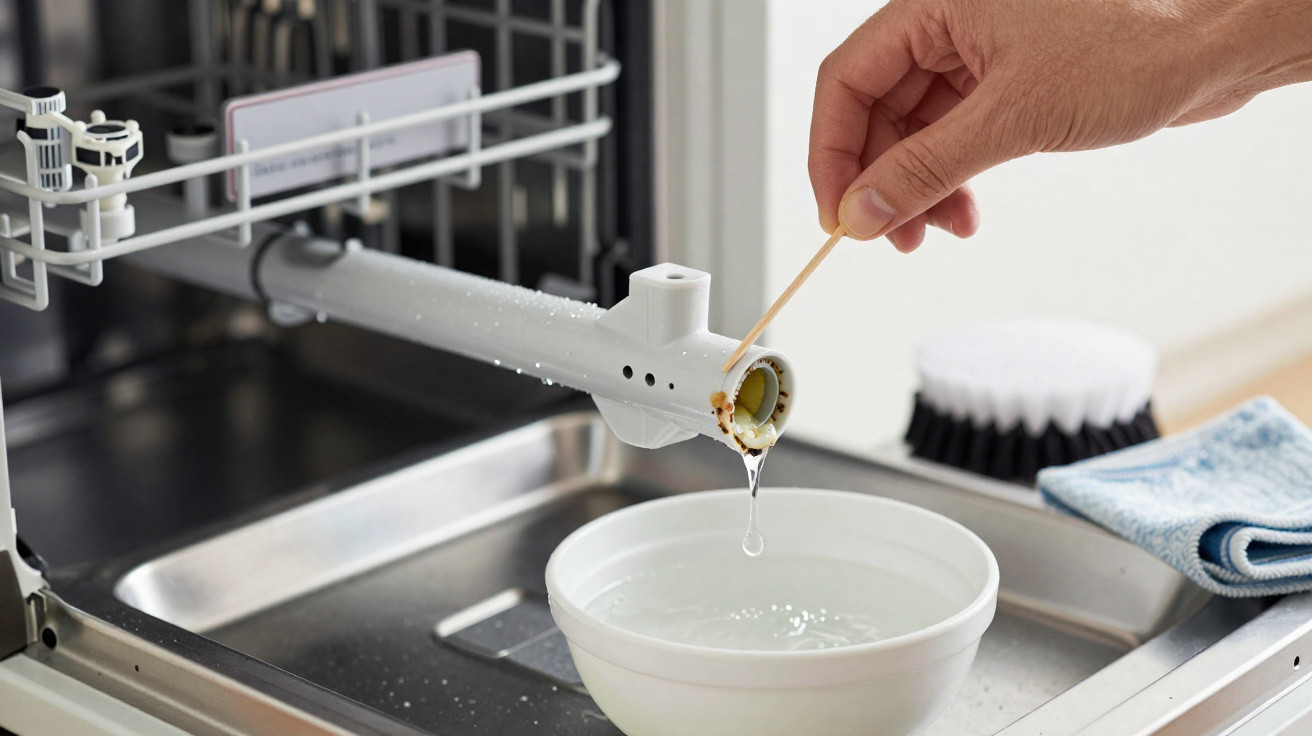
When plates come out with bits of food still clinging to them, it is easy to blame the tablet or reach for a hotter programme. Before doing either, check the dishwasher’s spray arms. Their tiny holes can become blocked by food debris, grease and limescale, stopping water from reaching the dishes evenly.
A wooden toothpick can be a useful, gentle tool for clearing the openings. It will not fix a faulty dishwasher or guarantee a longer service life, but regular cleaning can help the spray arms work as intended and may prevent you wasting water and electricity on repeat washes.
Why blocked spray arms affect washing results
The spray arms are the rotating bars below the lower basket and, on many machines, beneath or above the upper basket. During a programme, water is pushed through their small nozzles to wash the load from different angles.
If the holes are restricted, water may not spray evenly and the arms may not rotate as freely as they should. You might notice cloudy glasses, residue around the edges of plates or dirty water collecting in upturned bowls.
Limescale can be more of an issue in hard-water areas, including many parts of southern and eastern England. However, grease, food scraps and loose labels can cause blockages in any household.
A toothpick is a cleaning aid, not a repair. If a spray arm is cracked, warped or still will not turn after cleaning, the dishwasher may need professional attention.
What you need before you start
Gather a few simple items before removing any parts:
- Wooden toothpicks or a thin wooden cocktail stick
- A washing-up bowl or sink with warm water
- A soft washing-up brush or old soft toothbrush
- A clean cloth
- A dishwasher manual, especially if you have not removed the spray arms before
- A suitable dishwasher descaler, if the manual permits one and limescale is visible
Avoid drill bits, knives, metal skewers and thick wire. They can enlarge or damage the nozzle holes, affecting the spray pattern. A paperclip can also scratch the plastic and may push debris further into the arm.
Safety first
Turn the dishwasher off before removing parts. If you need to work near the filter housing or sump, take care: broken glass and sharp fragments can collect there.
Never mix bleach with vinegar, citric acid, descaler or any other cleaning product. Do not pour household cleaners into the dishwasher unless the appliance manufacturer says they are suitable. Avoid soaking electrical components or using boiling water on plastic parts.
Remove the spray arms without forcing them
The exact fitting varies by model. A lower spray arm may lift off, while others are held by a central cap or locking ring. Upper arms may be clipped to the basket, connected to a water feed tube or secured with a retaining nut.
Check the manual before pulling or twisting anything. Forcing a fitting can damage the plastic mounting or the water connection.
1. Empty the machine and check for obstructions
Remove the baskets if your model allows it, or pull them fully forwards. Look for obvious obstructions such as labels, small pieces of plastic, glass, fruit stones or bone fragments.
Turn each spray arm by hand before removing it. Make sure it is not catching on a tall plate, a pan handle or loose cutlery. Sometimes the problem is simply an overloaded basket rather than a blocked arm.
2. Remove the lower spray arm
Lift the arm gently or release its fastening as directed by the manual. Keep any cap, nut or clip somewhere safe, rather than leaving it beside the sink where it could be lost.
3. Access the upper spray arm
Pull the upper basket forwards. Depending on the design, the arm may detach with a twist, clip or retaining piece. Take a moment to note how it is positioned before removing it.
Also inspect the water feed tube connected to the basket. Residue in this area can reduce water flow before it reaches the spray arm.
Use the toothpick trick carefully
Hold each removed arm under lukewarm running water. Rotate it slowly and inspect every nozzle, including the holes at the sides and ends. Some are angled, so a blockage is not always obvious at first glance.
1. Ease debris out from the opening
Insert the point of a wooden toothpick only a short distance into a blocked hole. The aim is to loosen debris back towards the opening, not to push it further into the arm.
Work gently, one hole at a time. If the toothpick splinters, discard it and use a new one. Do not try to fish loose wood from deep inside the arm with metal tools.
2. Rinse from the central opening
Run water through the arm’s central opening and its nozzle holes. Then hold the arm with the main opening facing downwards and shake it firmly over the sink to dislodge loosened grit.
Repeat the process until water runs freely through the nozzles. Use a soft brush on the outside of the arm to remove greasy deposits, but do not scrub aggressively around the holes.
3. Check accessible feed openings
For an upper spray arm, rinse and wipe any accessible openings in the feed tube or connection point. Do not force wire, toothpicks or sharp tools into sealed or inaccessible sections.
Clear the holes gently from the outside, rinse through the inside and let water carry loosened debris out.
Deal with limescale and greasy residue
White, chalky deposits are often limescale. If the dishwasher manual allows it, use a dishwasher-safe descaler exactly as directed by its label. This is generally safer than experimenting with strong household cleaners.
For removable spray arms, some manufacturers permit a brief soak in warm water with a suitable descaling product. Check the appliance guidance first, particularly where plastic, seals and coatings are concerned. Rinse the arms thoroughly afterwards and make sure no cleaning residue or loose particles remain inside.
White vinegar is sometimes used for household cleaning, but it is not universally recommended for dishwashers. It can be unsuitable for certain materials or appliance components, so follow the manufacturer’s advice rather than assuming it is safe for your machine.
Clean the filter to help prevent repeat blockages
Spray arms can block again if food debris is circulating around the machine. The filter at the base is designed to catch much of it, but it needs regular attention.
Most dishwasher filters twist or lift out. Remove yours according to the manual, rinse it under running water and use a soft brush to clean the mesh and surrounding surfaces. Look carefully in the filter housing for fragments of glass, labels or food debris.
For many households, checking the filter monthly is a sensible routine. Inspect it more often if you run the dishwasher daily, cook with lots of baked-on food or notice poorer cleaning results.
It also helps to scrape plates into the bin or food-waste caddy before loading them. There is usually no need to pre-rinse dishes under the tap, but large scraps, cocktail sticks, paper labels and fruit stones should not go into the dishwasher.
Common mistakes that make cleaning less effective
A few shortcuts can create more trouble than the original blockage:
- Forcing debris deeper inside: work gently and try to draw material back towards the nozzle opening.
- Using metal tools: these can scratch or widen the holes, changing the way water sprays.
- Ignoring the filter: clean spray arms can quickly become blocked again if debris remains in the machine.
- Refitting parts incorrectly: check that every arm is properly seated and able to turn freely.
- Overloading the baskets: boards, trays and pan handles can stop an otherwise clean spray arm from rotating.
- Using unsuitable cleaners: follow the dishwasher manual and product directions, rather than mixing remedies from the cupboard.
Reassemble and test the dishwasher
Refit the spray arms in the reverse order, ensuring that clips, locking caps or retaining nuts are secure. Spin each arm gently by hand. It should move without catching on the baskets, crockery or sides of the tub.
Run an empty maintenance cycle or the hottest suitable programme recommended in your manual. If you use a dishwasher cleaner, choose one compatible with your appliance and follow its instructions.
Once the cycle is complete, check the base of the machine for any remaining debris. In normal use, inspect the spray holes every few months, or sooner if dishes start coming out poorly washed.
The toothpick trick is simple, but it is most useful as part of a routine: clear the spray-arm holes carefully, clean the filter and load the dishwasher so its arms can rotate. Those small checks can help the machine deliver a more even wash without unnecessary repeat cycles.














Comments
No comments yet. Be the first to comment!
Leave a Comment