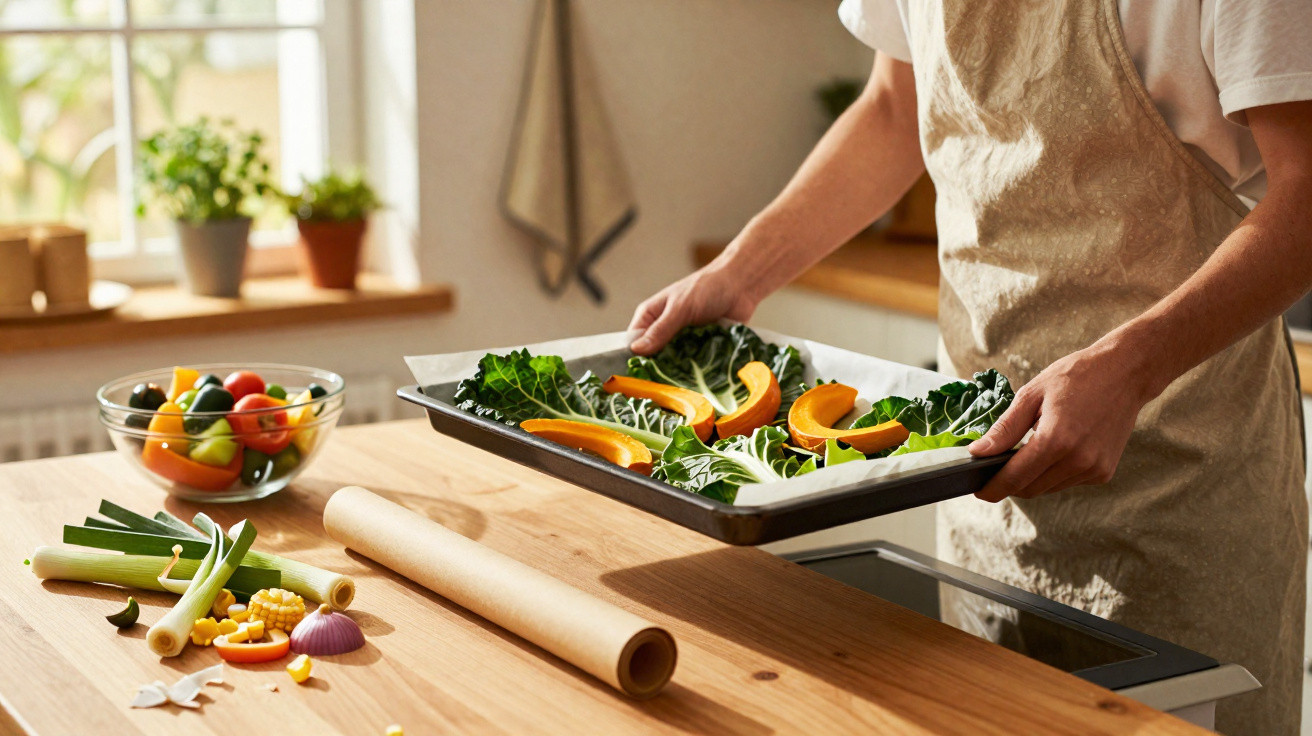
Anyone who cooks accumulates leftovers. And the most interesting parts often end up in the bin. That is precisely where a quiet kitchen revolution begins: one that is practical and enjoyable.
Why baking paper is not the only option
Baking paper is convenient, but it is nearly always coated, becomes greasy after baking and belongs in general waste. Every sheet is a single-use product, requiring raw materials and energy before eventually needing disposal. It is routinely added to shopping baskets in many kitchens, even though straightforward edible alternatives exist.
Edible lining instead of single use: leaves and peel from the vegetable drawer can replace baking paper – aromatic, heat-resistant and compostable.
The idea suits the season. Leeks, squash and varieties of cabbage are especially plentiful right now. Their sturdy outer layers withstand oven heat, add a subtle flavour and stop food from sticking. The outcome looks rustic yet contemporary, while reducing waste.
Leaves instead of baking paper: what works well in the oven
Leek leaves, squash peel and cabbage: three options with unexpected strengths
After brief blanching, leek leaves behave like flexible fabric. They can line tins, support tarts and lend a gentle green note. Squash peel creates a natural protective layer. It works well for cakes, breads and bakes cooked at moderate temperatures. Cabbage leaves – white cabbage, Savoy cabbage and sweetheart cabbage – are tough, easy to handle and particularly suited to gratins, lasagne-style dishes or savoury cakes.
- Leek leaves: delicately savoury, highly pliable and ideal for round or square tins.
- Hokkaido or butternut squash peel: mildly sweet, sturdy and warmly orange in appearance.
- Cabbage leaves: robust, moisture-regulating and add texture and bite.
The flavours remain understated. Rather than overpowering a dish, they complement it. For a more neutral result, lightly brush the leaves with oil, which also offers extra protection against drying out.
How to make the leaves pliable
The key is blanching. It softens the fibres and makes them elastic without causing them to fall apart. The leaves can then be folded, overlapped and pressed smoothly into place.
Quick guide: blanch in boiling water for 10–30 seconds, refresh in iced water and pat dry. They are then ready for the oven.
Step by step: the “plant baking mat”
- Wash the vegetables thoroughly, removing soil, sand and any wax residue.
- Choose large leaves. For cabbage, carefully trim thick leaf ribs flat.
- Blanch, cool rapidly and dry. If needed, briefly steam squash peel.
- Lightly grease the tin. Arrange the leaves in overlapping layers, allowing the edges to extend over the sides.
- Add the dough or mixture. Bake at 170–200 °C. Check any overhanging edges after 15 minutes and brush with a little oil if necessary.
- Leave to rest briefly after baking. Lift and turn out using the leaves, or serve directly from the tin.
The leaves act as a natural buffer. They prevent sticking, absorb some moisture and make it easier to release food from the tin. They are suitable for both savoury and sweet dishes baked at moderate temperatures.
Temperatures, moisture and hygiene
“Plant baking mats” perform best between 160 and 200 °C. At temperatures above 220 °C, the edges may darken. A light coating of oil helps protect them. Moist fillings benefit from cabbage leaves, while drier doughs are better paired with leek. Cleanliness is essential: wash well, dry thoroughly and use only fresh, undamaged leaves.
Which recipes work particularly well
Tarts, quiches, crustless cheesecakes, polenta bakes, breads made with wet dough and vegetable gratins all work well straight away. Even brownies are possible, as long as the edges are not exposed directly to top heat. Sweet fillings pair especially well with Hokkaido squash peel, while savoury dishes suit leek and cabbage.
Everyday recipe idea
Autumn tart with Hokkaido squash, goat’s cheese and leek leaves
- 1 roll of puff pastry
- 4 large outer leek leaves
- 350 g Hokkaido squash, thinly sliced
- 120 g soft goat’s cheese
- 2 eggs, 120 ml cream
- 1 tbsp olive oil, salt, pepper and nutmeg
- 1 handful of toasted pumpkin seeds
Blanch the leaves, refresh in cold water and dry them. Grease a loose-bottomed cake tin and line it with the leek leaves. Add the puff pastry, then arrange the Hokkaido slices over it. Mix the eggs, cream and cheese, season the mixture and pour it over the squash. Drizzle with oil and bake at 185 °C for around 35–40 minutes. Scatter over the seeds. It can be cut while warm and releases neatly from the tin.
Comparison of alternative “leaves”
| Plant part | Preparation | Oven suitability | Suitable dishes | Notes |
|---|---|---|---|---|
| Leek leaves | Blanch for 20 secs, then dry | 160–200 °C | Tarts, quiche, cheesecake | Very flexible, mild flavour |
| Squash peel (Hokkaido/butternut) | Steam briefly or lightly oil | 170–200 °C | Cakes, breads, bakes | Slightly sweet, robust |
| Cabbage leaves (Savoy/white cabbage) | Blanch for 30 secs, trim ribs flat | 170–200 °C | Gratins, lasagne, meatloaf | Regulates moisture, savoury |
| Chard leaves | Blanch for 10–15 secs | 160–190 °C | Vegetable pies, frittata | Tender; do not bake too hot |
Safety and limitations
What should not go in the oven
- Rhubarb leaves: they contain high levels of oxalic acid and are unsuitable.
- Tomato, potato or aubergine leaves: avoid because of solanine.
- Citrus peel from conventionally grown fruit: it is often waxed; use only sparingly and after thorough scrubbing.
- Badly damaged, mouldy or spoiled leaves: discard them.
The rule for edible oven linings is simple: use only fresh, clean and safe plant parts. Choose organic produce where possible and wash it thoroughly.
Anyone sensitive to cabbage should begin with small quantities. Leaves are not a substitute for good hygiene. Keep worktops clean, change washing water and clean knives and boards thoroughly.
Zero waste in everyday cooking: tips to get started
- Set large leaves aside while preparing vegetables, then blanch them immediately.
- Freeze leftovers in portions, arranged in layers without baking paper.
- Choose Hokkaido peel for sweet bakes and use leek or cabbage for savoury dishes.
- Brush overhanging leaves with oil to prevent them drying out.
- Serve the leaves with the finished dish or compost them after baking.
With only a few simple steps, you can save money and reduce waste – while giving dishes a fresh look and a delicate note of flavour.
Making more use of leftovers
Stock, crisps and base stock: what remains after preparation
Leek trimmings, onion skins and carrot tops make a richly flavoured vegetable stock. Thin pieces of squash peel become crisp oven-baked crisps when tossed with oil and salt. Cabbage ribs can be finely sliced, fried and used as a topping. This means that almost nothing needs to go in the bin.
Alternatives and a plan B for different kitchens
If suitable leaves are unavailable, grease baking trays generously and dust them with flour or breadcrumbs. Reusable baking mats are convenient, but they require raw materials and cannot be composted. The leaf method stands out for its flavour and complete usability. It is particularly effective at moderate temperatures and with cooking times that are not too long.
Practical impact: a small calculation, a big effect
Anyone baking two trays each week could save around 100 sheets of baking paper a year by using leaves. That means less packaging, less general waste and lower household costs. It also brings greater variety to the kitchen. Children can learn along the way how food can be used in full – from leaf to peel.
Fine-tuning for better results
Rub leaves with lemon juice before lining the tin if the filling is very fatty. This helps preserve their colour and prevents odours. For very liquid quiches, scatter a thin layer of breadcrumbs over the leaves. This absorbs juices and creates a more stable slice. For delicate cakes, line tins crosswise with leek leaves so that no corners are left uncovered.
Useful facts for the curious
Why does this work? The cellulose fibres in leaves act like a natural non-stick layer when hydrated and lightly oiled. Their surface separates the dough from the tin, while the fibres absorb excess moisture. At the same time, roasting flavours develop at the contact points. Together, these effects create clean slices and a pleasing mouthfeel.




Comments
No comments yet. Be the first to comment!
Leave a Comment