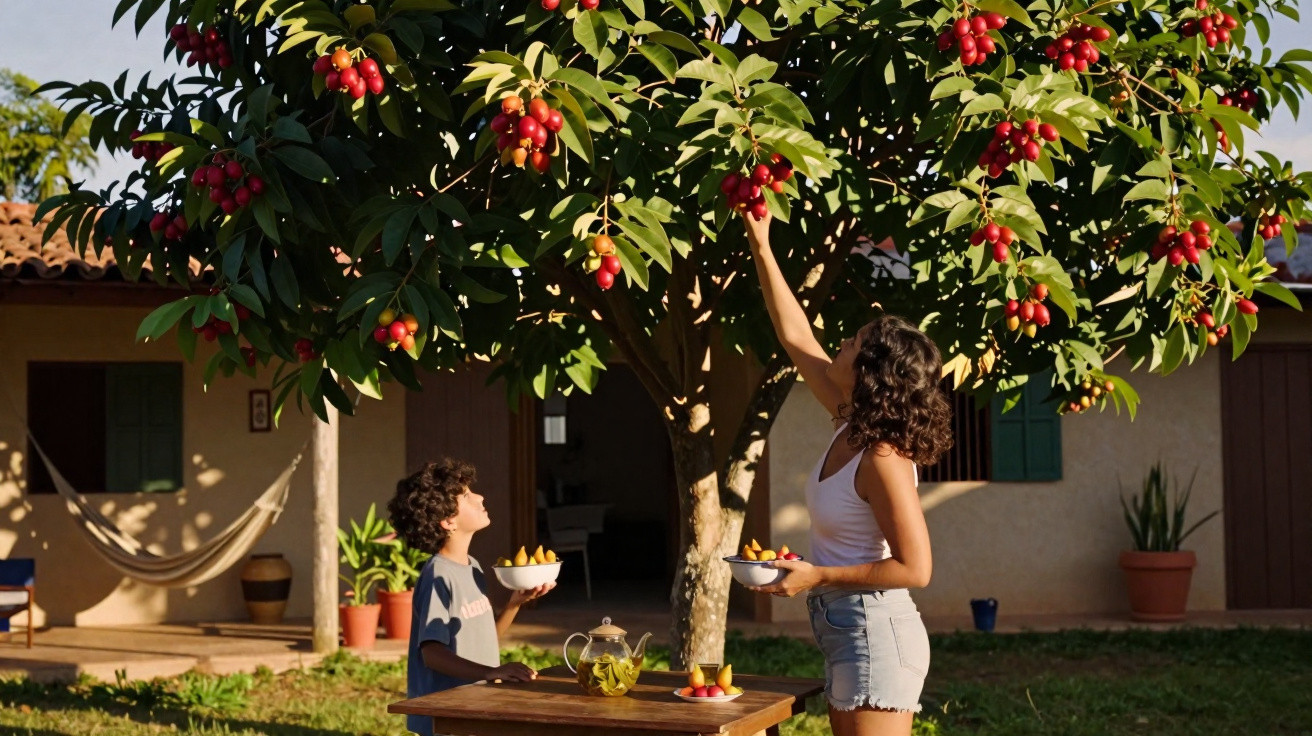
Children scramble through its branches, grandmothers rest in its shade, and there always seems to be someone gathering a handful of unusual, vividly coloured fruit to bring indoors. Neighbours insist its leaves make a comforting tea, “just like my grandmother used to make”. No one quite agrees on the best way to use it, yet the tree remains: always present, always offering something.
I encountered this backyard celebrity for the first time on a sweltering afternoon, when the air clung to your skin. The home was modest and the garden simpler still, but the tree commanded the whole space. Its leaves gleamed, its round fruit sat at every stage of ripeness, and it carried a difficult-to-explain sense of calm. A child dashed past, laughing, with pockets full of fruit. His mother smiled and said: “Here, this tree never takes a day off.”
That was when I understood that it was more than a tree. It was the understated heart of an entire way of life.
The Brazilian backyard tree that never stops giving
Ask people along Brazil’s coast about the garden of their childhood home and many will bring up a pitangueira - the Surinam cherry tree. It is not especially exotic-looking or showy: simply a medium-sized tree with glossy foliage and small, ribbed berries that ripen from green through orange to a rich, almost alarming red.
Still, this modest tree has a remarkable quality: across many regions, it bears fruit for nearly the entire year. While one branch is ending its crop, another may be beginning. This creates a gradual, continuing harvest that never seems to end altogether. The pitangueira does not demand attention; it simply carries on quietly in the background.
For many Brazilian households, this dependable nature is exactly why it is treasured. It provides midday shade, fruit for juice and jam, leaves for household remedies, and a living reason for neighbours to call at the gate “just to check if there are any ripe ones today”.
In a neighbourhood on the edge of Salvador, an older couple told me that their pitangueira is older than their youngest son. They planted it when they arrived more than 30 years ago, “just to have something green”. Today, it feels almost like part of the family record.
They measure each season through the tree’s changes: flowers first, then green pearls, followed by the sudden burst of red fruit that stains children’s faces. One neighbour recalls slipping in as a teenager to steal the ripest berries, certain that fruit tasted better when it was “forbidden”. Now he takes his own children there, retelling the story with a laugh.
There are no official figures for the number of “backyard pitangueiras per household”, but their presence is unmistakable. In the countryside, they run alongside fences. In suburbs, they spill across walls and pavements. In towns and cities, they endure in narrow courtyards or wedged between garages. They keep fruiting, shading and providing something modest yet free in a world where very little is.
Much of the tree’s appeal comes from its adaptability. It withstands heat, wind and a degree of neglect, while continuing to reward those living around it. From a botanical standpoint, the Surinam cherry (Eugenia uniflora) is neither immortal nor reliably “year-round” in every location. Its fruiting is strongest in particular months, notably spring and early summer.
However, in Brazil’s warm, humid areas, staggered flowering and local microclimates mean fruit can often be found at almost any time. One branch takes a break as another begins. Add the way memory favours abundance and overlooks the quiet gaps, and the myth of the “tree that never stops bearing” soon takes shape.
Local knowledge gives the tree another dimension. People see not merely a plant but an entire toolkit: shade for the house, screening from the street, fresh vitamins, and the celebrated leaves used in homemade teas. Scientific research is gradually examining its antioxidants and aromatic oils. Yet long before academic papers and laboratory testing, grandmothers were already infusing the leaves over gas hobs and wood fires, trusting their senses more than any study.
How Brazilians actually use their backyard Surinam cherry
When the fruit is ripe, locals standing beneath a pitangueira will usually offer one essential piece of advice: pick gently and choose the right colour. Its flavour can change dramatically in a single day. Orange berries are tart and acidic, bright red fruit becomes sweet and fragrant, while almost purple-red berries may taste like sweets with a faintly wild edge.
The technique could hardly be simpler. Support the branch lightly with one hand, then pinch and twist the fruit with the other. Eat it immediately, before its delicate skin is bruised. Some people gather fruit in a bowl for juice or jelly, but the most authentic Surinam cherry experience happens within arm’s reach of the trunk, juice running over your fingers as a hopeful dog or chicken watches below.
The leaves call for a different approach. People usually take only a small number at a time, selecting the younger, darker green leaves for tea. They dry them in a shaded spot before steeping them in hot water for a few minutes, often alongside lemon or other herbs. Nobody reaches for kitchen scales; it is guided entirely by experience and routine.
Speak with Brazilian families for long enough and the same advice, along with the same admissions, emerges. They will say the fruit makes excellent juice, ice cream and liqueur. They maintain that leaf tea “cleans the body”, “calms the nerves”, or “helps with digestion”. Then, often with a knowing smile, they admit they remember this supposedly magical tea only once they already feel unwell.
Let’s be honest: nobody really does this every day.
A woman in Recife keeps a jar of dried pitangueira leaves beside her cooker. She told me that her grandmother used to say, “If the tree is healthy, the house will be healthy.” She recognises that the saying is not strictly scientific, but it influences how she sees the plant. It is not an ornament; it is a quiet ally.
People also readily describe the errors they have made. They plant too near a wall, then regret roots lifting the paving. They neglect pruning, then complain that the fruit remains too small or too high to reach. They allow fallen berries to rot and attract insects rather than using them for compost or feeding chickens. The tree is forgiving in many ways, but these small choices influence how generous it can be in return.
Behind such practical guidance lies a subtler role: the tree’s social importance. Neighbours who have not spoken for months suddenly meet beneath its branches once the fruit ripens. Street sellers may ask permission to fill a bucket. Children learn, without being lectured, that food does not always arrive wrapped in plastic. It grows above their heads, in a familiar form, from a living trunk they can touch.
“The pitangueira is like a quiet grandmother,” a retired teacher in Florianópolis told me. “She doesn’t say much, but she’s always there, with something to give if you remember to visit.”
A quiet code of respect also appears in many conversations:
- Do not clear the tree completely; leave some fruit for birds and neighbours.
- Ask before picking from a tree growing over a wall - ownership may be shared, but courtesy still matters.
- Where possible, use fallen fruit for compost or animals, so the ground does not become a sticky mess.
- Prune gently after the main harvests to keep the tree low and easy to reach, rather than merely attractive.
- Try the leaves, but use common sense and listen to your body, as with any household remedy.
This is where the tree carries its greatest emotional weight. On a warm evening, you sit beneath it with a glass of homemade juice, watching children play while older relatives repeat familiar stories. On a rainy night, you boil water, add a few leaves and wait for the steam to settle you. On a hurried weekday, you walk past without a glance. Then, on a difficult day, you notice it again and realise how long it has been standing there in silence.
Beyond the fruit: what this “ordinary” tree says about us
Spend enough time around pitangueiras and they begin to resemble small reflections of the ways people coexist with nature. Not through grand, Instagram-perfect gestures, but through everyday repetitions: picking, pruning, brewing tea and chatting in the shade. A humble tree becomes a point of stability amid unpredictable days.
Everyone knows the feeling of life moving faster than they can manage, until something ordinary makes them pause. A branch brushes against your head. A berry lands at your feet. You smell leaves crushed between your fingers. That moment beneath the tree can be more powerful than the tea itself. It reconnects the home with the garden, and the person with the season unfolding around them.
Brazilian gardens are not always expansive green havens. Many are concrete yards with room for only one trunk. Even so, a single pitangueira can transform the atmosphere of the whole place. It softens harsh sunlight on the walls, offers some privacy from neighbouring windows, and creates shifting shade that marks the time of day without a clock.
For readers living far from Brazil, the precise species may matter less than the idea it represents: a tree that needs little, gives generously and remains long enough to enter family memory. The pitangueira stands for all the “ordinary” plants we inherit or put in the ground without much thought, before discovering decades later that they have shaped entire periods of our lives.
There is another gentle lesson in the leaves brewed into tea. Not every household remedy needs to become a worldwide trend or a miracle cure on social media. Sometimes it is enough for it to survive as a shared belief, a flavour or a comfort handed down around kitchen tables. Science will make its own findings. Grandmothers will continue preparing their infusion regardless.
Perhaps this is why the backyard tree is so loved: it contains both worlds at once. The practical - fruit, shade, tea - and the intangible - memory, habit, belonging. If you grew up beside one, you do not really “discover” it. One day, you simply recognise that it has always been there, quietly forming the backdrop to your story. That is when you understand why people smile as soon as you mention its name.
| Key point | Detail | Why it matters to the reader |
|---|---|---|
| Tree that fruits almost year-round | Surinam cherry (pitangueira) produces staggered crops in warm Brazilian climates | Explains why locals see it as a constant, reliable food source |
| Uses beyond fruit | Provides shade, privacy, and leaves used in traditional homemade teas | Shows how a single tree can support daily comfort and small rituals |
| Social and emotional role | Becomes a meeting point, childhood memory, and symbol of stability | Invites readers to reflect on their own “ordinary” trees and shared spaces |

















Comments
No comments yet. Be the first to comment!
Leave a Comment