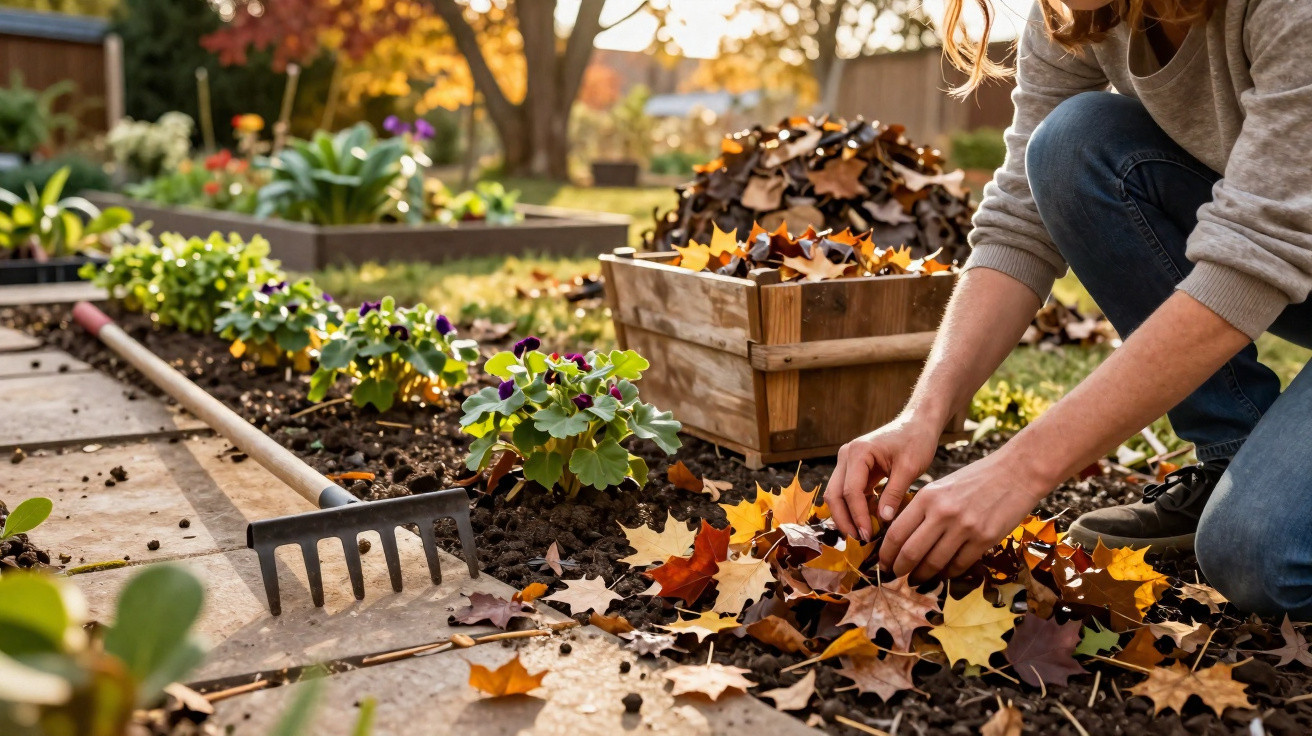
The rake moves across the lawn with its dry, recognisable scrape. Heap by heap, the garden is reduced to a tidy, uncovered expanse of green, with every trace of autumn swept into large orange piles along the fence. Perhaps you bag the leaves; perhaps you take them to the tip. Either way, the ground is left bare and “clean”, supposedly prepared for winter.
It is an appealing sight: order has returned, the task is finished, and the garden seems ready for its winter rest.
But another process is taking place beneath the surface. The soil becomes slightly less fertile, while the life below your feet grows a little quieter.
This calm, neat routine may be the biggest autumn error gardeners make year after year.
Why clearing every leaf is quietly wrecking your soil
Take a walk through any suburb on a bright October afternoon and the sounds are everywhere: leaf blowers whirring, rakes dragging and garden bins banging shut. Gardens appear immaculate, almost manufactured, without a single leaf on view.
We have been conditioned to believe that good gardening means tidy gardening: a golf-course lawn, freshly cleared beds and no “mess”.
Yet fallen leaves were never merely debris. They are a source of raw material, food and shelter: free, slow-release fertiliser supplied by your own trees.
When they are all removed during a weekend “clean up”, the soil loses its autumn covering and the natural cycle beneath the ground is interrupted.
In the US alone, estimates indicate that millions of tonnes of leaves are gathered and transported away as waste each year. Local authorities spend substantial sums managing material that could otherwise be an excellent soil improver.
One UK survey found that more than 60% of gardeners say they “fully clear” leaves from lawns and borders before winter, frequently sealing them in plastic bags. Many believe this avoids disease and keeps the garden “healthy”.
A horticulturist at a London community garden told me that, every autumn, they see neighbours fill bag after bag with leaves - only to buy fertiliser in spring to “feed” their exhausted soil.
The irony is difficult to miss.
What, then, happens when the ground is stripped bare? Without a layer of leaves, the soil is exposed to rain, wind and changing temperatures. Nutrients are washed out, micro-organisms lose their protection, and worms move nearer the surface only to find very little to eat.
Leaf litter works like a natural duvet: it cushions heavy rainfall, retains moisture and gradually decomposes into humus, leaving soil darker, richer and easier to cultivate.
Take all of it away and the soil slowly becomes compacted and depleted. Plants may still “survive”, but their roots have a harder time, leaving you to work more each year simply to achieve the same outcome.
The surface may look neat, but the living system beneath it is quietly being starved.
The right way to handle autumn leaves without wrecking your garden
The answer is not to turn your garden into an unmanaged woodland. It is about choosing thoughtful mess rather than absolute tidiness.
Begin by changing how you manage leaves, rather than trying to control how many fall. Instead of raking every leaf from lawns, pass over them with a mulching mower. Shredded leaves decompose more quickly and nourish the grass.
In beds and borders, collect dry leaves into a loose layer around 5–8 cm deep, then spread them around perennials, shrubs and trees.
Treat them as homemade mulch: straightforward, inexpensive and remarkably effective.
Some areas do still require care. Dense, wet heaps left on paths can become slimy and hazardous. Thick layers over delicate alpines or small seedlings may lead to rot or mould.
Move leaves to the places where they will do good rather than damage. Remove heavy mats from the lawn, while allowing a light scattering to remain. Put surplus leaves beneath hedges, around fruit trees or in a peaceful corner to create a small wildlife area.
Even on a compact balcony, one crate of shredded leaves can become valuable compost for pots in the future.
Let’s be honest: nobody really does this every day. One or two brief sessions each autumn are enough to make a real difference to your soil.
Soil scientists and ecologists deliver the same message each year, yet most people still reach for the large black bags.
“Every leaf you remove is a tiny delivery of nutrients you’re refusing,” says Dr. Hannah Rhodes, a soil ecologist who studies urban gardens. “If you shred and keep even half of them, your soil will look and behave differently within a couple of seasons.”
We have all seen a neighbour proudly gesture towards their bare, pristine lawn as though it were a mark of honour. Below it, the ground is quietly losing its vitality.
Try changing the approach with a handful of simple steps:
- Keep a light covering of leaves beneath shrubs and trees rather than leaving bare earth.
- Mulch-mow leaves into the lawn once or twice before winter.
- Create one small leaf-mould heap in a corner or container.
- Clear only hard surfaces and plant crowns, rather than every piece of ground.
- Apply finished leaf mould as a free soil conditioner in spring.
A different kind of “tidy” garden for autumn and beyond
Once you see fallen leaves as a resource instead of rubbish, your view of the whole garden begins to change. Bare soil is no longer the aim. A gentle, rustling covering becomes familiar - and even reassuring.
You may spot birds searching beneath shrubs for insects, or hedgehogs slipping into leaf heaps as evening falls. The garden starts to feel less like a display space and more like somewhere alive.
Soil gets better gradually, almost unnoticed. It holds moisture more effectively, breaks apart more easily in your hands, and supports stronger plants with less reliance on bags and bottles.
This is not a radical new concept. It is much closer to the way forests have always functioned: trees shed their leaves, the ground receives them, and the quiet decomposition feeds everything.
Gardening experts are simply encouraging us to follow that logic at home, rather than resisting it every weekend with rakes and blowers.
You do not need to leave every leaf where it falls. You simply need to stop fighting all of them at once.
A slightly “messier” autumn can mean a much more generous spring.
| Key point | Detail | Why it matters to the reader |
|---|---|---|
| Leaves feed the soil | As they decompose, they add humus, nutrients and organic matter | Less need for bought fertiliser, with more active and fertile soil |
| Making everything “clean” weakens the garden | Bare soil means erosion, compaction and a loss of underground biodiversity | Helps explain why a garden struggles despite all the effort put into it |
| Simple leaf management is enough | Mulch-mowing, light mulching and a dedicated leaf pile | Improves soil health with little autumn work |
















Comments
No comments yet. Be the first to comment!
Leave a Comment