A punnet can look bright and glossy, with no fuzz or odd odour. You rinse a handful, bite into one… and find the flavour bland, almost watery. The texture has already started to soften. Although the date on the pack says they should be fine, your taste buds say otherwise. You shut the fridge door with that small flash of frustration: money has been wasted, freshness has disappeared, and you do not know why.
A few days later, your sliced ham, salad leaves and even the cheese saved for Sunday brunch give you the same experience. There are no green patches or alarming smells. Instead, it feels as though the food has silently become old overnight. The labels suggest one thing, while the contents of your fridge suggest another.
Something unseen is taking place long before mould or slime appear.
Invisible spoilage: when food ages without looking old
Look inside almost any fridge and you are likely to find half-empty jars, leftovers covered only loosely, and vegetables lurking at the back like shy teenagers. It all appears perfectly normal… until you eat it. Flavours become muted. Textures lose their firmness. Freshness fades unnoticed, well before our eyes recognise the change. The reason is seldom a single major error; more often, it is a collection of small storage habits gradually taking their toll.
We naturally rely on what we can see. If there is no fuzz, it must be “fine”, surely? That visual rule made more sense when people prepared food on the day they bought it. In today’s kitchens, however, food may remain stored for several days. This is where the disconnect begins: when an item eventually looks unappealing, it may already have been underwhelming on the plate for some time.
This “invisible spoilage” is simply the continuation of life inside your food. It happens very quietly.
Consider a bag of salad leaves. You open it, allow some warm air inside, loosely roll the opening, and put it back in the fridge door. The following day, the leaves may still be green, but their crisp bite has gone. After another two days, the edges begin to darken and you remove the worst leaves. By the third day, the entire bag looks miserable. Nothing spectacular has occurred: oxygen, changing temperatures and a little moisture have merely been working slowly.
Bread provides another example. You may store a loaf in the fridge because you “don’t want it to go mouldy”. Visible mould may indeed be avoided, but the bread stales twice as quickly. It may remain safe to eat for longer, yet all enjoyment has gone. That is invisible spoilage in brief: the food is still “okay” on paper, while your senses already feel let down.
Several processes continue out of sight. Enzymes found naturally in fruit, vegetables and meat carry on working after harvesting or slaughter, reducing firmness and dulling flavour. Bacteria do not wait for mould to develop; many multiply discreetly even at fridge temperatures when the conditions suit them. Oxygen passes through thin packaging and gradually oxidises fats and vitamins. None of these changes needs to cause obvious decay immediately. They simply shift food from lively to “meh”.
The arrangement of your fridge creates another complication. The door is warmer than the rear, and the top shelf differs from the salad drawer. Put food in an unsuitable place and you give enzymes and bacteria a slight advantage. That may not make supper unsafe overnight, but it can remove days from the period when food is at its best.
How tiny storage habits steal days of freshness
One straightforward change in thinking can make a major difference: rather than asking “Will it rot?”, ask “How long will it remain at its peak?”. This involves treating the fridge as a space with different microclimates rather than one uniformly cold box. An item’s position, its exposure to air and the quality of its seal all affect its freshness clock.
A useful starting point is to place food in the appropriate cold zone. Milk, raw meat and fish should go in the coldest area, typically at the back of the bottom shelf. Herbs and leafy vegetables fare better in the salad drawer, preferably in breathable bags so that condensation does not overwhelm them. Eggs are more stable on a middle shelf than they are rattling about in the door. It may sound overly particular on the page, but in reality it becomes a handful of familiar places your hands learn automatically.
In everyday life, many of us make the same errors repeatedly. We leave leftovers cooling on the hob for hours before putting them into the fridge in one large, warm container. The middle stays lukewarm for a long time, creating precisely the conditions bacteria enjoy. Or we open cheese, remove the plastic, then return it to the shelf only partly wrapped. A week later, the edges are hard and the cheese seems strangely lifeless, despite having no visible mould.
Take berries placed directly onto a random fridge shelf in their supermarket punnet. There is no airflow beneath them and no kitchen paper to absorb moisture. By the second day, trapped humidity has already begun to soften the berries at the bottom. As those at the top still look good, the rest are easy to overlook. When one mouldy berry finally catches your attention, half the punnet may have lost its sweetness and texture. Technically edible, emotionally disappointing.
There is also the familiar problem of cooked rice or pasta left uncovered. The outer layer dries while the centre remains moist, producing an unpleasant combination of rubbery and soggy. There may be no green marks or unpleasant smell, only a subtle decline that turns leftovers from an easy success into something that feels like a punishment.
A range of factors work together to reduce shelf life without making a fuss. Temperature fluctuations accelerate all of them. Every time the door opens, warm kitchen air reaches the chilled food. Delicate foods kept in the door are therefore taken on a temperature rollercoaster throughout the day. Cold chains matter at home as well: a pack of mince left in a warm car boot, then on the worktop, and finally in an overcrowded fridge has already spent much of its “freshness budget” before it is cooked.
Moisture is another quiet influence. Too much allows microbes to thrive, while too little causes textures to fail. This is why cheese benefits from breathable wrapping rather than an airless plastic tomb, and why salad leaves keep longer when their container includes a sheet of kitchen paper. Oxygen gradually alters fats and vitamins, leaving flavours flat and sometimes faintly rancid before there is any clear smell. Freezer burn is simply severe dehydration combined with oxidation, occurring long before the ice crystals look alarming.
Food labels cannot reflect all of these subtleties. A “best before” date does not mean “tastes best until the final second”. It is an approximate indication, rather than a promise of freshness.
Simple rituals that stretch real freshness (not just safety)
You do not need a colour-coded, laboratory-style fridge arrangement. A few small habits, practised regularly, preserve flavour far more effectively than expensive storage containers. Begin with the door and remove fragile foods from it. That includes milk, cream, yoghurt, eggs and soft cheese. Put them on a middle or lower shelf instead, where temperatures remain more consistent.
Next, give delicate produce a gentler place to sit. Line containers of berries and salad leaves with kitchen paper to absorb surplus moisture. Treat herbs as you would flowers: trim their stems, place them in a glass of water, cover them loosely with a bag and keep them in the fridge. It may look a little absurd. It can also make drooping coriander last for a week rather than just one night.
Leftovers deserve attention too. Divide hot food between shallow containers so that it cools fast, then cover it once it is merely warm. If possible, add a piece of tape with the date written on it. Let’s be honest: nobody really does this every day. Even doing it a few times each week, however, can reduce how often food is discarded “just in case”. For cheese, wrap it again in baking paper or specialist cheese paper, then place it inside a loose plastic bag. This limits drying without holding excessive moisture against the surface.
For fruit and vegetables, keep the “sprinters” apart from the “marathon runners”. Soft berries, cut melon and bagged salad will not wait around; use them within the next couple of days. Root vegetables, whole apples, citrus fruit and cabbage are more patient. Keeping them together combines ethylene-sensitive produce with ethylene producers, hastening ripening in ways that may only become clear when it is too late.
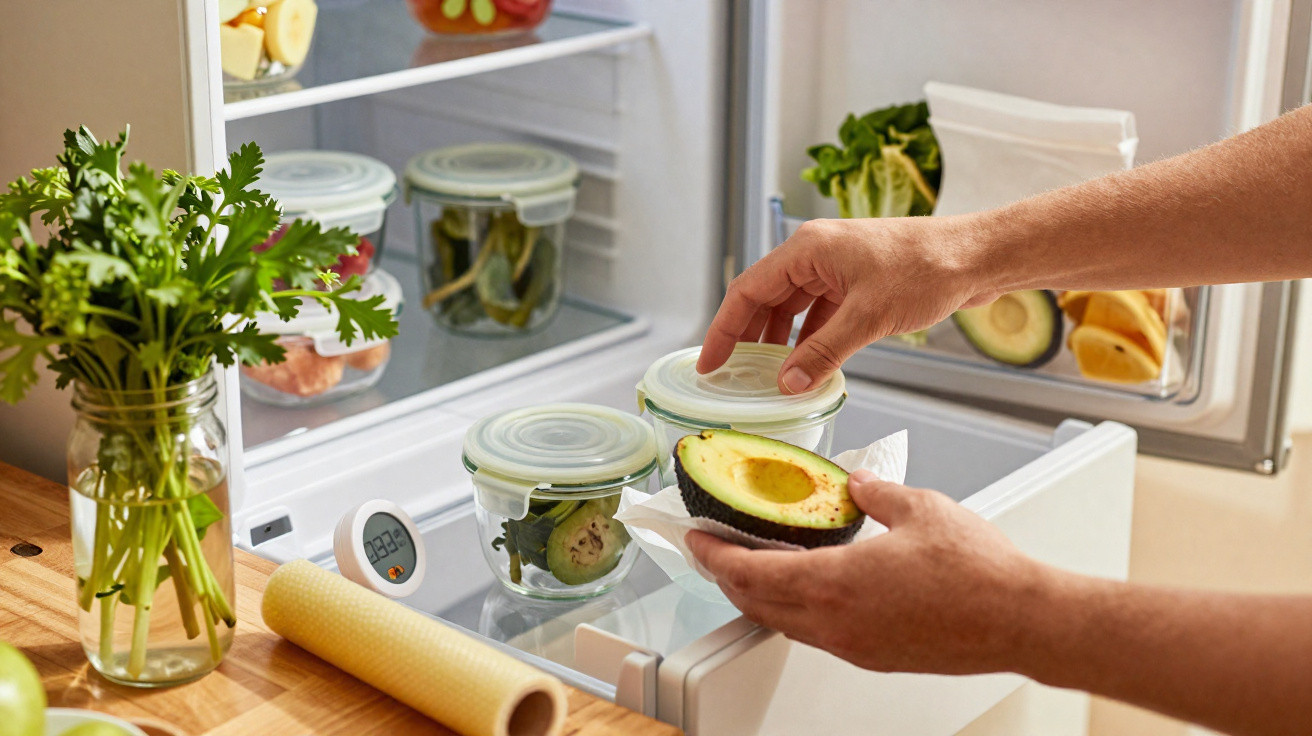
Cling film is often given more credit than it deserves. One loose layer around half an avocado or a cut onion does not completely prevent drying or absorption of fridge odours. A tightly sealed container, with a little lemon or oil over the cut side, better retains texture and flavour. This is not about achieving perfection; it is about shifting the odds in your favour.
“Food rarely goes from perfect to poisonous overnight,” says one food scientist I spoke to. “There’s a long middle stage where it’s still safe, but it’s already lost the qualities that made you want it in the first place.”
This middle stage is exactly where sensible storage has the greatest effect. You are doing more than avoiding food poisoning; you are safeguarding small pleasures such as a carrot’s snap, a peach’s perfume and the squeak of fresh halloumi. Once you notice this “in-between” period, it becomes simpler to adjust minor routines instead of blaming poor luck or supermarkets whenever food disappoints you.
- Store raw meat and fish on the coldest shelf, away from ready-to-eat food.
- Create a “use first” box for anything that is nearing its peak.
- Dry fridge shelves after wiping them; standing water quietly accelerates deterioration.
Freshness you can’t see, but you can feel
Most people only consider food storage when there is an obvious problem: green fuzz, slimy mushrooms, or cheese smelling like an abandoned gym bag. Yet the more important kitchen story happens earlier, through the small invisible changes that determine whether Tuesday’s dinner feels generous or grudging.
When you understand invisible spoilage, getting ahead of it becomes surprisingly satisfying. You begin to reposition food in the fridge without even thinking. Raw chicken naturally ends up in the cold rear corner. The salad drawer no longer becomes a graveyard because leaves and herbs receive slightly better care. By Friday night, your tomatoes still taste of tomatoes rather than damp cardboard.
Something else changes as well. The slight guilt connected with food waste eases, not because you have become a perfect person, but because your routines better match the way food actually behaves. The reward is there whenever you open a container of leftovers and discover something you genuinely want to eat, even though no label could ever have predicted that moment.
| Key point | Detail | Benefit for the reader |
|---|---|---|
| Invisible spoilage starts early | Enzymes, bacteria, oxygen and moisture gradually damage texture and flavour before mould appears | Avoid wasting food that is “technically fine” but already tastes disappointing |
| Fridge zones matter | Different shelves have different temperatures and humidity levels that suit particular foods | Simply rearranging food can add days of genuine freshness |
| Small rituals beat fancy gadgets | Shallow containers, breathable wrapping, kitchen paper and a “use first” box are enough | Make practical changes without purchasing costly storage solutions |











Comments
No comments yet. Be the first to comment!
Leave a Comment