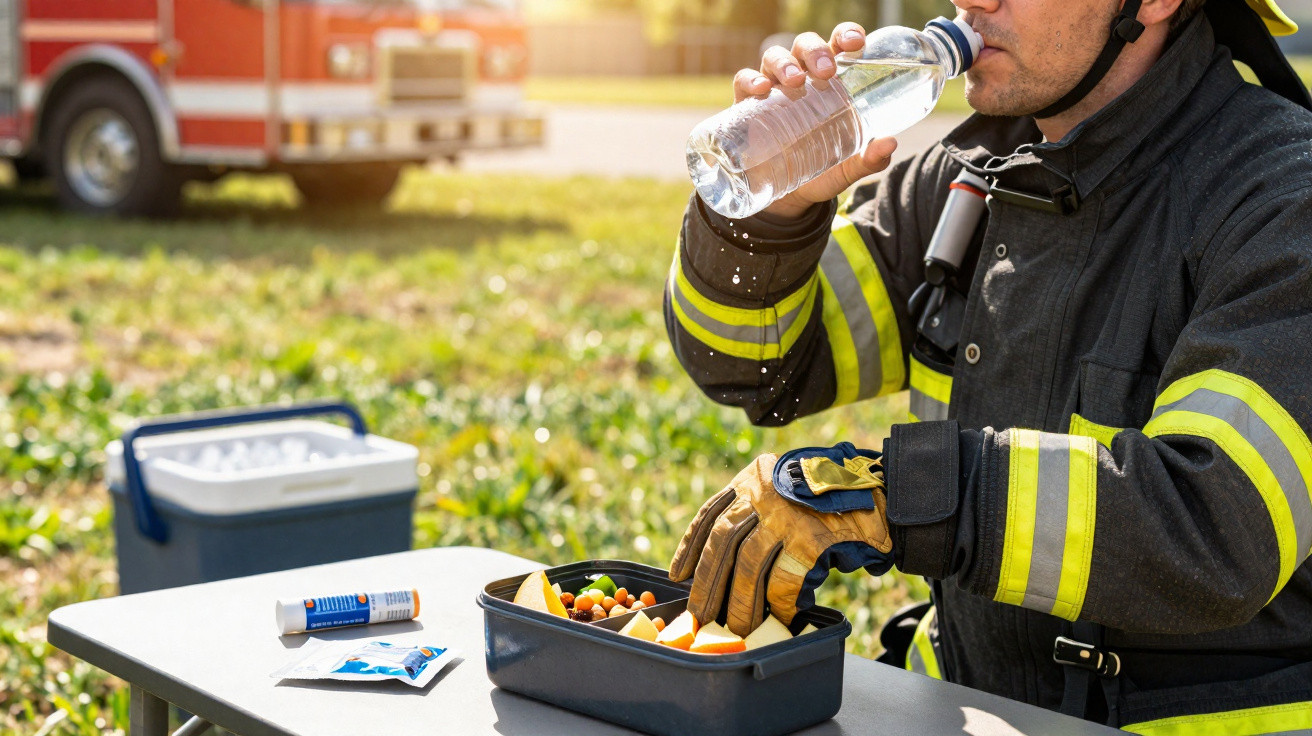
Berlin – During demanding, sweat-inducing fire service operations, particularly in the summer months, suitable catering needs to be planned in good time. This is essential for restoring expended energy and maintaining the body’s fluid balance. HFUK Nord highlights this on its website and also provides guidance on effective planning.
The Fire Service Accident Insurance Fund for Hamburg, Mecklenburg-Western Pomerania and Schleswig-Holstein advises personnel to drink sufficiently before an incident, rather than waiting until they feel thirsty (see also “10 Tips for Operations in High Heat” below). Depending on the duration of the operation, small energy-rich snacks that do not place strain on the body may then be appropriate. However, if the situation continues for several hours, suitable meals should be arranged. In general, easily digestible food should be provided to support firefighters without imposing an additional burden on the body.
Read the article on HFUK Nord’s website.
Fire service catering and hydration during operations
10 Tips for Operations in High Heat
Berlin – Fire service operations in high heat: The currently high temperatures can place enormous strain on the circulatory system, creating a potentially dangerous situation for male and female firefighters during an incident. Here are 10 tips on how fire service personnel should behave.
Drinking, vehicles and personal wellbeing
- In everyday life, continually drink enough unchilled water or suitable sugar-free and alcohol-free drinks – an incident can occur at any time. On longer journeys to an incident, there may also be time to drink some water in the appliance before arrival.
- Important for officers: make sure every member of the crew has sufficient fresh drinking water available on fire appliances, or juice spritzer. Check the best-before date regularly.
- Where possible, park private cars in a garage, underground car park or shaded area before an incident. If safe to do so, open ventilation slots so that the vehicle does not become excessively hot. When called out, first allow the worst of the trapped heat to escape before getting in and driving away.
Cooling vest
The body becomes fatigued and overheats very quickly when working in intense heat.
- Listen to your body: anyone already experiencing dizziness, circulatory weakness or otherwise feeling “not fit” must not take part in an operation under any circumstances. Anyone who responds to an incident in this condition is not only acting with gross negligence towards themselves, but may also become a burden on other personnel.
Protective equipment and relief for crews
- Personal protective equipment: wear the “thick” operational clothing (HuPF 1 / 4) only for as long as absolutely necessary, for example during internal firefighting. For woodland and open-ground fires, fire service protective clothing in accordance with Fire Service accident-prevention regulation section 14 (HuPF 2 and 3) is sufficient. Where possible, do not fasten the jacket until reaching the incident scene. As soon as a reduction in kit is possible, it should be ordered. Take care, however: reducing kit does not mean short trousers and a bare upper body. Clothing must be appropriate for the operation and its hazards. If a helmet does not need to be worn, headwear such as a baseball cap is highly sensible for protection from the sun.
- Breathing apparatus wearers awaiting deployment should be able to sit in the shade. More generally, seeking shade where possible is not a sign of weakness. The same applies to using sun cream: keeping a small tube readily accessible makes it easier to reapply it quickly during an operation.
- In hot conditions, request assistance from other fire services early so that crews can be relieved seamlessly.
Face mask with respiratory protection
Prepared for the next vegetation fire: this mask reduces the inhalation of smoke and ash particles while protecting the face against radiant heat and flying sparks.
Medical cover and post-incident clothing
- Request ambulance service support early for the crew’s own safety, if it has not already been mobilised automatically. Breathing apparatus wearers must be medically monitored during and after the operation.
- Even if it supposedly “looks cool” in photographs, do not pour water over your head and soak operational clothing: once wet, it is no longer suitable for use at an incident.
- Keep a change of clothing ready – after one incident comes the next!
Do you have further tips, comments or additions? Simply use the comments function beneath this article!















Comments
No comments yet. Be the first to comment!
Leave a Comment