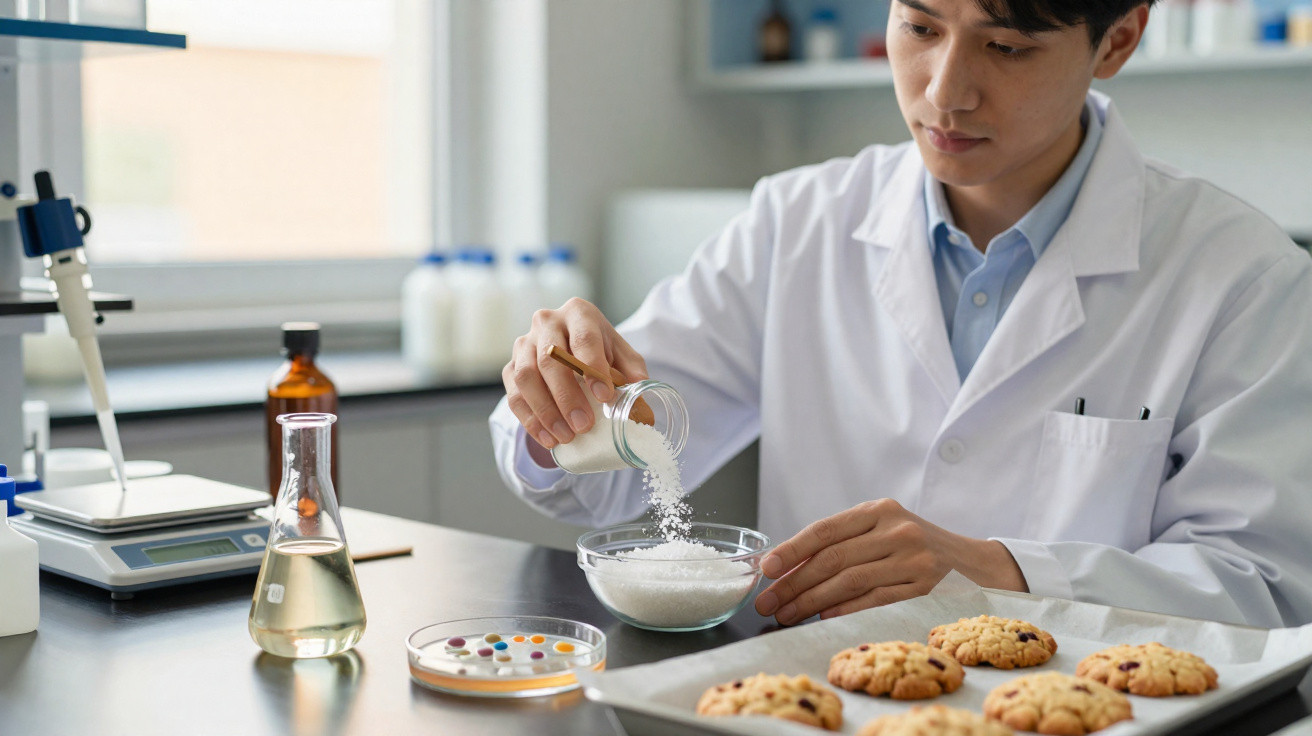
This is not another new sweetener with an unpronounceable name, but a genuinely natural sugar that is almost indistinguishable from sucrose. Far less harsh on the metabolism, it could even replace it entirely.
It is one of the food-tech industry's ultimate holy grails: a sugar with the same flavour and texture as sugar, but one that does not slowly kill you through its addictive properties and the glycaemic rollercoaster it creates in our bodies. The industry has therefore opted for what it does best: choosing the lesser evil. Food manufacturers have not really had any alternative when formulating their products: keep using real sugar (crystallised sucrose), or turn to sweeteners, some of which leave a frankly horrible aftertaste.
Perhaps this dead end has now been overcome, at least experimentally. Researchers at Tufts University in Medford, Massachusetts, have managed to clear the hurdle that had prevented a “rare sugar”, tagatose, from being used at scale. It is a natural sugar with exceptional metabolic properties, but one that has been far too expensive to synthesise. In a study published on 17 December in Cell Reports Physical Science, they set out a new method for producing it at high yield. Will tagatose become the true replacement for sucrose, reviled by health authorities around the world, or simply another outsider that will be forgotten within two months?
Biohacking: turning bacteria into tagatose factories
Tagatose occurs in tiny quantities (0.2%) in certain dairy products and in a handful of fruits, including apples, pineapples and oranges. Extracting it profitably, as is done with sugar beet or sugar cane, is therefore impossible. Industrial volumes must instead be synthesised, yet the existing industrial process, which converts galactose, itself an expensive sugar, was still too inefficient, with yields capped at between 40% and 77%.
The Tufts team therefore turned to a bacterium widely known to the public because of the various scandals it has caused in the past: Escherichia coli, a potent pathogen that they genetically modified. They introduced an enzyme taken from a “slime mould” (a myxomycete), enabling them to bypass the bacterium's normal metabolism. Rather than consuming sugar to generate its own energy, the bacterium is thus compelled to convert glucose, which is plentiful and cheap, directly into tagatose.
This enzymatic hack raises the yield to as much as 95%, putting tagatose in a highly favourable position should industrial-scale production ever be considered.
Tagatose, a sugar better suited to human metabolism
Tagatose's chief strength lies in its molecular structure. Although it is an isomer of fructose, meaning its atoms are arranged almost identically, that minute distinction changes everything during digestion. It delivers 92% of the sweetening power of sucrose, yet the human body lacks the enzyme transporters needed to metabolise it efficiently.
Unlike conventional sugar, which is immediately absorbed through the wall of the small intestine and floods the bloodstream, 80% of ingested tagatose remains trapped in the digestive tract. Because it does not cross the intestinal barrier in large amounts, it cannot cause a spike in blood glucose. This poor absorption is what ensures an almost non-existent insulin response: the pancreas simply does not detect the arrival of a sugar.
The remaining molecules - and therefore the greater share - complete their journey in the colon. There, they take on another role: they cease to be carbohydrates and become food for the microbiome. Gut bacteria ferment them, turning a sugar that is “useless” to our cells into fatty acids that benefit our gut flora. Tagatose can therefore fool the taste receptors on the tongue, before acting like a prebiotic fibre once swallowed.
In cooking, it behaves physically like sugar: it gives cakes bulk and flavour, browns effectively, and caramelises perfectly through the Maillard reaction. For manufacturers, this is the decisive argument: sucrose can be replaced without altering the finished product's texture or its performance during baking.
Caution is still required, however. The fact that tagatose can now technically be produced does not mean the industry will adopt it. Sucrose, the food sector's favourite, benefits from a heavily subsidised global industrial ecosystem whose logistical efficiency and economic inertia represent an obstacle far more formidable than any technological barrier. More fundamentally, replacing sucrose with a sugar that is better tolerated metabolically would never address the root of the issue: our dependence on sweet flavours - nutritionally unnecessary, dangerous, yet deeply ingrained in contemporary eating habits. Even though tagatose is already recognised as safe by US authorities, including the FDA, we should remember that these are the same authorities that industrialised junk food and normalised tobacco. For now, such a label is worth little more than an endorsement that has already sanctioned far worse things… for far too long.










Comments
No comments yet. Be the first to comment!
Leave a Comment