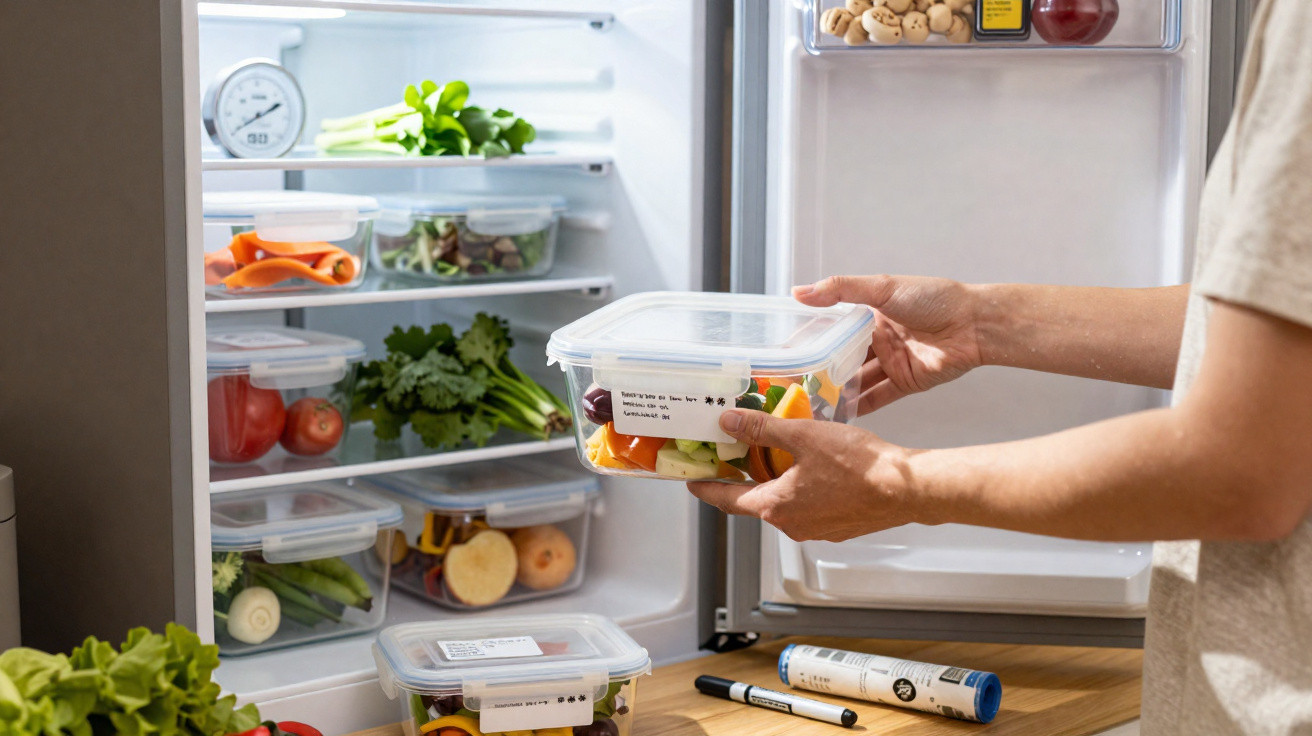
Rather than throwing away meat, fish or ready meals, people often put them in the freezer at the last minute. But how safe is this in reality? When does freezing protect against pathogens – and when does it merely create a false sense of security? This guide sets out the key rules, dispels common myths and gives clear storage times for the home freezer.
What “nearly out of date” really means day to day
In everyday life, many different foods are labelled as “needs using soon”: yesterday’s chicken fillet, meatballs from the butcher, as well as yoghurt, cheese or bread. The important distinction is between two types of date:
- Use-by date (usually stated as “use by”): mainly found on fresh meat, fish, minced meat and chilled ready meals.
- Best-before date: more common on yoghurt, cheese, butter, frozen foods and tinned goods.
A use-by date that is close is considerably more critical than a best-before date that is approaching. Freezing indiscriminately can lead to gastrointestinal infections rather than preventing food waste.
The basic rule: freeze only foods whose use-by date or best-before date has not passed – freezing does not make spoiled food presentable again.
When questionable foods can still be frozen
“Nearly out of date” means that the date remains valid but is close. At this point, freezing can be a sensible strategy to avoid waste, provided that two conditions are met.
1. The date must still be valid
Once the use-by date has passed, particularly perishable foods such as fresh meat, fish or chilled ready meals should be thrown away. A freezer cannot make an already spoiled product safe again.
- Fresh cuts of meat, minced meat and fish fillets: freeze only while the use-by date is still valid.
- Chilled ready meals, fresh soups and stews: freeze before the date expires.
- Foods with a best-before date: these are generally more flexible; appearance, smell and packaging matter most here.
2. The cold chain must have been maintained
Just as important as the date is this question: Has the food been kept chilled continuously? A piece of meat left in a warm car for hours is no longer a good option, even before its date.
Examples of risk include:
- Meat left at temperatures above 20 degrees for more than an hour on the journey home.
- Ready meals that have partially thawed because of a power cut.
- Products with packaging that is noticeably bulging or appears slightly inflated.
In these cases, it is better to throw the food away than freeze it. Food safety cannot be put right afterwards.
How long can different foods stay in the freezer?
If food reaches the freezer in time and in good condition, time slows down, but not indefinitely. Texture, flavour and, in some cases, nutrients will change. The following approximate household guidelines are useful:
| Food | Recommended storage time at -18 °C |
|---|---|
| Raw chicken breast, chicken legs | up to around 6 months |
| Pork, lamb, veal | 6–8 months |
| Beef, game, other poultry cuts | up to around 8 months |
| Minced meat (all types) | around 3 months |
| Fish fillets and seafood | 3–4 months |
| Cooked meals, stews, soups | 3–4 months |
| Baguettes, part-baked bread | around 1 month |
| Bread rolls, pastries, sweet baked goods | up to 2 months |
| Cakes, grated cheese, butter | around 3 months |
| Fruit and vegetables (raw or blanched) | up to around 1 year |
In practice, a home freezer often maintains temperatures less consistently than industrial freezing equipment. Anyone freezing food deliberately close to its date should therefore avoid storing it away indefinitely and use it promptly.
Warning signs after defrosting
The time at which food is frozen is not the only deciding factor; what happens when it returns to the fridge or kitchen worktop matters too. Once defrosted, a product should look and smell as it normally would.
- Colour loss: pale, greyish or greenish tones on meat are a clear warning sign.
- Slimy surface: discard meat or fish if it feels slimy.
- Unusual smell: sour, rotten or “old” odours mean it should not be eaten.
- Large amounts of liquid: meat or fish sitting in a large pool of watery liquid may already have thawed, or thawed more than once.
As soon as the smell or appearance causes doubt, the product belongs in the bin – not on the barbecue or in the frying pan.
Foods that are better not frozen
Not everything that can technically survive freezing is worthwhile freezing at home. Some foods change so dramatically that they are barely palatable afterwards.
Raw eggs and delicate dairy products
- Eggs in their shells: the water inside expands, potentially cracking the shell and making it easier for germs to enter.
- Soft cheeses such as Camembert or Brie: the texture becomes crumbly and the flavour often turns unpleasant.
- Yoghurt and milk-based desserts: water separates after defrosting, while the mixture curdles and becomes grainy.
Some hard cheeses, on the other hand, freeze well, especially when grated. They are ideal later for toppings or pasta bakes.
Fruit and vegetables with a high water content
Tomatoes, cucumbers, melons, watermelon and strawberries consist largely of water. Ice crystals form during freezing and rupture their cell structure. After defrosting, they become soft and mushy.
They are of little use in salads afterwards, but can still work in cooked dishes or smoothies. Planning creatively in this case saves money and prevents waste.
Practical tips for safe freezing at home
- Freeze early rather than late: put products in the freezer directly after shopping or cooking where possible, rather than waiting until the final day of the date.
- Divide into portions: separate meat, bread or ready meals into smaller servings so that only what is actually needed has to be defrosted later.
- Label everything: write the date and contents on bags or containers with a pen. After a few weeks, much of it looks the same.
- Freeze flat: flat bags freeze through more quickly, stopping germs from multiplying sooner.
- Never refreeze: do not put fully defrosted foods back into the freezer.
Why the cold chain is so important
The term “cold chain” describes the uninterrupted route food takes from production to the kitchen, ideally without extended periods of warmth. Pathogens such as salmonella or listeria multiply mainly at temperatures between 7 and 60 degrees. The longer food remains in this range, the greater the risk.
If a product is already critically contaminated, freezing it later will not help. Freezing stops further multiplication, but it neither removes toxins nor reverses damage already caused to the food. With sensitive products such as minced meat or raw poultry, every hour matters.
Common everyday mistakes and how to avoid them
Many supposedly clever ways to save money turn out to be risky. Three kitchen classics are:
- “It still smells fine, so freeze it.”
Some germs produce toxins without significantly changing smell or taste. A normal smell alone is no guarantee of safety. - “The freezer keeps everything fresh.”
Even a constant -18 degrees cannot repair a spoiled product. When it was frozen remains the key factor. - “Freezing it again will not do any harm.”
Germs begin multiplying again during the first defrosting. Refreezing then preserves a much higher germ count.
When freezing is genuinely worthwhile
Used correctly, a freezer is a powerful way to reduce food waste, particularly for:
- large packs of meat on special offer that are divided into portions and frozen immediately,
- home-cooked stews stored in several small containers in the freezer,
- overripe fruit that can later be used as a smoothie base or in cakes,
- bread and bread rolls frozen in slices and baked as needed in portions.
Keeping track of what is in the freezer not only saves money in the long run, but also significantly reduces household waste. A small planner on the fridge or a note on a smartphone is often enough to stay organised.










Comments
No comments yet. Be the first to comment!
Leave a Comment