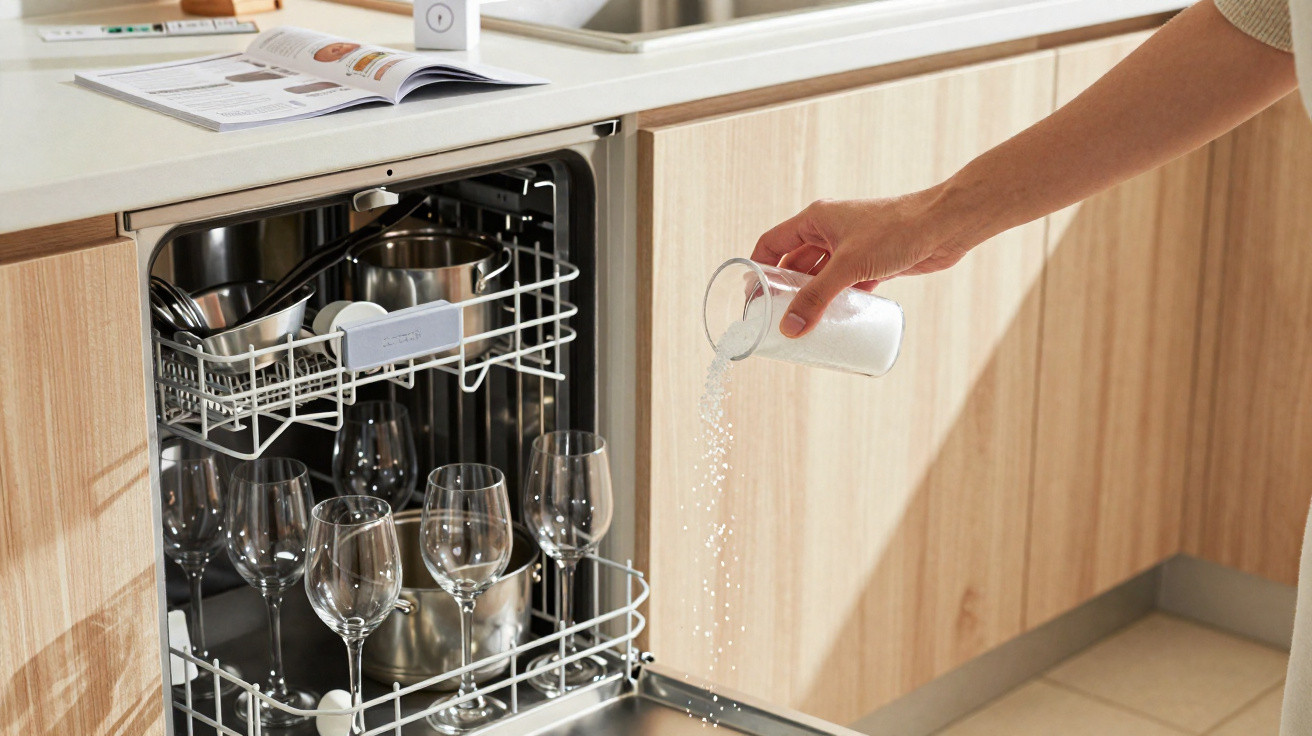
Sunday morning begins innocently enough: coffee, unloading the dishwasher – then, suddenly, the glasses gleam as though they have come straight from an advert.
The reason is neither a new appliance nor an expensive specialist tablet, but an unremarkable reach for the salt compartment. For many households, one small change in use delivers a striking result: less limescale, more shine and fewer frustrations with cloudy glasses. It may sound trivial, yet it has a great deal to do with physics, water hardness and an appliance that is often misunderstood.
Why dishwasher salt matters at all
Many people only notice the dishwasher salt reservoir when they move in or when its warning light starts flashing insistently. Yet this compartment quietly tackles one of the main issues in the background: hard tap water.
In most areas, tap water contains limescale. It builds up on heating elements, in pipes and, naturally, on crockery as well. The outcome is cloudy glasses, dull cutlery and white marks on plates.
Dishwasher salt enables the appliance's ion exchanger to remove limescale from the water – making shine possible in the first place.
The ion exchanger is a small resin container inside the dishwasher. It captures calcium and magnesium ions – the components that make water “hard”. To keep this resin container functioning, it must be regenerated regularly using a salt solution. This is where regenerating salt comes in.
The one change: stop treating salt as an afterthought
When it comes to salt, many people make three common mistakes:
- They top it up irregularly or only once the warning light appears.
- They pour it in quickly and immediately run a short programme.
- They use unsuitable salt or rely entirely on multitabs.
The change increasingly reported by users is almost unspectacular: they regard salt as maintenance in its own right, rather than a quick job done on the way out of the kitchen.
Step by step: how dishwasher salt changes the result
Using salt differently generally means following a routine like this:
- Switch the dishwasher off completely and allow it to cool.
- Open the salt reservoir and check its current level.
- Use dishwasher salt only, never table salt.
- Fill it slowly until the compartment is genuinely full, then remove any spilled salt granules.
- Once it is filled, wipe around the opening with a cloth.
- Then run a reasonably long programme, ideally at a high temperature.
The change is this: no longer “topping up salt quickly between two programmes”, but filling it deliberately and activating it with a full wash cycle.
This adjustment allows the salt solution to distribute more effectively through the ion exchanger, flushes away excess granules and helps the system operate cleanly. Results often appear after only one or two cycles rather than weeks: less haze, fewer spots and clearer glass.
Multitabs, rinse aid and salt: what does each one do?
Many households rely solely on tablets labelled “All-in-One”, “7-in-1” or “multifunction”. Although convenient, they do not always replace conventional regenerating salt.
| Component | Role | Typical mistake |
|---|---|---|
| Regenerating salt | Softens water via the ion exchanger. | Confusing it with table salt or not using it at all. |
| Rinse aid | Helps water run off faster so that droplets do not remain. | Using too much, leaving streaks or a bluish film. |
| Cleaning tablet/multitab | Cleans crockery and removes grease and food residue. | Assuming it completely replaces the water softener in hard-water areas. |
Dishwasher manufacturers often note in the small print that appliances in hard-water regions need additional salt even when multitabs are used. Ignoring this can later mean dull glasses and limescale-covered components.
Water hardness and why the dishwasher setting is crucial
Many dishwashers have a water-hardness setting in the menu or behind a concealed flap. This controls how intensively the ion exchanger operates and how often it regenerates with salt.
Anyone wanting to use salt differently should start by checking their household water hardness. This information is available from the local water supplier, or it can be tested with inexpensive test strips from shops.
Only when the hardness has been set correctly can salt deliver its full effect – otherwise, shiny crockery is simply a matter of chance.
If tap water falls into the “hard” or “very hard” category, a multitab alone is very rarely sufficient. It is then worth consulting the instruction manual closely. Many users discover that their dishwasher was set to medium hardness at the factory, despite very hard water coming from the tap locally.
Everyday results after changing your routine
Glasses, cutlery and pans – the visible difference
People who use the salt reservoir consistently, match it to their water hardness and follow it with a full wash cycle often report similar observations:
- Glasses look clearer and more colour-neutral, without a grey haze.
- Cutlery shines more, particularly knives and fork prongs.
- Stainless-steel pans develop fewer rainbow marks.
- White plates emerge without dull edges or spots.
There is also a less obvious side effect: after a few days, many dishwashers smell fresher because less limescale and detergent residue gathers in hoses and spray arms.
Dishwasher lifespan and energy consumption
Limescale acts as an insulating layer on heating elements. As a result, the dishwasher requires more energy to heat the water. At the same time, seals and plastic parts wear more quickly when stubborn deposits form on them.
Using regenerating salt consistently reduces strain on the whole system. Heating elements remain clear for longer, spray arms clog less often and the interior is easier to clean. This lowers the need for aggressive specialist cleaners, which can in turn attack plastics and seals.
Common misunderstandings about dishwasher salt
“My tablets already contain salt, so that is enough”
The small “salt block” in a tablet mainly affects the pH value and dissolves limescale from the wash water. However, it does not replace the ion exchanger. That component needs its own salt solution in the reservoir to work.
“Salt in the compartment makes crockery salty or stained”
Marks appearing after a top-up usually result from spilled salt collecting in the door seal or around the tub edge. Rinsing the compartment with a little water after filling it, or wiping the surrounding area, prevents these granule traces.
When used correctly, salt does not reach the crockery directly; it remains within the closed cycle of the ion exchanger.
“Table salt is much cheaper, so surely that works too”
Household salt may contain anti-caking agents, iodine or fluoride. Such additives can damage the ion exchanger or leave residues behind. Special dishwasher salts consist almost entirely of coarse sodium chloride and dissolve in a more controlled way.
Risks and limits of the dishwasher salt trick
Overfilling the salt reservoir or constantly adding more will not automatically produce extra shine. An excessively high regeneration setting may lead to water in the appliance that seems slightly salty, which can put stress on components. There is only one solution: follow the manual and do not turn the hardness setting up to maximum “just in case”.
In areas with very soft water, extra salt offers little additional benefit. A low setting is sufficient for many appliances there – and incorrect use may even cause streaking because the water becomes too aggressive.
Practical everyday examples
Consider a realistic situation: a four-person household with hard water and a dishwasher that is ten years old. Its glasses have been cloudy for years, with some already permanently etched. Before investing in new glasses, it is worth trying a month of adjusted salt use:
- Check the water hardness and set it on the appliance.
- Fill the salt reservoir thoroughly and clear away any spillage.
- Run a dishwasher cleaner through the machine once.
- Afterwards, use tablets + salt as normal and reduce the rinse aid slightly.
Older glasses that are permanently etched will not become like new again, but new glassware stays noticeably clearer for longer. At the same time, fewer limescale spots appear on stainless-steel sinks and cutlery.
In another household with medium water hardness, it was enough to reserve multitabs for heavily soiled loads and otherwise dose powder, rinse aid and salt separately. This gave greater control over each component and therefore visibly better results.
Frequently confusing terms, briefly explained
In this context, “regeneration” means that the ion exchanger releases the limescale ions it has absorbed into the concentrated salt solution, leaving it “free” again to treat fresh hard water.
“Ion-exchange resin” describes the small plastic beads in the dishwasher's water-softener block. They bind certain ions from the water – chiefly calcium and magnesium in domestic settings.
“Water hardness” measures the concentration of these minerals. The higher the value, the more readily limescale deposits form – in kettles, on shower screens and, of course, in the dishwasher.
Combining salt with other measures
Once you have started with the salt reservoir, other adjustments can be tested. Using slightly less rinse aid prevents iridescent films on glasses. Switching from short programmes to standard-length wash cycles gives detergents and salt enough time to do their jobs properly.
Together, these measures create an effect that surprises many people: the dishwasher seems younger, while the crockery appears, intriguingly, newer than before. This is not because anything magical has happened to the glasses, but because the water is once again working as the manufacturer originally intended.

















Comments
No comments yet. Be the first to comment!
Leave a Comment