Golden lasagne, fizzing around the edges, with cheese browned as though it belongs on the cover of a food magazine. Then came the smell: an acrid, bitter whiff from one side. Beneath the crisp topping, that section was blackened. Not pleasantly charred, simply spoiled. It was the same recipe, the same dish and the same oven setting as before, yet the outcome was completely different.
Ask other home cooks and the tale will be familiar. One half of the roast potatoes turns wonderfully crunchy while the other remains pale. A cake rises beautifully on the left but collapses into a gloomy hollow on the right. You have followed every instruction precisely, but your oven appears to be following a plan of its own.
Professional chefs deal with this problem every day, usually without making a fuss. Their ovens can run too hot, too cool or somewhere between the two. Many of them rely on one simple preheating method to settle hot spots before they ruin a meal.
Why your “200°C” oven does not actually cook at 200°C
Walk into a hectic restaurant kitchen and you will spot chefs opening oven doors, shifting trays and turning tins without even glancing at the controls. It is not theatre. They are responding to a reality that home cooks do not discuss often enough: no oven, including a costly one, heats with perfect consistency.
Every oven has its own character. One may throw out fierce heat from the rear, while another is hottest beside the fan. The highest shelf may behave like a grill and the lowest one more like a slow cooker. Selecting 200°C therefore creates a landscape of tiny climates rather than one uniform temperature. Some areas can be 15–25°C hotter, while others trail behind. Recipes rarely mention this.
A UK consumer test in 2023 saw technicians position thermometers throughout standard mid-range ovens. The results varied dramatically: one corner reached 228°C, while the opposing corner stayed near 185°C. It was the same oven, at the same moment, on the same setting. A very different situation for your lasagne. The dial may show 200°C, but the tray experiences chaos.
This difference between the selected setting and the real temperature is where much of the frustration begins. One batch of biscuits turns out perfectly, then the next batch, cooked on another shelf, emerges burnt on one side and underbaked on the other. A fan oven can improve matters, but it is not a cure-all. Air still circulates, strikes surfaces, ricochets around the cavity and forms warmer zones. Put food directly into that erratic environment and the most exposed areas suffer first.
The oven preheating trick chefs use to settle hot spots
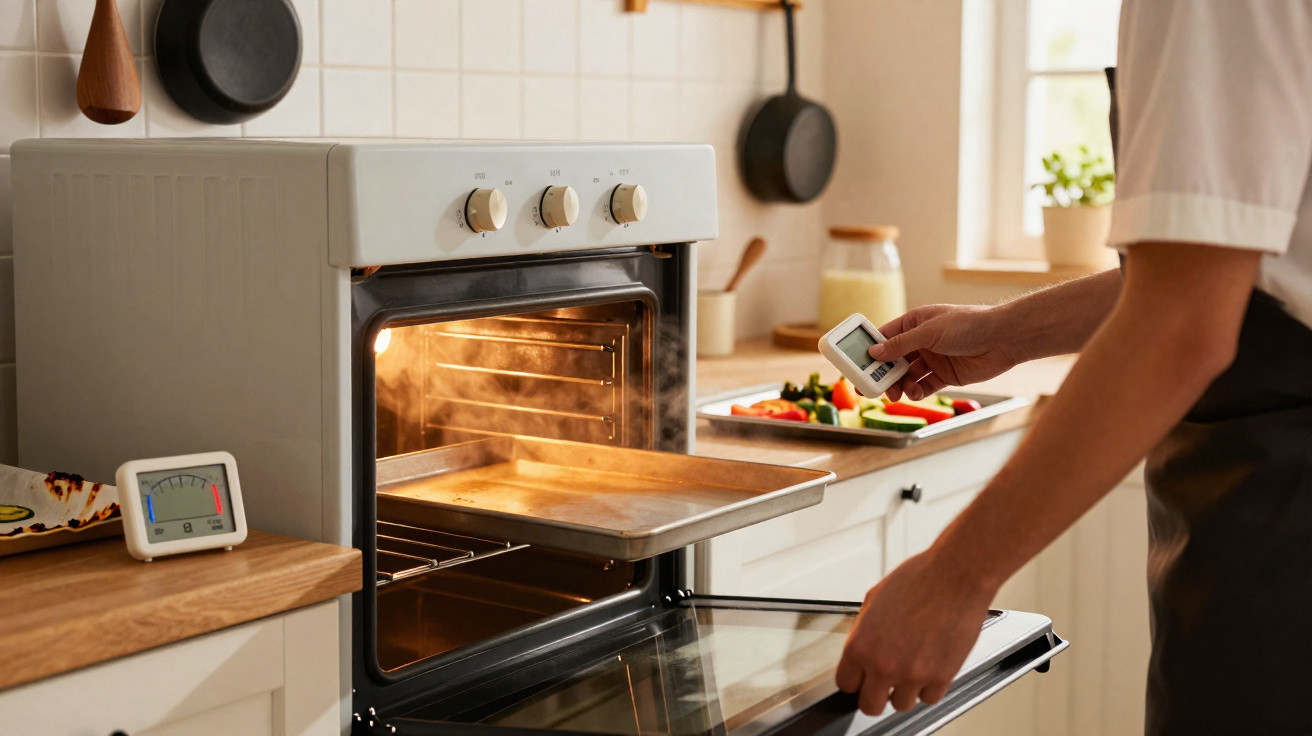
This is the technique many chefs wish more home cooks knew: heat the baking surface as well as the oven. Put a weighty tray, baking steel or substantial baking stone inside as the oven warms, then leave it there for at least 15–20 minutes after the light indicates “ready”. The purpose is not merely heat, but consistency.
That heavy, heated surface works as a heat battery. Placing a tin or dish on top gives its base immediate, evenly distributed contact heat, helping to protect it from fierce pockets at the sides or back. It smooths out the oven’s temperature swings. The back-right corner is no longer dramatically harsher than the centre, and food has a better chance of cooking evenly.
On an ordinary weekday evening, this may feel like an unnecessary extra task. You are worn out and hungry, and more steps before dinner are hardly appealing. Let’s be honest: nobody genuinely does this every day. Yet on occasions that count – a roast promised to friends, a birthday cake or a tray of vegetables you would prefer not to taste like charcoal – this one practice can transform the result.
One London chef put it this way: “We treat the oven floor or stone as our true heat source, not the air.” The routine itself is straightforward. They preheat a thick tray on the middle shelf and bake everything straight on it, regardless of the dish: roast chicken, sourdough, brownies and even frozen chips. The heated tray creates a levelling effect, making the heat food encounters more predictable than the circulating air temperature.
Home bakers who have used a pizza stone or baking steel often find that their bread rises more effectively and develops a more even colour. The same principle is at work here. What may be less apparent is the extent to which it benefits almost everything else. Root vegetables can caramelise without one edge burning before the rest. Fish fillets cook through before their thinner ends dry out. The weighty surface quietly manages the oven’s most troublesome hot spots.
“We get fewer disasters when we give the oven time to become one solid pocket of heat, not a patchwork of hot and cold,” says chef Emma Lewis, who runs a small bistro in Brighton.
“If you only wait until the little light clicks off, you’ve just hit the starting line. The oven walls, the racks, the heavy tray – they’re all still catching up. Another 15 minutes makes the difference between gambling and cooking.”
Many people miss out the additional wait, then blame themselves when their food burns. That is the understated disappointment of weekday cooking: you assume your skills are at fault when your oven is really misleading you. If using a thick tray or stone, place it on the middle or lower-middle shelf before switching on the oven. Keep it inside throughout preheating. For baking, allow a full 20 minutes after the “ready” beep; for roasting, give it at least 10 minutes.
- Choose a heavy, dark metal tray, pizza stone or baking steel as a “heat battery”.
- Put it into a cold oven and preheat it there.
- Wait beyond the indicator light, allowing an extra 10–20 minutes.
- Set dishes directly on the preheated surface every time.
- For persistent hot spots, turn the tray halfway through the cooking time.
Living with an unpredictable oven – and learning to work with it
Once preheating becomes something you do for your oven’s temperament rather than simply for the number on its dial, your approach changes. You no longer expect laboratory-like precision from a metal box beneath your hob that is flung open ten times a week. Instead, you work with its oddities rather than being caught out by them.
The next time you cook, look for recurring patterns. Perhaps the back-left corner browns cheese more quickly, the upper shelf cooks faster than the middle one, or one side of every tray colours first. These signs are valuable. Pair them with a preheated “heat battery” and you gain practical choices: keep delicate bakes on the gentler side, put robust roasts in the more energetic areas and allow the heavy tray to balance the remainder.
At a more personal level, this modest routine can alter how you feel about cooking in your own kitchen. You are not simply at the mercy of an enigmatic appliance; you are setting the conditions. You may still burn the occasional carrot or biscuit, as everyone does. We have all had that moment when we open the oven door with a little hope… and a lot of doubt. But when something fails, you now have a way to investigate: was the tray fully heated? Did I put in too much at once? Did I turn it halfway through? It becomes a conversation rather than a defeat.
This is the quiet satisfaction chefs understand but seldom spell out. They do not “trust” the oven. They test it, control it and give it the time and equipment required to behave. A heavy tray or stone, properly preheated, is one such piece of equipment. It is inexpensive, needs no degree in thermodynamics and can prevent hot spots from turning dinner into a guessing game. When the oven light clicks off next time, you can choose whether that is the starting line or merely the warm-up lap.
| Key point | Detail | Benefit for the reader |
|---|---|---|
| Preheat the baking surface | Leave a heavy tray, stone or steel to heat for 10–20 minutes after the “ready” signal | Reduces burnt patches and uneven cooking |
| Stabilise the oven’s internal heat | Allow the walls, racks and accessories time to reach an even temperature | Delivers more predictable results for delicate recipes |
| Watch for hot spots | Identify where the oven browns or cooks faster, then position dishes accordingly | Lets you tailor each cook to your own oven without changing recipes |











Comments
No comments yet. Be the first to comment!
Leave a Comment