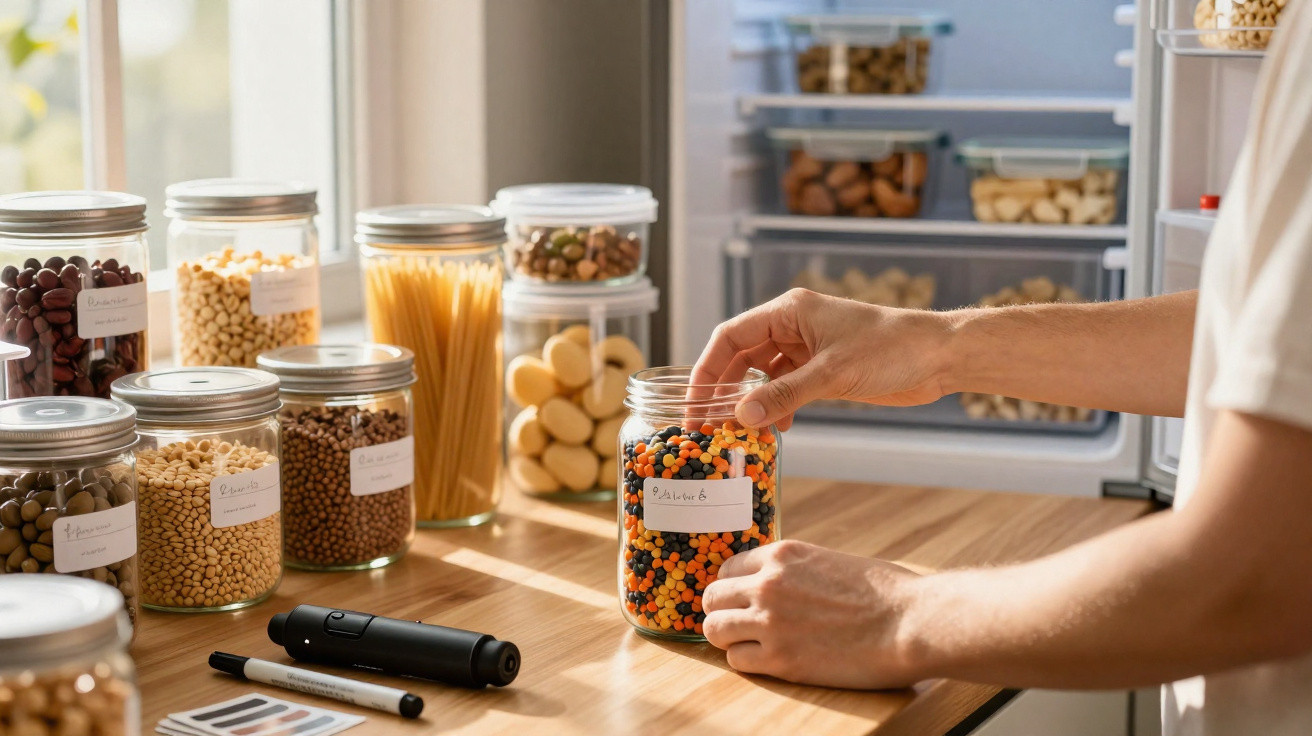
The refrigerator light has a particular way of making you feel guilty.
You open the door for a quick bite and spot it: an unidentified container pushed to the back, clouded with condensation. You lift the lid, smell it, pause, then do what you knew you would do all along. Into the bin it goes, with a flat, remorseful thump.
The most frustrating part is remembering that you made the dish with the best intentions, using fresh herbs that certainly were not cheap. The only thing it lacked was a four-second step: a label.
Some kitchens steadily waste time and money. Others rely on small, barely noticeable routines. Often, the difference begins with a marker and a strip of tape.
Why clear kitchen labels transform the atmosphere
Enter a kitchen where each container carries a plain, easy-to-read label and it feels different straight away. Rather than searching, you choose. When you open the fridge, your options are visible: “Curry – Tue,” “Roasted veg,” “Pasta sauce – freezer.” It may sound minor, even slightly obsessive, until you realise what has disappeared: uncertainty, sniffing at food, and the unspoken debate about whether that rice is from last week or last month.
A labelled shelf gives the impression that someone has planned ahead for you. Leftovers suddenly become less like a punishment and more like a shortcut for hectic evenings.
My friend Maria began labelling containers after an alarming grocery-bill moment. For one week, she quietly tracked what she threw away and discovered that she was binning roughly three complete meals’ worth of food. Not unused ingredients, but meals she had actually prepared. There were partly eaten stews that had faded grey at the edges of her memory, along with carefully chopped fruit that had simply… ended up behind the yoghurt.
She bought an inexpensive roll of masking tape and a black marker, then made one rule: every container needed a two-word label and a date. Within a month, her bin had changed. There was more packaging and less food. Her freezer ceased to be a graveyard and became a menu.
Labelling succeeds because it makes decisions easier. Instead of peering at a container and asking, “What is this?” and “Can I still eat it?”, your brain receives two useful facts: what it contains and when it was made. Once you have that, planning becomes possible. You see “Chili – Thu” and immediately know it is tonight’s dinner or tomorrow’s lunch, rather than a biohazard experiment.
There is a quiet psychological change, too. A dated label shows that food has a lifespan rather than an endless pause button. That small prompt encourages you to use older food first, cook with what is already there, and value what cost you both time and money.
Simple food-labelling habits that last
The most effective approach is not elaborate; it is easy to repeat. Keep a single pen and a single roll of tape in one convenient, permanent place. Do not hide them in a drawer beneath three whisks or leave them in the office; keep them beside the containers or the fridge. The rule is simple: no food goes into the fridge or freezer without a label. It takes five seconds at most.
Include three details:
- What it is
- Whether it is cooked or raw
- The date
For example: “Chicken – cooked – 10/03,” “Rice – 10/02,” “Veg stock – freezer – 09/30.” Untidy, brief handwriting does the job perfectly well. This is about practicality, not creating a Pinterest board.
Many people abandon the habit because they try to make it flawless. They purchase a label maker, decorative chalk pens and bespoke jars, then give up as soon as a pen runs dry. Realistically, nobody keeps up a system every day when it feels too precious.
The answer is forgiving, effortless labelling. Use masking tape that tears easily and a chunky marker that is legible at a glance. If you miss a label once, you have not “failed”; write on the lid with a dry-erase marker, or add tape to the side when you next open the container. We all know that moment when you assure yourself you will remember what is inside an unlabelled tub. You will not. That is fine-that is exactly why the label is there.
Sometimes I eat better on my busiest weeks just because my containers are labeled. The decision is already made for me when I open the fridge, and it keeps me from ordering in out of pure confusion.
- Use one labelling spot – Keep the tape and marker beside the containers or fridge rather than spreading them around.
- Keep labels brief – Write the name and date, not poetry. Your future self has three seconds to read it.
- Follow a “first to expire, first to eat” rule – Give the oldest labelled item priority at the next meal.
- Colour-code if you like – Use one colour for freezer food, another for ready-to-eat items, and another for ingredients.
- Label during clean-up – Put labels on as leftovers are stored. It is one small ritual with no drama.
From labelled tubs to calmer kitchen days
After you begin, something interesting happens. You do not only label containers; you start recognising patterns in your own life. You see which meals always create leftovers, which ingredients slowly and quietly go to waste, and which sauces you freeze but never use. Labels become a gentle feedback loop: “You cooked too much rice again,” “You actually love that soup,” “You never use half a can of coconut milk unless it’s visible and named.”
The labels aren’t there to judge you, they’re there to tell you the story you’re already living. From that story, you can make small adjustments: prepare slightly less, schedule one leftovers night, freeze half a batch immediately, or portion out lunches in advance. It comes from clarity rather than guilt.
| Key point | Detail | Value for the reader |
|---|---|---|
| Simple labels save food | Adding contents + date to every container cuts “mystery box” waste | Fewer spoiled meals, lower grocery bills |
| Ritual beats perfection | Basic tools (tape, marker) used every time work better than elaborate systems | A habit you can actually keep on busy days |
| Labels speed decisions | Clear information makes the fridge a visible menu rather than a guessing game | Faster meal prep, less stress, more home-cooked meals eaten |
FAQ:
- Question 1 What should I write on a kitchen label to keep it useful but simple?
- Question 2 How long can labeled leftovers safely stay in the fridge?
- Question 3 Do I need special labels for the freezer, or is regular tape enough?
- Question 4 How do I start labeling without feeling overwhelmed by my current chaos?
- Question 5 Is labeling really worth it if I live alone or cook small portions?












Comments
No comments yet. Be the first to comment!
Leave a Comment