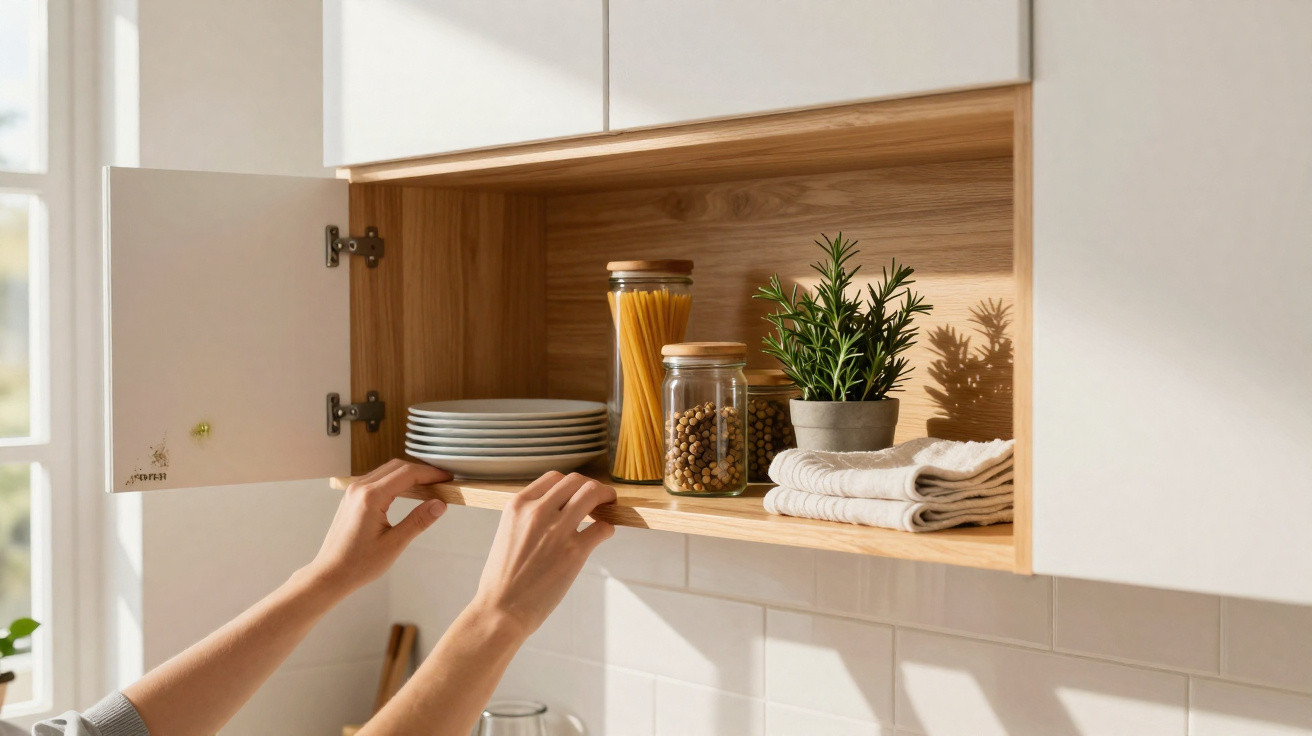
The first thing that hits you is the smell.
It is a faintly sweet combination of bloated chipboard, stale coffee and something… damp. You open a base cabinet to take out a pan and find that the back panel has swollen like an old croissant. Its formerly bright white surface is now a weary beige, while the hinges groan whenever you pull the door. This kitchen was supposedly “new” just five years ago. Already, it seems to have surrendered.
As you quietly blame steam, splashes and unexplained leaks, Instagram keeps serving up kitchens that appear immune to ageing. They are open and light-filled, with crisp lines, shelving instead of oversized boxes, and unusual yet elegantly simple frames supporting everything. There is no puffed-up MDF or mouldy plinth concealing clumps of dust. Only organisation. And brightness.
A few of those kitchens have a hidden eye-watering price tag. Yet an increasing number are more affordable. They rely on a lower-cost concept that is steadily replacing conventional cabinets. Once you notice it, those large, box-like units will never look quite the same.
Why people are quietly ditching traditional kitchen cabinets
Watch any lively family kitchen for ten minutes and the decline of classic cabinets makes sense. Doors are slammed, children hang off them, dogs investigate the kickboards, and pans are pulled out and put away as though they are part of a workout. Then there is steam from kettles and boiling pasta, plus dishwashers releasing hot air into every gap. It is a harsh environment for compressed sawdust covered with a thin veneer.
For this reason, more designers are guiding homeowners towards open storage on metal frames rather than enclosed boxes. Picture robust shelving systems, powder-coated steel frames and aluminium rails made to withstand humidity. There are no concealed gaps for water to penetrate and no laminate edges lifting like worn-out stickers. Instead, there is exposed, ventilated storage that makes no attempt to imitate flawless furniture. It is straightforward. And it lasts.
Helena, a 32-year-old living in a small Manchester terrace, discovered this first-hand. The low-cost kitchen installed before she bought the house began warping around the sink within 18 months. Behind the plinths, she noticed tiny black mould spots, along with soft areas around the pipe openings. “I hadn’t spilled a bucket of water,” she said. “I just cooked like a normal person.” Replacing the most damaged units would have cost nearly as much as a straightforward new kitchen.
A friend proposed another option: remove the base cabinets along the dampest wall and fit a heavy-duty galvanised shelving frame with deep metal drawers. On the first day, it had a slightly industrial appearance, like something from a stylish coffee shop. After two years of regular pasta dinners and endless washing-up, however, nothing has swollen, peeled or developed fuzzy patches. She wipes it down, cleans it, and it remains unchanged. The cost was around half the estimate she had received for replacement base units from a well-known brand.
The reasoning behind this trend is starkly simple. At their centre, conventional cabinets contain MDF or particleboard, which are both formed from small wood fibres, glue and pressure. Water is their enemy. A minor leak, or years of light condensation, will eventually seep into the board, causing it to expand and the bonding to fail. The coating splits, doors become misaligned, and a “10-year kitchen” quickly resembles a worn-out rental. Open metal systems do not take in moisture. Nor do they depend on concealed joints remaining watertight. Air moves around the shelves, allowing splashes to dry rapidly and depriving mould of the persistent damp it needs. At a time when renovations cost a small fortune, a less expensive system that does not simply rot is beginning to seem like common sense.
The cheaper, tougher alternative: metal frames and open storage
At the centre of this movement is one uncomplicated change: replace bulky boxes with skeletal frames. Rather than using complete carcasses with tops, sides, backs and plinths, structural metal uprights and horizontal rails form the basis. Shelves, drawer units, baskets and even worktop supports can then be clipped or bolted onto the rails. The principle is much like warehouse shelving, only slimmer, more attractive and intended for crockery rather than pallets.
This approach is not reserved for ultra-modern lofts. Plenty of homeowners retain their wall cabinets while swapping the bottom row for open metal modules in black, white or stainless steel. The worktop appears to float above the frames, with orderly rows of pans, appliances and baskets below. There are no false base panels behind which water can collect, and no tightly enclosed corners where stagnant air lingers. Should a pipe leak, you see it straight away. You address the cause rather than dealing with the damage afterwards.
Naturally, clutter is the main concern. Few people want cereal boxes and chipped mugs on display from morning until night. This is where some planning helps. Those who enjoy these kitchens almost always divide storage into two categories: “show” and “stow”. Daily plates, attractive pantry jars and cast-iron pans sit on open shelves or in wire drawers. The disorder - plastic containers, children’s snacks and that old blender you promise yourself you will use again - is concealed in one durable closed cabinet or a tall larder cupboard with doors.
In practical terms, this arrangement can reduce costs in unexpected ways. Metal frames are frequently modular, allowing you to purchase only what you require and install more shelves later. You are not tied to an inflexible sequence of boxes built for a single wall. If one shelf becomes scratched or worn, you replace that element rather than the entire unit. It is closer to building with Lego than commissioning a permanent kitchen sculpture. Anyone who has endured a complete rip-out renovation will understand the appeal of a flexible - and non-soggy - alternative.
How to make the “no cabinets” trend actually work at home
If you are considering abandoning standard cabinets, begin on a small scale. The simplest place to start is the kitchen’s wettest and most heavily used area: the space around the sink and dishwasher. Take out the lowest units nearest to leaks and splashes, then replace only that section with a metal frame or open shelving system. Where possible, retain your current worktop and have it cut so that it rests on the new structure.
Then select shelving and drawers that suit the way you genuinely live. For daily cooking, deep pull-out metal drawers for pans and lids are invaluable. If you mainly reheat food and snack, wide open shelves for appliances may be more useful. Do not copy a Pinterest image and assume it will work with your routine. Mentally follow an ordinary evening: where do you chop, boil, serve, wash and dry? That is where the strongest and easiest-to-reach storage belongs, even if it is not the most photogenic view.
There is an emotional consideration too. When you are having a difficult day, open storage can make it feel as though the kitchen is criticising you. Build in some kindness instead. Keep a “catch-all” drawer or basket beside the main preparation area, so items have somewhere to land without guilt. At eye level, place the objects that are most attractive and reassuring - the good bowls, the calming jars and the wooden board that makes you feel vaguely capable.
Let us be honest: nobody really does this every day. No one folds every tea towel perfectly or arranges spice labels in military-straight lines. What matters is a system that quickly forgives you. That could be a rail with mug hooks, a row of matching baskets concealing mismatched packaging, or simply one closed cupboard where clutter disappears before friends come round.
People who have used this arrangement for some time tend to make the same observation:
“Once the lower cabinets were gone, I could finally see what was going on in my own kitchen – the leaks, the dust, the clutter – and deal with it before it became a disaster.”
To maintain that feeling of control, several straightforward rules make a real difference:
- Restrict open shelves to items you use each week, rather than things used once a year.
- Arrange belongings by purpose: one shelf for baking, another for everyday plates and another for pans.
- Pick finishes that can be wiped clean without excessive care - matt metal, sealed wood or stainless steel.
- Put a removable tray beneath the sink to protect items if leaks return.
- Maintain one “secret” storage area with doors, so the kitchen does not feel like a showroom.
The quiet revolution under your worktop
Enter a kitchen packed with heavy cabinet blocks, then walk into one organised around slim metal frames. The contrast is not merely visual. Usually, the latter sounds different as well: less creaking, fewer doors banging, and more clinking plates accompanied by a gentle hum of activity. It resembles a workshop more than a showroom, which many people find unexpectedly reassuring.
This change reveals much about the direction of home design. Rather than pursuing an immaculate kitchen that remains untouched, people are recognising that these rooms are busy, demanding and untidy. They want materials that reflect that reality: surfaces that can be wiped, knocked and splashed while still looking good. They are also reluctant to spend vast sums on something that relies on staying completely dry in the one room where that is rarely possible.
A more profound shift sits behind the steel and open shelving. Visible storage subtly changes daily behaviour. You buy fewer duplicate gadgets because you can see what you already own. You are more inclined to transfer pasta into a jar when the packet looks chaotic on the shelf. Most importantly, you notice a small drip from the trap beneath the sink before it can turn a £50 leak into a £1,500 cabinet replacement.
On a personal level, it is about honesty as well. We have all experienced the moment when someone looks through the kitchen door and says, “Oh, it’s lovely here”, while you know perfectly well that a particular cupboard must never be opened. The “goodbye cabinets” trend will not magically organise your life. It merely makes concealment slightly more difficult and looking after your space slightly easier. Somewhere between those two realities, a more relaxed kind of kitchen begins to take shape.
| Key point | Detail | Why it matters to the reader |
|---|---|---|
| Metal frames vs. cabinets | Use steel or aluminium structures instead of full carcasses | Cheaper upfront, far more resistant to warping and mould |
| Open + closed mix | Combine visible shelves with at least one closed pantry zone | Allows practicality and privacy, without feeling on display |
| Start with the wet zone | Replace units around sink and dishwasher first | Targets the area most likely to rot and saves money on a full refit |












Comments
No comments yet. Be the first to comment!
Leave a Comment