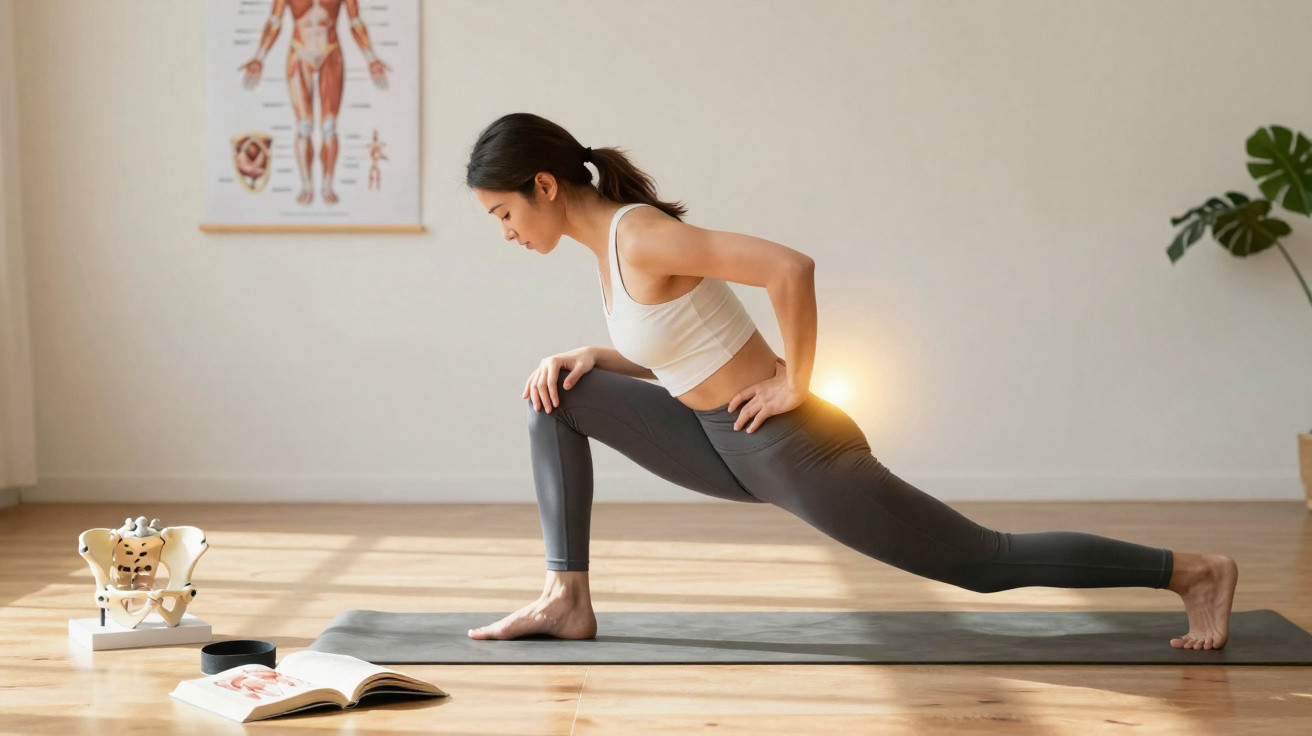
The hip joint is a complex, sophisticated and highly relevant joint to understand when teaching any form of movement.
From my experience of teaching group Yoga classes with rapid transitions, it is not always possible to educate students fully. Common cues include: “lift out of the hip”, “don’t collapse in the lower back”, “tuck your tail bone in”, “draw your belly button to your spine”.
However, what do these instructions really mean? This is particularly important for Yoga teachers. Which warning signs might you be overlooking, and how can you develop your anatomical knowledge, verbal cues and hands-on adjustments?
A recap of hip joint anatomy
The hip bones link the lower limbs of the axial skeleton with the appendicular skeleton.
The pelvis is made up of 4 bones
- The right and left hip bones
- The ilium (upper portion)
- The ischium (back portion)
- The pubis (front portion)
By adulthood, these bones have fused together.
The sacrum and coccyx, commonly called the tail bone, also make up part of the pelvis.
What is a joint?
A joint is formed where two or more parts of the skeleton meet. Joints are designed to permit varying types and degrees of movement.
Each joint has two roles: mobility and stability. Joints are classified according to these elements.
The hip joint is freely movable, so it is classed as a synovial joint. It is further categorised as a ball and socket joint.
Features of synovial joints include
- Articular (hyaline) cartilage that covers the ends of the bones forming the joint
- A joint cavity lubricated by synovial fluid (think of Q20).
- Strengthening or reinforcement through collateral or accessory ligaments.
- Cushioning supplied by a fluid-filled sac called a bursa
- Tendon sheaths that offer protection by surrounding tendons exposed to friction.
A ball and socket joint has a ‘ball’, created by the head of one of the bones, which moves within the ‘socket’ of another bone. These joints offer the greatest range of motion, allowing flexion, extension, adduction, abduction, circumduction and rotation. The shoulder is another example of a ball and socket joint.
In comparison, the shoulder is generally more mobile and less stable, while the hip is more stable and less mobile. Joint integrity describes a balance of mobility and stability.
Think of the hips as structures that keep the body stable and balanced.
The Sacroiliac (SI) joint
The Sacroiliac joint is the point where the sacrum meets the pelvis, at the iliac crest.
Characteristics of the SI Joint
- Small and extremely strong, with reinforcement from strong surrounding ligaments
- Very limited movement
- Transfers force from the upper body into the pelvis and legs
- Functions as a shock-absorbing structure
The sacral area of the spine can become irritated easily, particularly in advanced Yoga postures such as deep forward folds, strong twists, wide-legged straddles and even backbends.
Muscles of the hip
Hip muscles travel from the pelvis to the thigh bone, or femur, and can extend beyond the knee joint. The larger muscles create the shape of the thigh, such as well-defined quadriceps. Most of these muscles carry out more than one action at the hip.
Muscles are grouped by the movement they produce at the hip, for example flexors, extensors and adductors.
Main hip flexors
Rectus femoris – part of the quadriceps group and used in most standing asanas. Standing balances, warrior, tree and boat pose are examples of strengthening postures. Bow pose, both legs during backbends, and the back leg in warrior poses and crescent lunge are stretching asanas.
Sartorius – known as the body’s longest strap muscle. It is also active in standing postures, as with rectus femoris. Due to its length and its insertion at the tibia, it is used in seated postures including easy pose and lotus. Reclined hero pose stretches this muscle.
Iliopsoas – comprising the psoas major, iliacus and psoas minor. Standing hand to big toe posture strengthens this group. To stretch these muscles, try half bridge pose. The psoas is a stabiliser.
Main hip abductors
Tensor fasciae latae – located in front of the gluteus maximus on the lateral side of the hip. Any variation of gate pose strengthens this muscle. It is active in most standing asanas and wide-legged forward folds. The front leg in pigeon pose stretches the TFL.
Gluteus medius – an often overlooked muscle hidden by the gluteus maximus.
Gluteus minimus – located even deeper than the gluteus maximus is the gluteus minimus.
To strengthen the glutes, practise gate pose and “jane fonda” variations. To stretch them, explore the sensations in supine spinal twist variations.
Main hip extensors
Gluteus maximus – one of the body’s heaviest muscles. Warrior postures, bridge pose, full wheel, camel, locust and cobra all strengthen the glute max. Supine twists, happy baby and child’s pose are stretching options.
Hamstrings – these are often overstretched in Yoga sequencing and are an essential muscle group to warm up correctly. Bow pose strengthens the hamstrings. Stretching options include forward folds with straight knees, plough pose and downward facing dog.
Main hip adductors
Adductor magnus, brevis, longus – collectively, these muscles adduct and laterally rotate the hip. Any standing posture that uses the adductors as stabilisers will strengthen this group, for example intense side stretch. Bound angle pose and happy baby encourage stretching.
Gracilis – a slender muscle that runs along the inner thigh. The same postures used for adductor magnus, brevis and longus will strengthen and stretch it.
Pectineus – a small muscle positioned between the psoas major and adductor longus. It is also strengthened in pyramid pose and in any standing pose where the adductors stabilise. Bound angle pose, happy baby, and any wide-legged standing or seated poses stretch the pectineus.
Deep hip outward rotator
Piriformis – the largest of the six outward rotators. It can often be responsible for impingement of the sciatic nerve.
Quadratus femoris – positioned very close to the sit bones.
Asanas that strengthen the deep hip outward rotators include half moon pose, goddess pose, lotus, bound angle pose and tree. Seated twist variations and pigeon pose are ideal for stretching this muscle group.
Hip inward rotator
Gluteus medius & minimus
Tensor fasciae latae
Semitendinosus, semimembranosus – Muscles of the quadriceps
Pectineus
Gracilis
All these muscles have other primary actions that have already been discussed. Inward rotators can be strengthened through reclined hero pose and standing forward folds. Goddess pose, lotus and bound angle pose can be used as stretching applications.
What do we understand energetically about the hip joint?
As Yoga teachers, we recognise that the hips hold a great deal of emotional tension. The first two chakras sit in the lower hip region. Muladhara, or the root chakra, is at the base of the spine. When it is in harmony, we feel safe, secure and grounded. The second chakra is situated in the lower pelvic-floor area. Svadhisitana, or the sacral chakra, is associated with sexuality, desire, pleasure and procreation. If you struggle to let go and allow things to flow, you may have noticed resistance in deep hip-opening postures.
Fear about the future and avoidance of past issues are said to be held in the back of the hips. Tight psoas and hip flexors can suggest hesitation about facing the future. If the glutes will not release, this could reflect unresolved past issues.
It is no surprise that the hips are also connected with romantic relationships.
For women who have recently given birth, the hip area may need considerable time to recover. The hormone relaxin, natural birth or caesarean birth all contribute to physical and energetic changes in a woman’s body.
The psoas muscle is also directly connected to the body’s natural fight-or-flight response. Immediate or prolonged trauma causes this muscle to tighten, which can disrupt both the physical and emotional bodies.
Bringing hip joint knowledge together in Yoga
For many students, Yoga is solely a physical practice. Others arrive with intention and awareness of deeper energetic principles. Teachers rarely have sufficient time with students to identify every alignment issue.
Stay aware of anatomical principles and of which muscles work in particular postures. This will give you a clearer understanding of what you are strengthening and what you are stretching. Remember that no two bodies are the same, physically or emotionally.
On some days, the hips are accommodating; on others, they are resistant. This may relate to other training modalities or simply a bad day at the office.
Sequence your postures thoughtfully, offer modifications and props wherever possible, and above all, be gentle when using hands-on adjustments.
Visit my online courses to register for the Fundamentals of Anatomy – Hip Joint module.










Comments
No comments yet. Be the first to comment!
Leave a Comment