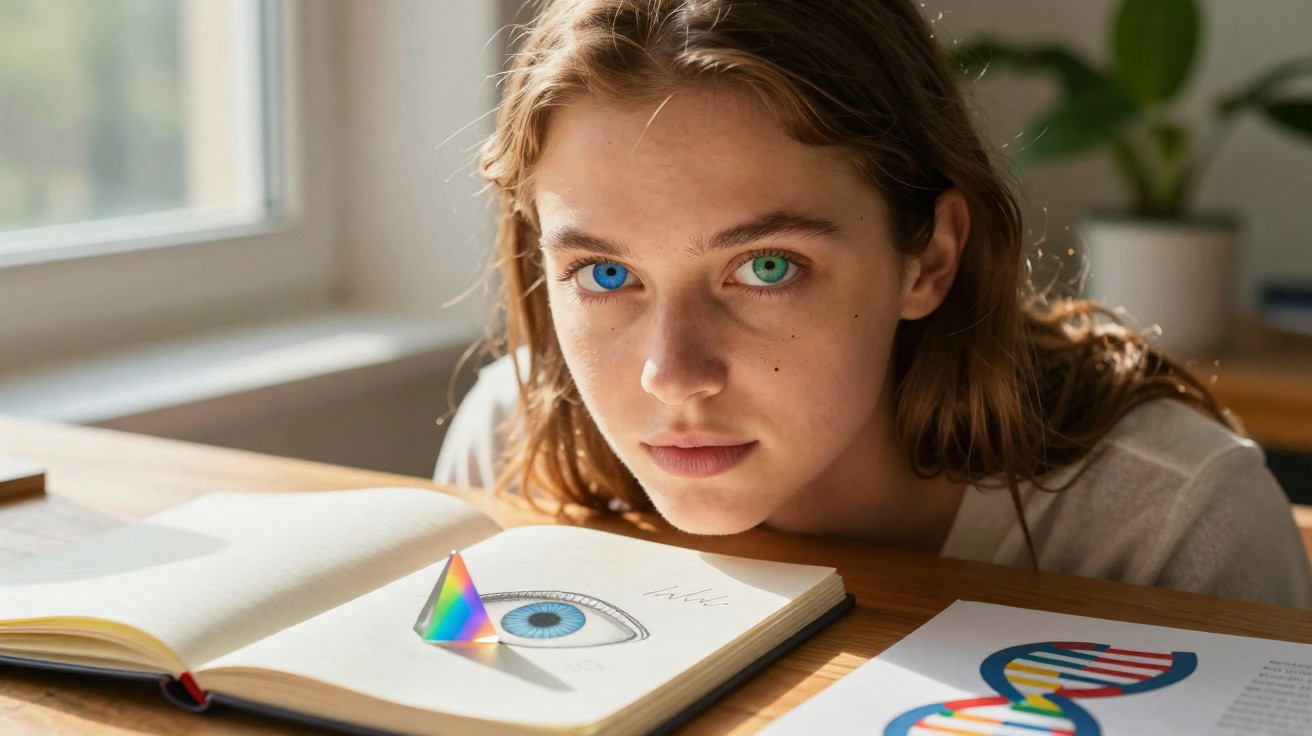
When you meet someone for the first time, their eyes may immediately draw your gaze. Perhaps they are a deep, earthy brown, a light blue, or an uncommon green that seems to alter with each change in the light.
Eyes can captivate us, prompting familiarity or curiosity before either person says a word. They are frequently the first feature we register in another person and, at times, the one that remains most memorable.
Human eye colours form a broad spectrum around the world. Brown is overwhelmingly the most widespread colour, particularly across Africa and Asia, whereas blue eyes occur most commonly in northern and eastern Europe.
Green is the least common eye colour, occurring in only around 2% of people worldwide.
Hazel eyes bring further variation, often seeming to move between brown and green according to the lighting.
What, then, causes these variations?
Melanin and eye colour
The explanation lies in the iris, the coloured tissue forming the ring around the pupil. A pigment known as melanin is largely responsible.
Brown eyes have a high melanin concentration, which absorbs light and produces their darker look. Blue eyes, by contrast, have very little melanin. Their colour is not created by pigment; instead, it comes from light scattering inside the iris. This physical process, called the Tyndall effect, is similar to the phenomenon that makes the sky appear blue.
Within blue eyes, shorter light wavelengths, including blue, scatter more efficiently than longer wavelengths such as red or yellow. Because little melanin is present, less light is absorbed, so the scattered blue light becomes the dominant colour we see. The blue appearance therefore arises from the interaction between light and the eye’s structure, rather than from a blue pigment.
Green eyes are produced by a middle ground: a moderate level of melanin combined with light scattering. Hazel eyes are more complicated again. Melanin is distributed unevenly through the iris, creating a patchwork of colour that may look different under varying ambient light.
How genes shape eye colour
The genetics behind eye colour are equally intriguing.
Scientists once thought inheritance followed a straightforward “brown beats blue” pattern governed by one gene. Current research shows that it is far more complicated than that.
Numerous genes play a part in establishing eye colour. This is why siblings can have strikingly different eye colours, and why two blue-eyed parents may occasionally have a child with green or even light brown eyes.
Eye colour can change as well. Many babies with European ancestry are born with blue or grey eyes because they have not yet developed much melanin. As pigment slowly accumulates during the first years of life, blue eyes can become green or brown.
Eye colour is generally steadier in adulthood, although its appearance can vary slightly with lighting, clothing and pupil size. Blue-grey eyes, for instance, may seem strongly blue, distinctly grey, or faintly green depending on the surrounding light.
Lasting changes are less frequent, but they may happen with age or as a result of certain health conditions that alter melanin in the iris.
Unusual eye colour features
There are also some genuinely unusual cases.
Heterochromia occurs when each eye is a different colour, or when a single iris has two clearly separate colours. Although uncommon, it is visually distinctive. It may be inherited, caused by an injury, or associated with particular health conditions.
Celebrities including Kate Bosworth and Mila Kunis are familiar examples. David Bowie’s eyes seemed to be different colours because an accident left him with one permanently dilated pupil, creating the appearance of heterochromia.
Ultimately, eye colour is not merely an outcome of genetics and physics. It illustrates the way biology and beauty meet. Every iris resembles a small universe: circles of pigment, golden specks, or rich brown pools that reflect light differently on every look.
Our eyes do more than enable us to see the world; they help us form connections with each other.
Blue, green, brown or somewhere between the three, every pair tells a completely individual story of ancestry, individuality and the subtle wonder of being human.
Davinia Beaver, Postdoctoral research fellow, Clem Jones Centre for Regenerative Medicine, Bond University
This article is republished from The Conversation under a Creative Commons licence. Read the original article.

















Comments
No comments yet. Be the first to comment!
Leave a Comment