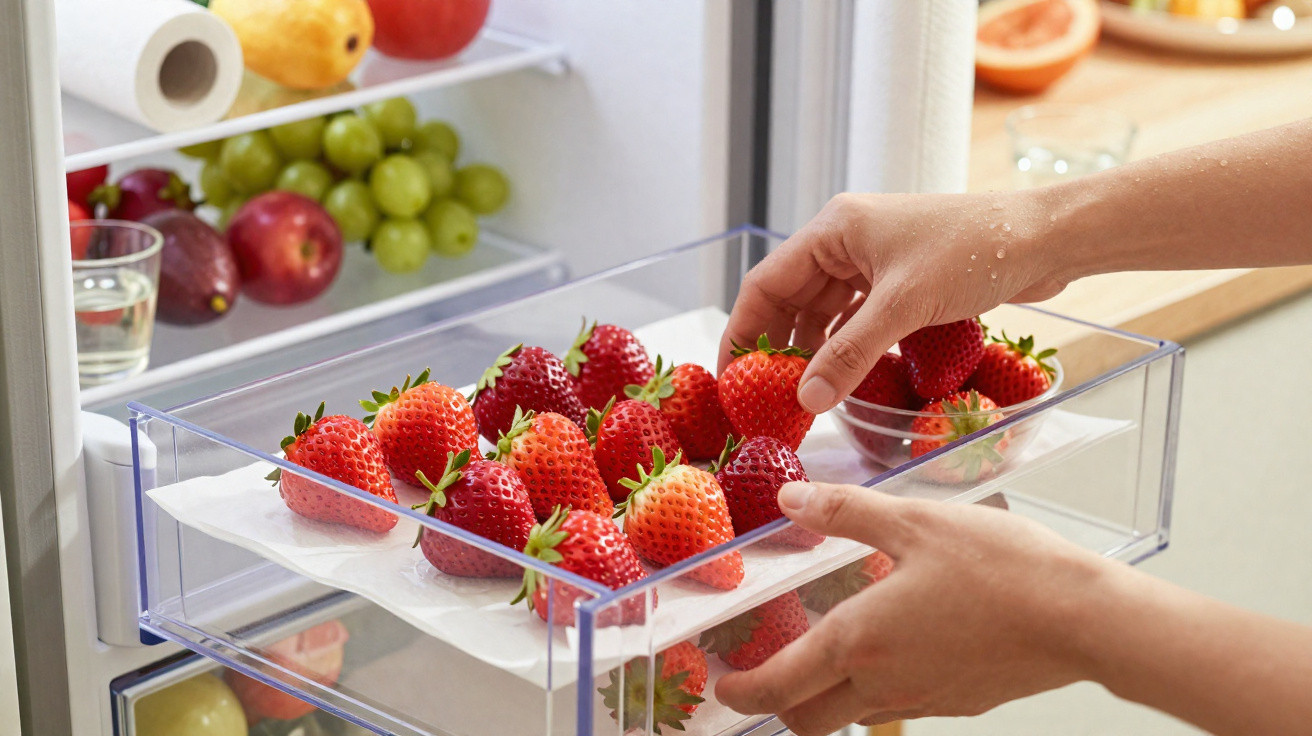
A tiny adjustment in the fridge can make a remarkable difference.
Most people know the situation: a punnet of strawberries from the supermarket looks flawless, yet after just a few days in the fridge, soft patches appear, followed by mould. Rather than being enjoyed, half the fruit ends up in the bin. A straightforward trick using an everyday household item can extend their fridge life to seven days or more – with no specialist container or high-tech solution required.
Why strawberries go mouldy so quickly
Strawberries are among the most delicate fruits on the produce aisle. Water accounts for around 90 per cent of their weight. This is what makes them juicy, but it also leaves them exceptionally vulnerable.
Unlike apples, their skin is not smooth: it is slightly porous, almost resembling a fine sponge. Moisture becomes trapped in this texture, and that moisture provides ideal conditions for mould to grow.
The main culprit is a fungus called Botrytis cinerea, more commonly known as grey mould. It thrives on two things: warmth and high humidity. Refrigeration slows the process, but does not stop it completely. The fungus can remain active even at 0°C.
“Moisture determines whether strawberries last two or seven days – not temperature alone.”
Packaging can make matters worse. Strawberries are usually sold in shallow plastic punnets with very little ventilation. After shopping, condensation can quickly form inside, especially when fruit that has been warm outdoors is moved into a cold fridge. This moisture collects unnoticed at the bottom of the punnet, precisely where the lowest berries are resting. Everything may still look fine from the outside, while spoilage has already begun underneath.
The simple kitchen towel trick for strawberries
The good news is that this miniature climate at the bottom of the punnet can be tackled with something found in almost every kitchen: ordinary kitchen towel.
The principle is simple. As mould needs moisture, the aim is to remove as much of it as possible. Kitchen towel absorbs condensation like a sponge, creating a dry buffer layer between the plastic and the fruit.
How to use the method properly
- Place one layer of kitchen towel on the base of the punnet or a shallow container.
- Arrange the strawberries in a single layer on top, avoiding stacking them where possible.
- If the container is taller, you can optionally place another layer of kitchen towel over the top.
- Close the container loosely and keep it in the fridge at 0–4°C.
- Check the kitchen towel every one to two days and replace it if it is visibly damp.
The towel catches the moisture produced before it can gather beneath the fruit. As a result, the berries stay noticeably firmer. Many households report that, rather than lasting around three or only two to three days, their strawberries can look and taste good for up to a week using this approach.
“A soaked kitchen towel no longer helps – it then becomes a source of moisture itself. Replacing it in time makes all the difference.”
Common mistakes that ruin strawberries
Washing strawberries too early
It is tempting to rinse strawberries under running water as soon as they are bought, then put them in the fridge. However, this greatly reduces how long they keep. Every wash adds extra moisture to their delicate surface.
Tests show that unwashed strawberries kept dry on kitchen towel in the fridge last, on average, several days longer than fruit stored immediately after rinsing.
The rule of thumb is therefore clear: wash them only just before eating, not beforehand.
The wrong neighbours in the fridge
Other fruits stored nearby are another commonly overlooked factor. Apples and bananas in particular release ethylene, a ripening gas. It significantly speeds up ripening in delicate fruits such as strawberries.
A bunch of bananas placed right beside a punnet of strawberries can shorten their fridge life by several days. Ideally, give them their own compartment or at least keep them away from fruit that releases high levels of ethylene.
Removing the leafy tops too soon
The green top of a strawberry does more than improve its appearance. It acts as a small cover that protects the exposed area at the top of the fruit. Removing the hulls immediately after shopping opens the berries up to air, bacteria and fungi.
It is better to remove the green tops only shortly before serving or using the fruit, rather than when putting it away.
The vinegar-bath hygiene method
Many people want to clean berries thoroughly, for example because of germs or residues. Anyone unwilling to skip this step can use a particular method that supports both cleanliness and a longer shelf life.
In a bowl, mix water and household vinegar at a ratio of one part vinegar to three parts water. Place the strawberries in the solution for around five minutes. The vinegar substantially reduces germs, including many mould spores.
| Step | What to do |
|---|---|
| 1 | Fill a bowl with 1/4 vinegar and 3/4 water |
| 2 | Carefully add the strawberries and leave them to soak for 5 minutes |
| 3 | Rinse gently, avoiding a strong stream of water |
| 4 | Leave them to dry thoroughly on kitchen towel |
| 5 | Store them in the fridge using the kitchen towel trick |
When used correctly, no noticeable vinegar flavour remains, as any excess disappears during the final rinse. In households using this method, berries often keep for up to two weeks in ideal conditions – particularly when the fridge temperature and humidity are well adjusted.
The daily 30-second check
One more small habit has a major effect: regular inspection. Just one mouldy strawberry in a punnet can be enough to infect the others in a short time.
Taking a quick look in the container once a day and consistently removing any suspect fruit stops this chain reaction. It takes only a few seconds, yet can lead to substantially less food waste.
“A mouldy strawberry acts like a source of fire – removing it early often saves the entire punnet.”
How to make strawberries from the fridge taste truly aromatic
A fridge preserves freshness but dulls flavour. Strawberries eaten straight from the cold compartment may feel firmer, but often taste less pronounced. The solution is to take them out around 20 minutes before eating and let them come up to room temperature.
During this time, their volatile flavour compounds develop more fully. The sweetness tastes more intense and the fruit seems more rounded. Anyone who has taken care to store strawberries properly should allow for this final step as well.
When specialist containers are worth it – and when they are not
Shops now sell dedicated fruit and berry containers with ventilation slots or anti-condensation bases. They can be helpful, but they are not essential. For most households, kitchen towel in the container already available delivers a similar result, often at a much lower cost.
Specialist containers are particularly useful when larger quantities of berries are kept regularly, such as in family households or by people preparing plenty of jam or desserts. Anyone who only occasionally buys a small punnet will already benefit considerably from a layer of kitchen towel in a standard container with very little effort.
More tips for less strawberry waste
If, despite every trick, it becomes clear that there are too many strawberries, it is possible to act in time. They freeze well when cleaned, patted dry and pre-frozen on a tray before being transferred to a bag. This prevents them from sticking together into one solid block and keeps them useful for smoothies, cakes or porridge.
Quick recipes such as crumble, speedy jam or a simple strawberry quark also provide a practical way to use fruit that is beginning to deteriorate. The key is to use bruised berries early rather than overlooking the punnet for “another day or two”.
Anyone who combines the right temperature, dry storage with kitchen towel, distance from ripening fruit and brief daily checks will find strawberry season far more relaxed – and throw away noticeably less.













Comments
No comments yet. Be the first to comment!
Leave a Comment