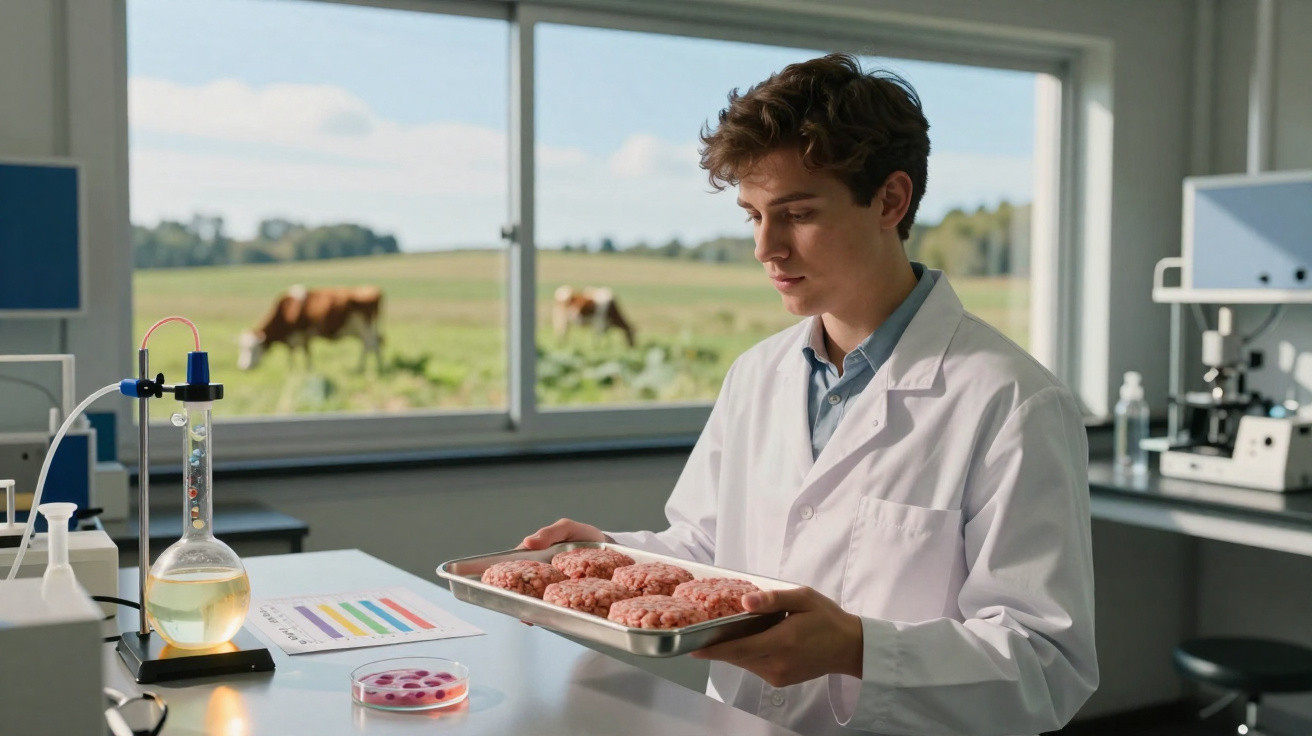
Fresh research is bringing the excitement surrounding cultivated meat back down to earth.
Investors continue to pour in money, regulators are moving cautiously, and consumers remain intrigued. However, a recent assessment challenges the key claim that cultured meat is unequivocally lower-carbon than farmed beef.
What the new analysis actually says
Researchers at the University of California, Davis examined the complete cradle-to-gate impact of cultivated beef. Their preprint indicates that current manufacturing approaches may produce substantially more greenhouse-gas emissions than conventional cattle farming. While the estimated range is broad, its overall implication is clear.
Based on current processes and inputs, one kilogram of lab-grown beef could carry a global warming footprint four to twenty-five times higher than a kilogram of conventional beef.
The main issue arises earlier in the supply chain: highly refined growth media and growth factors. Cultured cells require a carefully formulated mixture of amino acids, sugars, minerals and proteins. Suppliers purify these materials to pharmaceutical-grade specifications to prevent contamination and endotoxins. This refining process uses considerable energy and water, with the burden mounting rapidly at tonne-scale production.
The team also included the substantial electricity demand of sterile production sites. This covers continuous HVAC systems that keep cleanrooms within tight temperature and particle thresholds, steam-in-place and clean-in-place procedures, and bioreactors operating continuously. Combined, these requirements create a larger footprint than many anticipated when imagining pastures being replaced by gleaming steel facilities.
Why lab-grown meat has a high energy demand
The growth media challenge
Animal cells multiply slowly and require expensive ingredients. Insulin, transferrin, fibroblast growth factors and other recombinant proteins enable cells to divide and develop into muscle. Manufacturing and refining every bottle involves fermentation, filtration, chromatography and refrigerated storage. At scale, every one of those stages expands.
Purifying growth factors to pharma-grade specs dominates the footprint because quality standards sit far above normal food manufacturing.
Many start-ups argue that they can move to food-grade media or develop cells that depend on fewer growth factors. These options may reduce emissions, but they involve compromises: greater contamination risks, regulatory scrutiny and more demanding consistency requirements when production shifts from a laboratory to a factory.
Equipment that operates continuously
Bioreactors must remain sterile at all times. Air-handling systems, HEPA filtration and positive pressure prevent microbes from entering. Steam sterilises tanks and pipework. Stainless-steel equipment is cleaned repeatedly. Unless the electricity grid has very low carbon emissions, this turns kilowatt-hours into kilograms of CO2.
- Sterile HVAC demand remains substantial, including when batches are paused.
- Preparing and purifying media requires several heating and filtration stages.
- Where they are used, single-use plastics transfer impacts to waste treatment and incineration.
- The electricity mix determines the outcome: grids reliant on fossil fuels increase emissions.
- Low cell densities require more energy for every kilogram of edible product.
Market momentum meets a reality check
The first cultured burger cost roughly $250,000 in 2013. Costs have since declined, prototypes have advanced and Singapore authorised limited sales in 2020. Major food companies invested, while dozens of start-ups constructed pilot lines. A prevailing story emerged: scaling up would improve both affordability and environmental performance.
This fresh modelling weakens that assumption. It indicates that low-carbon cultivated meat will not emerge automatically. Less expensive media is not necessarily lower-emission media. Quicker cell growth does not remove cleanroom energy demands. Expanding production from grams to tonnes may also magnify overlooked impacts.
Cheap cells are not green cells unless the supply chain, purity specs, and factory energy all change at the same time.
Could scale reduce the footprint?
It could, but only if the technology moves beyond pharmaceutical-style inputs and fossil-fuelled electricity. Teams are already trialling plant-produced growth factors, microbially manufactured proteins and animal cell lines able to cope with less pristine conditions. Continuous bioprocessing may operate nearer a steady state, reducing cleaning cycles and idle time.
| Lever | Potential effect on emissions | Key hurdle |
|---|---|---|
| Switch to food-grade media | Large cut if purity requirements drop | Contamination risk and regulatory comfort |
| Plant- or microbe-made growth factors | Lower purification burden | Yield, consistency, and cost at industrial scale |
| Higher cell densities | More meat per kilowatt-hour | Oxygen delivery and metabolic waste management |
| Renewable power and heat | Direct reduction in scope 2 emissions | On-site generation or reliable green contracts |
| Process integration | Fewer sterilization cycles, less downtime | Complex engineering and validation |
Climate calculations, land and water
Cattle emit methane, require land and consume water. Cultivated meat avoids enteric methane and could reduce farmland use if it displaces beef at scale. Yet it transforms energy into heat and CO2 through industrial machinery. The comparison depends on the chosen system boundaries and local circumstances.
One frequently repeated water claim is that beef requires 15,000 litres per kilogram. French agronomy researchers instead place typical figures at around 550–700 litres for the share that puts pressure on water systems. The difference reflects the definitions used: blue water, green water and regional water-scarcity factors all matter. The water footprint of lab-grown meat will depend on its media supply chain and each facility’s cooling demand.
Why comparing beef with bioreactors is difficult
Life-cycle assessments may reach different conclusions because they use different reference points. Some assess only edible tissue, whereas others include by-products. Certain studies assume renewable electricity, while others apply present-day national grids. Changing just one assumption can shift the conclusion from a climate benefit to a climate burden.
What to watch next
- Media cost per litre and media emissions per litre: both need to fall at the same time.
- Proven cell densities in large tanks rather than only laboratory flasks.
- Contamination levels and downtime at pilot facilities.
- How regulators approach food-grade inputs compared with pharmaceutical-grade inputs.
- Power agreements: authentic renewable supply or book-and-claim certificates.
Where this leaves alternative proteins
Cultivated meat represents one part of a broader transition. Precision fermentation uses microbes as protein factories for dairy, egg and meat alternatives. Plant-based products are continuing to improve in texture and price. Hybrids combining plant protein with cell-grown fats may provide a quicker path to impact while requiring less energy.
For consumers, the immediate trade-offs are practical. Where climate is the main priority, plant-based options still offer the largest assured reduction today. For those motivated by animal welfare, cultivated meat remains promising, although its climate advantage depends on factories, inputs and the grid supplying their power.
Useful terms to know
- Growth factors: proteins that tell cells to divide and mature; they are expensive to produce and purify.
- Endotoxins: bacterial residues that can damage animal cells; their removal adds processes and energy use.
- Global warming potential (GWP): a method for comparing greenhouse gases according to their heat-trapping effect over time.
A practical way to consider impact
Picture two otherwise identical facilities in separate locations. One relies on electricity generated largely from coal, while the other uses wind, solar and heat recovery. Both produce the same item using the same recipe, but their climate footprints will differ dramatically. At present, the power source and the purity of the media are the two factors that most influence the result. Focus on those two controls before accepting the next headline declaring either a clear victory or a dead end.

















Comments
No comments yet. Be the first to comment!
Leave a Comment