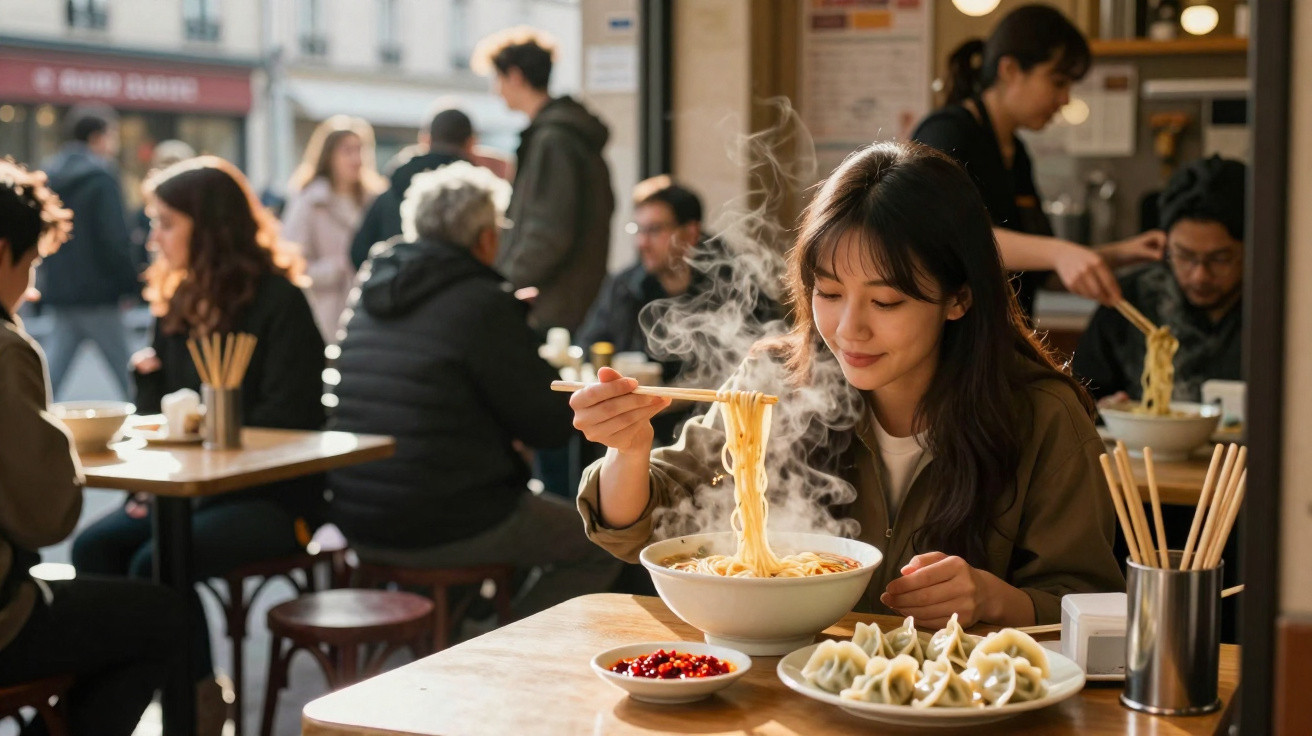
On cold evenings in Paris, a small Belleville frontage attracts a crowd that can scarcely be contained on the pavement.
Residents, students and intrigued people passing by queue patiently, packed shoulder to shoulder, for a hot bowl of noodles that generally costs no more than a cocktail. There is no bright neon sign or stylish terrace: only the aroma of broth, the rattle of bowls and one simple offer - freshly handmade noodles for roughly €8.
An unassuming spot that stops people in their tracks
This scene unfolds on most nights on Rue de Belleville in the 20th arrondissement. The neighbourhood is lively and loud, with plenty of bars and inexpensive places to eat. Even so, one very small restaurant appears to draw a huge share of the passing crowd: Mian Guan, a compact Asian soup restaurant at number 34.
At first glance, it resembles any other local canteen. It has white walls, harsh lighting, a slim doorway and a handwritten menu displayed in the window. Its décor is not what makes people notice it; the queue is. Between 20 and 30 people - and occasionally more - can be seen extending several metres along the pavement.
People willingly stand in line for up to half an hour just to sit down to an €8 bowl of noodles.
Bookings are not available. A member of staff positioned at the entrance calmly and efficiently sets out the system: customers are served in the order they arrive, while service itself is swift. That simplicity is part of the appeal for plenty of diners. The restaurant has an egalitarian feel, with no waiting lists, calls or apps - only a queue, a doorway and a busy steaming kitchen behind it.
The star attraction: Mian Guan hand-pulled and knife-cut noodles
The main reason for the queue is described plainly on the menu: hand-pulled noodles. For enthusiasts of regional Chinese cuisine, those words are an immediate draw.
At Mian Guan, customers can select noodles made using two traditional methods:
- Hand-pulled noodles - lengthy, springy strands that are stretched and folded by hand
- Knife-cut noodles - broader, chewy strips shaved straight from a piece of dough
Each type is offered either in broth or stir-fried, with toppings that run from straightforward vegetables to beef, pork and other meats. Depending on the topping, prices sit between €7 and €9.50 - an unusual bargain in a city where even a simple main course can readily cost twice as much.
The kitchen’s performance is visible from the dining area. At the rear, the chef works at his counter, rolling, striking and pulling the dough. In a near-choreographed rhythm, he tosses it through the air, twists and folds it, then separates it into dozens of delicate strands before lowering them into vast pans of gently bubbling broth.
The constant motion of dough being pulled, stretched and sliced is as hypnotic as it is appetising.
Behind the chef, large stockpots simmer with fragrant broths flavoured by spices and slowly cooked bones. The noise never really stops: dough slapping the worktop, woks sizzling during stir-frying, and conversations taking place in several languages.
What €8 actually buys you here
For regular customers, much of the appeal comes down to value. Low-cost food is readily available in this area of Paris, but good quality at these prices is less common.
| Dish type | Typical price range |
|---|---|
| Hand-pulled noodle soup | €7 – €9.50 |
| Knife-cut noodle soup | €7 – €9.50 |
| Stir-fried noodles (with meat or veg) | €8 – €9.50 |
Servings are substantial, commonly arriving in large bowls that feel like a full meal rather than a light evening option. The broth generally provides the base: flavourful and rich without being oily, with depth instead of excessive salt.
Google reviewers give the restaurant 4.6 out of 5, with comments repeatedly highlighting quick service despite the crowds, reasonable prices and noodles that seem freshly prepared rather than reheated or pre-packaged.
A canteen atmosphere that fuels quick turnover
The dining room is arranged for simplicity and efficiency. Tables stand close together, with solo customers sitting alongside couples and larger groups of friends. There is limited privacy and little scope for lingering. When the bowls arrive, conversation often stops, replaced by chopsticks, spoons and the sound of eating.
Staff circulate rapidly, usually taking orders within minutes and removing plates once diners have finished. The purpose is not to hurry guests away, but to maintain a steady flow. With a queue continuously waiting outside, every chair matters.
This is a place where you come to eat well and cheaply, not to sit for hours over a glass of wine.
For many people living nearby, Mian Guan serves as a contemporary canteen. Regulars call in after work or before going to Belleville’s bars. Friends arrange to meet there when nobody wants to debate spending limits. By declining reservations, the restaurant effectively puts everyone on equal terms: students, office workers and tourists all join the same queue.
How long will you wait – and is it worth it?
Queue times differ, although waiting 20 to 30 minutes is normal on an average evening. The line may be longer at weekends or after 8pm. Once customers are inside, however, the pace picks up: orders are generally taken within a few minutes and dishes leave the kitchen remarkably quickly.
For a first visit, it is best to arrive earlier in the evening or choose a quieter time. Dining alone or with one other person may also reduce the wait, as smaller parties can more easily fit at shared tables.
In financial terms, an €8 noodle soup in Paris makes a meaningful difference for many locals. For anyone keeping an eye on their outgoings, an address like this can become a weekly routine rather than an occasional indulgence.
Why hand-pulled noodles feel different
Hand-pulled noodles offer more than visual theatre. Their preparation changes their consistency: repeatedly stretching and folding the dough aligns its gluten strands, producing a bouncy, lightly elastic texture that factory-made noodles seldom replicate.
Knife-cut noodles, on the other hand, are more substantial. Because dough is shaved directly into boiling water, the strips emerge in uneven shapes and varying thicknesses, allowing them to hold broth and sauce in different ways. Their admirers frequently call them more filling and rustic.
Those accustomed to instant noodles or dried pasta may find the contrast striking. The chewiness, density and interaction between the noodles and broth lend the dish a soothing, almost home-cooked quality.
Practical tips before you join the queue
A few points can make a visit to Rue de Belleville easier:
- Payment: Take a bank card, as well as some cash in case there is a minimum spend for card payments.
- Menu choices: Choose between soup and stir-fry while waiting in line to make ordering faster.
- Clothing: It can be hot and steamy indoors, so layers are the most practical option.
- Noise: The dining room is animated and may not suit very quiet or intimate conversations.
For anyone unfamiliar with French restaurant customs, “no reservations” generally means arriving and waiting for a table. In small, sought-after restaurants such as this, tables often turn over in under an hour, explaining how such a limited space can serve so many diners during one evening.
Beyond the soup: what else to try next time
Although hand-pulled noodle soup is the main attraction, regular customers do not usually stop at one dish. Dumplings, stir-fried noodles with marinated pork and other small plates often become choices on a second or third visit, once curiosity has taken hold.
The concern at a restaurant such as Mian Guan is not food safety or quality - the rapid turnover helps keep ingredients fresh - but ordering too much. Affordable prices can encourage groups to cover the table with dishes. Leftovers are frequent, and takeaway boxes are not offered readily by every restaurant in France, so it is sensible to ask before getting carried away with the menu.
For many diners, sharing is the strongest approach: choose several noodle styles and toppings, exchange bowls midway through the meal, and compare their textures and flavours. This makes a quick, inexpensive meal feel more like a tasting experience, while still costing the equivalent of one main course elsewhere in the city.








Comments
No comments yet. Be the first to comment!
Leave a Comment