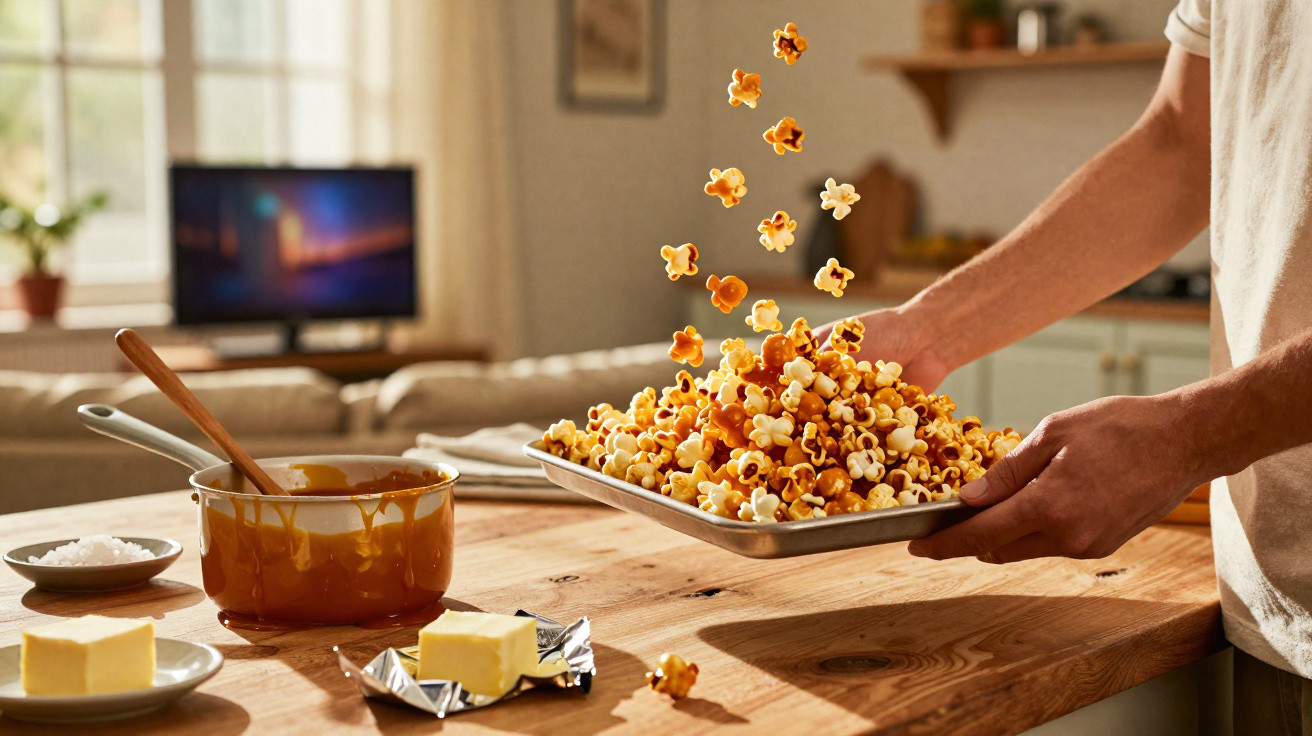
You are in the kitchen holding a sticky bowl of homemade caramel popcorn, yet something feels slightly wrong. It is sweet, certainly, and some pieces are crisp. Still, that unmistakable movie theater flavour is nowhere to be found. You try another piece, looking for the rich, toasted, faintly salty taste that appears halfway through a tub in a dark auditorium, when the air conditioning is a little too cold and the trailers are still playing.
The popcorn tastes good, but it does not taste like the movies.
The reality is that cinema popcorn has one small secret, and it is sitting in your cupboard rather than inside an industrial machine.
Why movie theater caramel popcorn tastes different
Most people first spot the difference at home rather than at the cinema. You have that pleased moment when the baking tray comes out of the oven, its golden kernels gleaming beneath a shiny caramel coating. They crackle while they cool, and you feel rather proud.
Then you take a handful. It is pleasant, but lacks that nearly burnt, buttery richness: the flavour that catches at the back of your throat and stays there while you search for “just one more piece.”
A friend once described their own caramel-popcorn let-down after a Sunday film marathon. They had followed a viral recipe precisely: butter, brown sugar, syrup and vanilla. They popped the corn, baked it slowly at a low temperature and dutifully stirred it every 15 minutes.
The finished batch looked made for Pinterest: completely picture-perfect. Yet, while the film played, everyone gradually returned to the shop-bought bag on the coffee table. The homemade bowl sat on the worktop, cooling and largely untouched. Nobody voiced it, but the judgement was obvious: attractive, restrained and rather dull.
Restaurants and cinemas understand that exceptional flavour depends less on elaborate recipes than on one straightforward factor: controlled browning. Caramel develops when sugar is cooked beyond the cautious pale-golden point, becoming darker and more complex shortly before it burns.
Commercial equipment achieves this reliably by keeping the sugar hot and in motion. At home, we tend to stop prematurely because we fear taking it too far. That is exactly where the divide appears between “nice” and I can’t stop eating this and I don’t even like sharing.
Double-heat caramel: the quick trick for movie theater flavour
The method is surprisingly easy: heat the caramel twice. Prepare your usual caramel in a saucepan, then give it a brief extra spell over the heat before it reaches the popcorn. That fast second “push” is what brings out the movie theater flavour.
Begin with a familiar mixture of butter, brown sugar, a spoonful of corn syrup or honey, and a pinch of salt. Allow it to bubble softly for 4–5 minutes. Next comes the step cinemas replicate with hot kettles: increase the heat slightly and whisk for another 45–60 seconds, until the caramel changes from golden to deep amber and gives off an intensely toasted aroma.
An additional minute may not sound significant, which is precisely why so many home cooks leave it out. They see the bubbling caramel, become wary and switch off the heat at the first sign of colour.
That is the point at which the flavour disappears. In this brief second stage, the sugars continue changing, the butter solids brown more deeply, and nutty, roasted notes emerge that suggest “the movies.” Tip this darker caramel over freshly popped corn and toss it quickly, and each kernel becomes coated in something that tastes as though it came from professional equipment rather than a saucepan doing its best.
From a scientific perspective, this takes caramel closer to bitterness without letting it cross the line. Maillard reactions in the butter, combined with further sugar caramelisation, create layers of flavour that a straightforward sweet syrup cannot achieve.
This also explains why cinema popcorn does not taste merely “sweet.” It is sweet, salty, gently bitter, warming and oddly moreish. That contrast is what your brain locks onto. Recreate it with the double-heat technique and a batch made in your kitchen begins to taste remarkably like something sold in an enormous tub at an unreasonable price.
Making cinema-style caramel popcorn without burning it
Use this practical approach to recreate the cinema method in an ordinary kitchen. First, pop 120 ml kernels in a sturdy pan with 15 ml neutral oil, keeping the lid on over a medium heat. Shake the pan occasionally until the popping slows, then tip the fluffy popcorn into a large metal bowl and remove any unpopped kernels.
In a saucepan, melt 115 g butter with 200 g brown sugar, 60 ml corn syrup or honey, and a generous pinch of salt. Bring the mixture to a simmer over a medium heat, letting it bubble gently for roughly 4–5 minutes and stirring now and again. It will change from grainy to glossy.
Now for the “movie” stage. Raise the heat by a small amount and continue stirring as the caramel becomes a deeper amber, taking around 45–60 seconds. Use your sense of smell: as soon as you notice a lightly toasted, almost smoky scent, remove it from the heat immediately. Mix in 1/2 teaspoon bicarbonate of soda and a dash of vanilla. The bicarbonate of soda will foam and lighten the caramel, helping it cling more effectively to the popcorn.
Immediately pour the hot caramel over the popcorn, turning it with a spatula or two large spoons. Move quickly, but do not worry if a few clusters form; that slightly irregular texture feels more authentic than perfectly uniform factory-made pieces.
A gentle warning is needed here: people generally do not undercook caramel because they are lazy, but because burnt sugar is traumatically unpleasant. If you have switched off the heat too early before, be kind to yourself.
One plain-truth sentence: nobody is standing over a sugar thermometer on a Tuesday night for fun.
Arrange the coated popcorn across a parchment-lined baking tray and bake at 120°C for 30–40 minutes, tossing it every 10–15 minutes. This dries the coating, creates that shattering crispness and carries on the gradual browning without turning the batch to charcoal.
Sometimes the whole kitchen smells like a movie theater before you even take the tray out. That’s when you know you’ve hit the right shade of caramelized.
Rely on the “nose test”
Do not judge by colour alone. Once the aroma shifts from sweet to toasted, you have entered movie territory.Use more salt than you expect
A modest dusting of fine salt over the hot popcorn just after baking transforms plain caramel into something more layered and grown-up.Experiment with “cinema add-ons”
Once the popcorn has cooled, add roasted peanuts, pretzel pieces or a drizzle of melted dark chocolate. These reminders of snack-bar chaos make the bowl feel unexpectedly familiar.Allow it to cool fully
Warm caramel popcorn is delicious, but its proper crunch-and-crackle reward arrives only when everything is completely cool and dry.Store it as the cinema would
An airtight container preserves the crisp, glossy coating for longer. A paper bag makes it softer. Pick your preference: crunchy tub or chewy bag.
Why this small change can feel so emotional
This technique lands more deeply than simply producing a better snack for a reason. Movie theater caramel popcorn is connected with first dates, children with sticky fingers, and late screenings in half-empty rooms where you keep reaching into the tub long after you are full. When that scent suddenly fills your kitchen, it draws those memories straight into the hallway.
You might find yourself alone at the worktop, picking up piece after piece before anyone else knows it is ready. There is a modest, private pleasure in realising that this cinema-only taste can now come from your everyday saucepan.
There is no need to pursue perfection every time. Some batches will be a touch darker, a bit clumpier, a little too salty or not quite sweet enough. That is perfectly fine. The aim is not to become a concession stand, but to bridge the distance between “almost” and “oh wow, this tastes like the real thing.”
The next time you put on a film at home, use the double-heat caramel method and see what happens. People will reach for the bowl more frequently. The room will go quiet for a second. And someone will probably say, without thinking, “This tastes just like the theater.”
| Key point | Detail | Value for the reader |
|---|---|---|
| Double-heat caramel | Cook the caramel, then continue for 45–60 seconds until it reaches deep amber | Recreates the intense, toasted movie theater flavour |
| Low-temperature oven drying | Bake coated popcorn at 120°C for 30–40 minutes | Delivers lasting crunch and prevents sticky, soggy kernels |
| Use salt deliberately | Salt the caramel, then lightly season the finished popcorn | Creates the moreish sweet-salty balance cinemas depend on |
FAQ:
- Question 1: How can I tell that the caramel has cooked far enough without scorching it?
- Question 2: If I am short of time, can I leave out the oven stage?
- Question 3: Which sugar is most suitable for movie-style caramel popcorn?
- Question 4: Can I make it less sweet while retaining the movie flavour?
- Question 5: For how long will homemade caramel popcorn remain crunchy?









Comments
No comments yet. Be the first to comment!
Leave a Comment