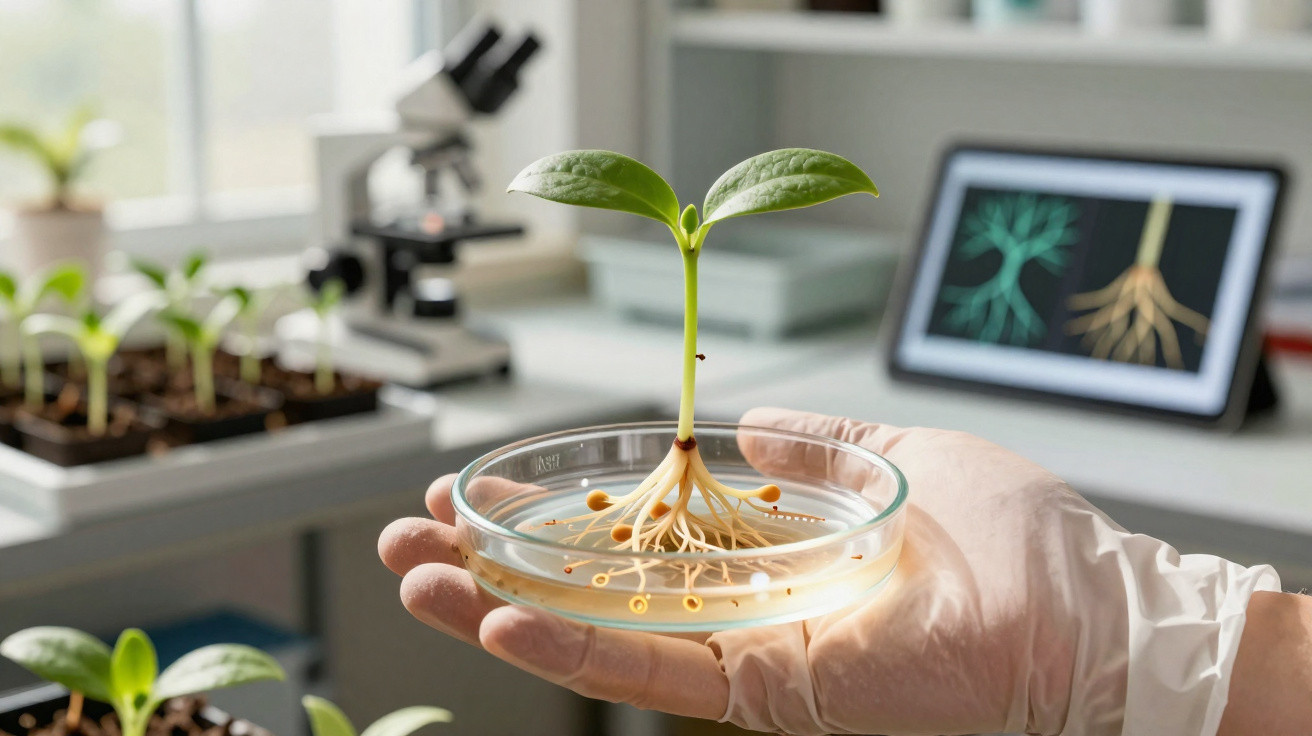
Every seed starts with a straightforward purpose: finding water, taking in nutrients and remaining stable. Below ground, root tips explore the soil, producing branches that sustain the plant.
Ensuring these branches emerge in precisely the right place and at the right time has become still more important as weather shifts from extended droughts to sudden downpours.
Researchers have linked this timing to autophagy, the cellular recycling process that many associate with the health benefits of fasting.
Tracking a shape-changing protein in Arabidopsis roots allowed the team to show how short clean-up bursts enable new branches to develop and may help crops withstand more challenging conditions.
Plant roots’ cellular clean-up crew
Researchers at the University of Copenhagen charted this process in live seedlings. They observed the transcription factor ARF7 disappear and reappear in regular cycles, with every cycle corresponding to a surge in the growth hormone auxin.
“Fasting has become popular as it seems to have a range of health‑promoting effects in humans, as periods without food cause the body to activate clean‑up processes to dispose of various waste products in cells,” explains Assistant Professor Eleazar Rodriguez from the Department of Biology, who led the study.
“We have proven that the same mechanism, which also exists in the plant kingdom, plays a vital role in the ability of plant roots to grow and absorb water and nutrients for the rest of the plant.”
NBR1 drives the process by acting as a tag that directs worn-out proteins to a vacuole, where they are broken down. Removing ARF7 each time resets the signalling circuit, allowing it to activate again a few hours later.
If autophagy becomes slower, ARF7 builds up, signals persist for too long and the root’s normal rhythm is disrupted.
Autophagy and auxin
Lateral roots usually emerge with remarkable regularity. About every four to six hours, auxin reaches a peak at the root tip, activating genes that designate a section of tissue for later branching.
“The movement of a root is almost like watching a snake slithering forward in search of water and nourishment in the soil. And we can see that the heartbeat is strongest every time the root meanders forth,” says Rodriguez.
A luminescent reporter enabled the researchers to verify that ARF7 rises and falls in time with these hormone pulses.
Although this pattern is similar to the circadian rhythms that control leaf opening, it follows an independent timetable and is devoted entirely to constructing the plant’s underground portion.
When autophagy stalls
The researchers next switched off crucial autophagy genes to examine the limits of the pathway. The mutant seedlings formed fewer lateral roots and absorbed less water.
“When we disrupted the plant’s autophagy, there was waste everywhere, and we were able to detect the ARF7 protein among the waste,” says Rodriguez.
Microscopy showed enlarged vacuoles filled with debris. Areas of growth that had previously cleared their protein reserves before each auxin pulse remained congested, with no capacity for a new signal. This produced a thin, inefficient root system.
Importance of faster plant growth
As the recycling machinery is common to flowering plants, the results create fresh possibilities for plant breeders and firms producing microbial soil additives.
Many approaches are now available for altering plants’ genetic characteristics. They can be used to make plants grow longer roots more quickly and, as a result, become more resilient to droughts or floods.
“One of the methods enlists the help of bacteria that live in symbiosis with the plant and can cause the plant to change its growth pattern. Several companies in Denmark are working on this right now,” explains Ph.D. student Jeppe Ansbøl, who co-authored the study.
Fine-tuning autophagy or modifying NBR1 tags could enable roots to pursue moisture further down in the soil and take up fertiliser that might otherwise be washed away, raising harvests without additional inputs.
Autophagy makes stronger roots
“The more roots the plants have, the more water and nutrients they can take up, so the plants grow better, faster,” Rodriquez summarized.
“We’re heavily dependent on plants because they feed us, extract CO2 from the atmosphere and produce the oxygen we breathe. As such, it is extremely important to understand them fully, to which end we have just taken a big step forward.”
Trial plots in Denmark are already putting these concepts to the test amid changing rainfall patterns. Initial observations suggest that crops with altered recycling recover faster following both waterlogging and dry periods.
BZR1 gives plants instructions
Lastly, BZR1 - the protein that instructs a plant when to grow and at what speed - is highly important. When growth hormones appear, it enters the cell nucleus and begins issuing instructions to thousands of genes.
These genes relax cell walls, enabling stems and leaves to extend and enlarge.
The process requires careful control. Before initiating rapid growth, BZR1 monitors the plant’s sugar levels, preventing it from exhausting its energy supplies.
This protein also works alongside light-detecting proteins, ensuring that available energy is used to reach sunlight as efficiently as possible.
Taking charge at the root level
BZR1 influences more than plant height. It also governs events underground, directly affecting the way the root system develops.
It activates particular “pluripotency” genes - including ARF7 - which direct ordinary cells to become new lateral roots. This creates a dense, branched network that secures the plant against wind and rain.
The larger root network draws in additional water and nutrients, allowing the plant to continue performing well even in poor soil or severe weather.
BZR1 additionally manages the plant’s internal recycling system. Damaged cellular components are rapidly removed, helping the plant maintain its structure during heat or salt stress.
Plants, autophagy, and the future
Future research will investigate whether other auxin response factors use the same recycling route, and how light, temperature and soil chemistry changes alter its timing.
Research involving mosses and liverworts, which diverged from flowering plants around 400 million years ago, could show just how ancient the relationship between autophagy and development is.
For farmers, prompt cellular housekeeping could mean more dependable yields. Keeping root cells free from clutter gives plants the scope to create the networks required to flourish in a climate that is rarely stable.
The complete study was published in the journal EMBO Reports.

















Comments
No comments yet. Be the first to comment!
Leave a Comment