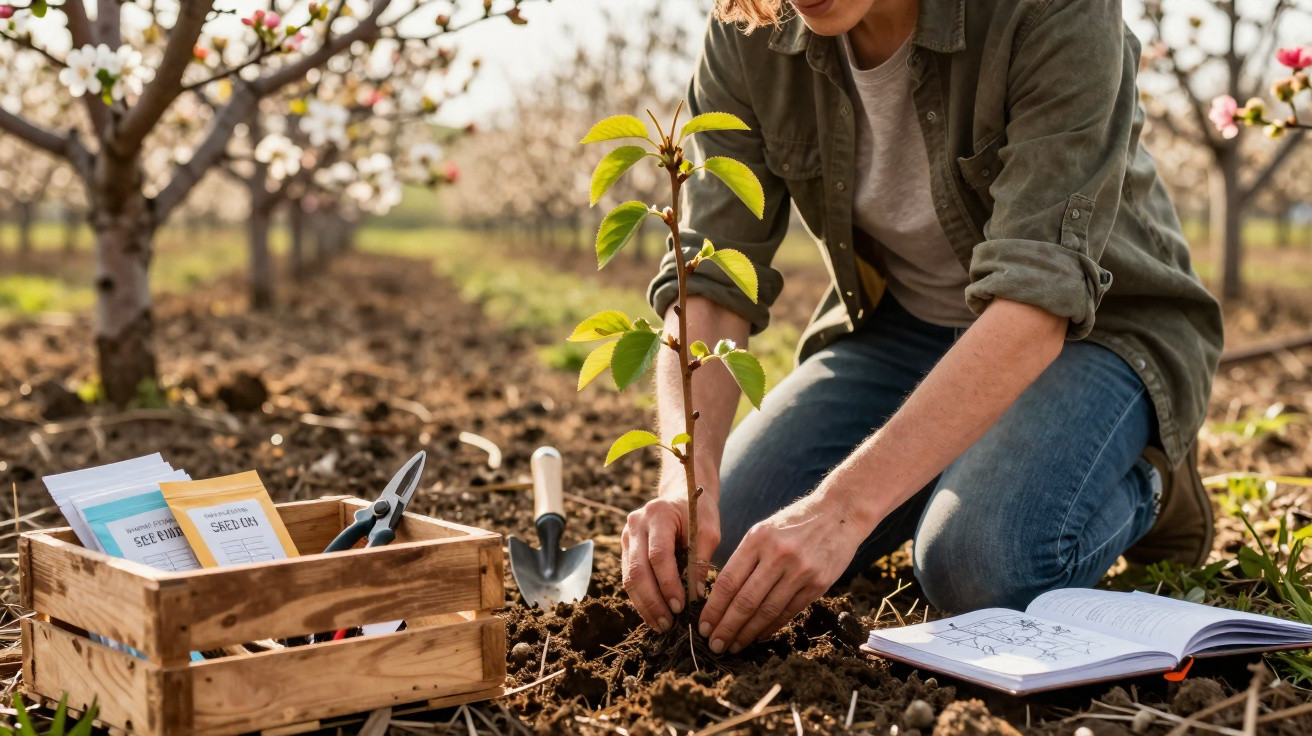
The grass is pressed flat, branches resemble bones, and the soil carries such a heavy, exhausted appearance that you question why you ever decided to grow fruit at all. Then you spot something small and nearly hidden: pale bulb tips piercing the earth, a ribbon of white flowers on an early plum, or a row of last year’s bare-root whips now unexpectedly speckled with buds. The gardeners behind orchards like these did not get there by chance. Months earlier, while everyone else was still scrolling through seed catalogues, they had quietly put plants in the ground. Beneath the winter gloom, spring was already preparing.
The quiet backbone of a spring orchard
Every seasoned orchard grower has a private list of plants they always make time for. It is seldom glamorous: rootstocks, companion plants for the understory, bulbs, hedges and several dependable shrubs that discreetly support the entire setting. Take a closer look at a thriving orchard in spring and the layers become clear: fruit trees beginning to stir, bees already busy, and soil with a living scent. None of this is accidental.
A grower in Devon told me that she considers early-spring colour and forage for pollinators a “non‑negotiable input”, just as important as pruning. Her orchard floor is therefore striped with crocus and muscari in March, while neighbouring growers are still trudging through mud. Local bees visit her orchard first, gathering nectar and pollen as the fruit trees begin to prepare for blossom. The bees are followed by the yields. For her, those early plantings are a quiet form of insurance.
The reasoning is straightforward. Fruit trees do not exist as islands. What grows around and between them influences everything: ground-level temperature, soil moisture, the pollinator population on site and pest pressure. Alter the planting, and you alter the entire microclimate. This is why experienced growers describe “planting an orchard ecosystem”, rather than simply arranging trees in rows. Better still, once these supporting plants are established, the workload falls considerably and the orchard begins taking on more of the effort itself.
What professionals plant before fruit-tree blossom
At the top of almost every professional’s list are bare-root fruit trees grown on suitable rootstock. Winter is the time for setting out replacements and new cultivars, placing them in cool ground while they remain completely dormant. Their roots settle in without fuss, so when spring comes, the trees can put energy into growth rather than merely surviving. Growers will also include at least one pollination partner for every variety, sometimes selecting a crabapple with weeks of flowers to draw in pollinators.
Along the tree rows, they establish nitrogen-fixing companions such as white clover and birdsfoot trefoil. These modest but hard-working plants bind the soil together, supply a gradual dose of natural nitrogen and maintain ground cover. Beneath mature trees, growers may add comfrey crowns, positioning them far enough from trunks to prevent competition between roots. In early spring, comfrey foliage surges upwards, drawing nutrients from deep in the ground and holding them in its broad, fleshy leaves. Those leaves can later be turned into free mulch and liquid fertiliser, returning nutrients to the trees once more.
Bulbs and early nectar plants also change the entire character of an orchard. In autumn, experienced gardeners plant daffodils, crocus, snowdrops and early species tulips in broad, informal drifts beneath and between trees. Some sow self-seeding calendula and phacelia close to young trees, expecting them to flower enthusiastically as the first bees emerge. The principle is both clear and uncompromising: the greater the early-spring food supply for pollinators, the stronger their colonies will become and the more dependably they will work the fruit blossom when it matters.
How to adopt their orchard habits without becoming overwhelmed
One approach appears repeatedly because it is dull in theory yet excellent in reality: design the orchard floor before thinking about anything else. Begin with a sketch of the fruit-tree positions, then identify circles or strips where grass will not be allowed to take over. These areas are for your permanent plant power: clover, yarrow, comfrey, bee balm, chives and mint kept within a contained space. Consider it permanent wiring beneath the orchard, supplying energy to every spring.
After that, add your “alarm clock” flowers: plants that wake the orchard before its trees do. Use snowdrops, crocus, scilla, muscari and early alliums. Set the bulbs where you regularly walk, so that you can genuinely appreciate them. On another weekend, sow a small trial area with a living-mulch mixture - low-growing clovers, creeping thyme and perhaps some self-heal. Watch how it performs for a season before expanding it. Let’s be honest: nobody really does all this every day, and professionals do not either.
The usual mistake is to lean too far towards decoration or excessive neatness. Many first-time orchard owners plant trees in plain grass, then spend every spring fighting that grass. Others fill the space with assorted perennials that appear attractive in a catalogue but offer nothing to the soil or insects. Both approaches mean more labour and fewer apples. At a human level, this is why so many initially hopeful orchards are quietly given up after three or four dispiriting years.
“If the soil looks busy and the insects sound busy in early spring, the fruit usually follows,” an old grower in Herefordshire told me, leaning on a shovel. “When it’s silent out here in March, I know I’m in trouble.”
To make things manageable, many experienced gardeners keep a brief, uncompromising checklist attached to the shed wall:
- One pollination partner or crabapple for every main variety of fruit tree
- At least two early-flowering plants for bees under or between each pair of trees
- A strip or ring of nitrogen-fixing plants instead of bare soil or pure grass
- Three or four clumps of dynamic accumulators like comfrey at the orchard edges
- One area left slightly wild, as shelter for beneficial insects and birds
The spring orchard that keeps rewarding you
Once these plantings begin functioning together, an orchard no longer feels like a group of demanding individual trees and instead acts as one living system. The trees are not left exposed to the wind, but protected by shrubs and hedges. The soil is no longer bare, as roots and mycorrhiza run through it. Blossoms do not open into silence, but into a humming, shifting cloud of wings and life. Once you have seen them side by side, the contrast between a “tree field” and a genuine spring orchard is remarkable.
In human terms, this creates something less easy to quantify but immediately recognisable. On a cold April morning, you step outside and sense warmth in the air that the weather app has not recorded. Birds move along the hedgerow, removing pests from the trees before sprays have even entered your thoughts. You breathe in, and damp earth, blossom and crushed clover beneath your feet tell you that the year has properly started. During a difficult week at work, that walk may be what helps you regain your balance.
We have all looked at somebody else’s abundant spring orchard and thought, “They must spend their whole life out here.” Usually, however, what you are seeing is not constant labour but intelligent planting done once, then gently maintained year after year. The understated reality is that suitable bulbs, companions, understory planting and shelterbelts can transform a struggling group of trees into something that nourishes you in fruit and in headspace. That transformation begins months beforehand, with plantings that most people do not even consider while the branches are bare.
| Key point | Detail | Benefit for the reader |
|---|---|---|
| Establish the bare-root framework | Select appropriate rootstocks and bare-root trees during winter | More vigorous, better-rooted trees that are ready to flower and fruit sooner |
| Feed the soil and pollinators | Plant clovers, comfrey, early bulbs and nectar-rich flowers | More fertile soil, less fertilising work and more bee visits in spring |
| Think in terms of an “ecosystem”, not rows | Combine hedges, an understory, a wild area and living mulches | A more resilient orchard, fewer pests and a more attractive place to enjoy every day |

















Comments
No comments yet. Be the first to comment!
Leave a Comment