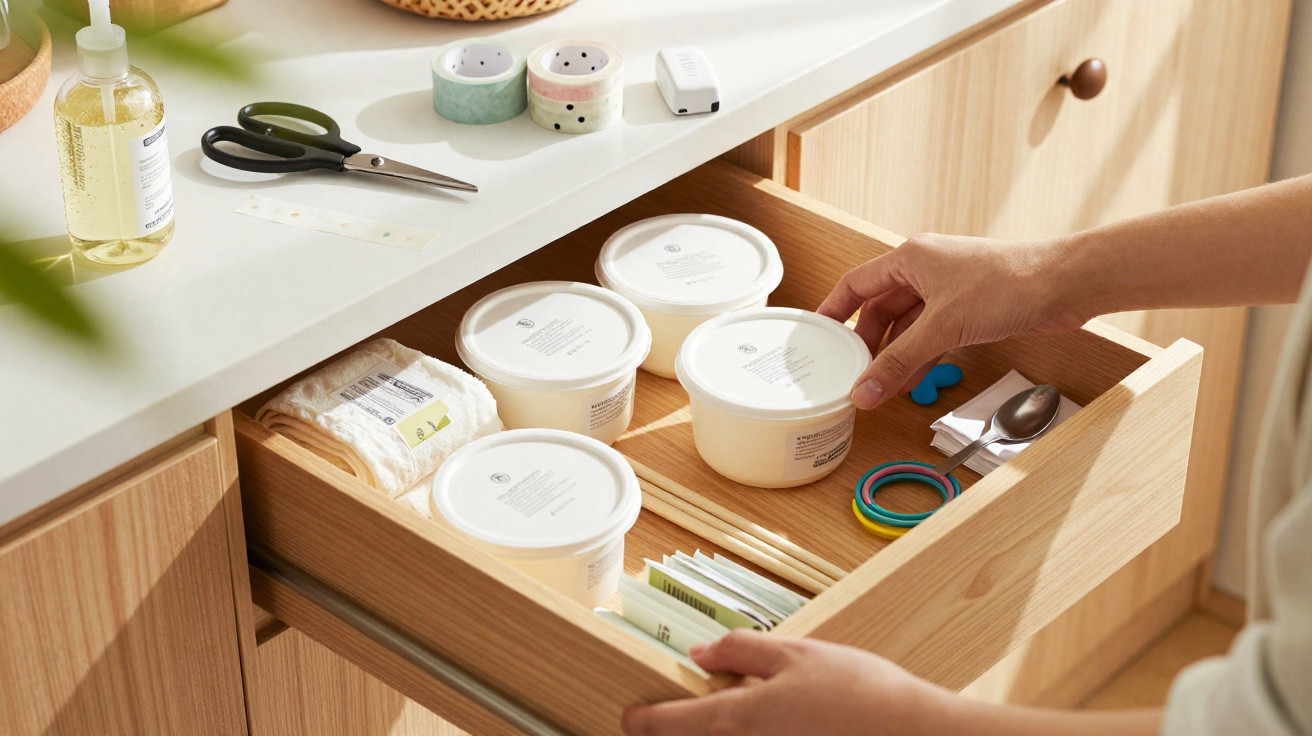
Turning margarine tubs into drawer organisers is based on a straightforward principle: use what is already available, cut down on waste and keep belongings tidy without spending money. Drawing on Japanese organisation, this approach focuses on practicality, visual neatness and smart use of compact spaces, offering quick answers for drawers packed with small bits and pieces.
How does reusing margarine tubs work in Japanese organisation?
Japanese organisation places value on reuse and on being able to see everyday belongings clearly when storing them. Rather than throwing away plastic packaging, many households adapt it to section off drawers, sort items into categories and make contents easier to view in limited spaces.
Using a margarine tub as a drawer organiser delivers three main benefits: affordability, sustainability and convenience. These containers can be made into made-to-measure compartments, following the principle of preventing waste and extending the useful life of anything that can still serve a purpose at home.
How should margarine tubs be cleaned and prepared for reuse?
For reused tubs to work properly, they need thorough cleaning to remove grease and strong smells. A well-prepared container is easier to handle, makes the organiser last longer and prevents the drawer from looking greasy or developing an unpleasant odour.
Once they are clean, it is worth deciding which tubs will keep their lids and which will be cut down, with quick visibility of the contents as the priority. The following steps make this initial stage easy to organise:
- Remove the labels: peel off the label by hand and, if needed, soak the tub in warm water for a few minutes to soften the adhesive.
- Wash with washing-up liquid: apply mild washing-up liquid inside and out, using a soft sponge to remove grease.
- Rinse thoroughly: remove all soap to prevent slippery residue.
- Dry completely: use a clean cloth or leave the tubs to drain in a well-ventilated place until they are fully dry.
- Sort by size: group similar tubs together to plan their placement inside drawers more effectively.
What types of organisers can be made from margarine tubs?
A few simple cuts can turn the tubs into shallow trays, tall baskets or modular dividers suitable for different rooms around the home. This makes it possible to build a flexible system that fits the drawers already available and the number of small items that need storing.
These ideas are useful for anyone wanting to try out solutions before buying ready-made organisers. Here are some practical options, inspired by the way Japanese homes make good use of small containers:
- Shallow trays for cutlery, make-up, paper clips, pens and small accessories.
- Tall lidded baskets for cables, chargers, medicines and infrequently used items.
- Modular boxes for socks, rolled belts, costume jewellery and small clothing items.
How can efficient organisers be assembled and customised using margarine tubs?
To make shallow trays, simply mark the cutting height, remove the top portion of the tub and sand the edges to create low-sided compartments. Covering the outside with self-adhesive vinyl, fabric or adhesive tape keeps the inside visually uncluttered and makes stored items easier to see.
For tall baskets and dividers, the original height can be retained, or the tubs can be cut uniformly to between 5 and 7 cm and arranged side by side in the drawer. Simple labels on the front of each tub help keep every category in its proper place, making it quicker and more intuitive to put away and find objects each day.












Comments
No comments yet. Be the first to comment!
Leave a Comment