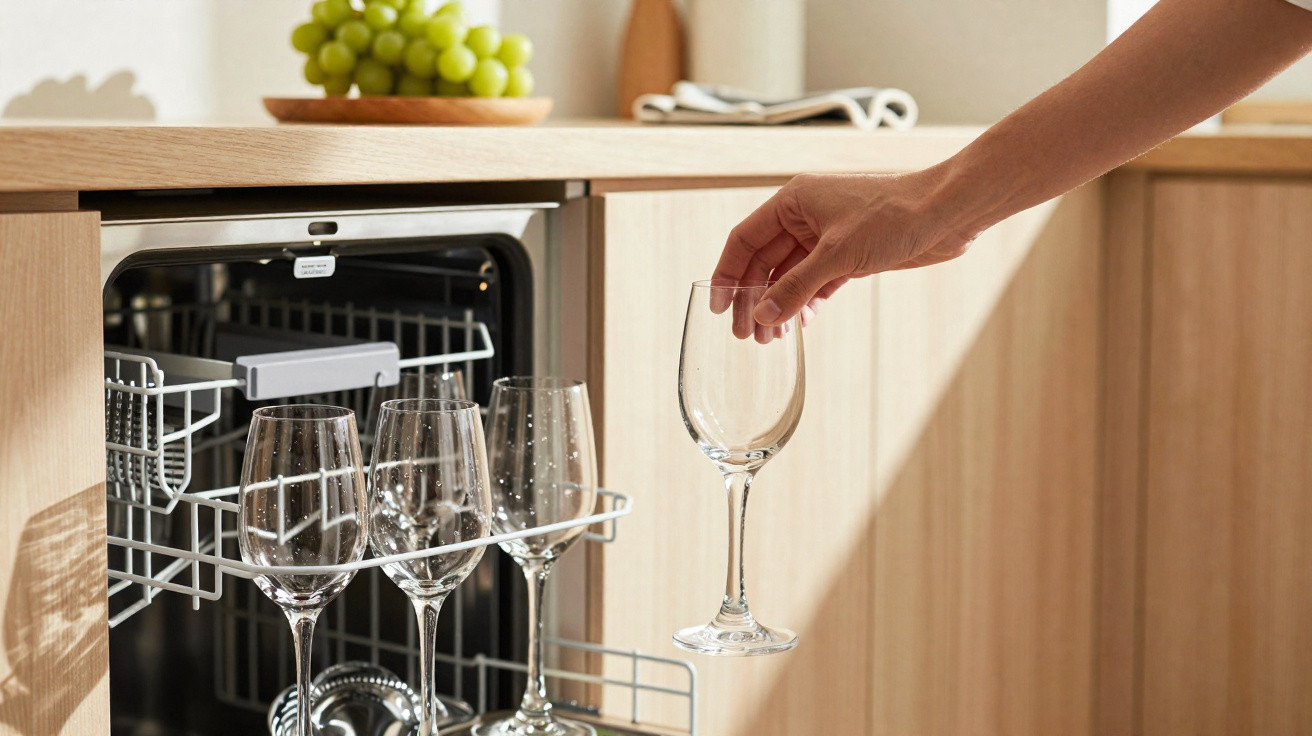
If you own tall glasses, you will know the issue: the lower dishwasher basket is already full of pans and plates, while the glasses in the upper basket reach the spray-arm clearance limit. That leaves you either washing them by hand or risking damage. Yet a simple adjustment lets you set the upper basket in many dishwashers so that even tall wine glasses fit securely.
Why tall glasses can be tricky in the dishwasher
Wine glasses, champagne flutes and rounded gin and tonic glasses are generally made from thin, delicate glass. If they knock against cutlery, plates or the spray arm, small cracks and chips can quickly occur. When they are positioned at an angle, they may also fail to wash properly and be left with water marks.
For this reason, many people prefer not to put these glasses in the dishwasher at all. That uses extra time, washing-up liquid and patience – and is often unnecessary. Modern appliances are designed to accommodate different types of crockery.
“In many dishwashers, the upper basket can be adjusted in height – this unobtrusive mechanism solves the space problem for tall glasses in seconds.”
Adjusting the upper basket: making room for tall glasses
Nearly all recent models from Bosch, Siemens, Neff, Bauknecht and other brands allow the upper basket height to be changed. Some manufacturers use names such as “RackMatic”, “Vario basket” or similar terms. The procedure is usually much the same.
Step-by-step guide to adjusting the height
- 1. Empty the dishwasher: Ideally, remove everything from the upper basket. It will then be easier to move, with nothing likely to jam.
- 2. Find the side levers: There are usually small levers, sliders or locking tabs on both sides of the basket. On some appliances, they are positioned at the front of the runner rails.
- 3. Raise or lower the basket: Press or lift both levers at the same time, then carefully move the basket up or down until it clicks into place.
- 4. Test the glasses: Place one or two of the tallest glasses in the empty basket and close the door carefully. If it shuts without resistance, the height is suitable.
- 5. Check the spray arm: Once the door is closed, listen briefly, or reopen it and check that the spray arm can rotate freely.
Many owners do not realise their appliance has this feature because it is easily overlooked in the manual or was not mentioned when they bought it. If the mechanism is not immediately obvious, checking the instruction manual is worthwhile.
How to position tall wine glasses correctly in the basket
Placing glasses properly matters almost as much as setting the basket height. Carelessness here can lead to breakages or poor washing results.
The key rules at a glance
- Never place them on top of one another: Glasses must not touch each other, otherwise they can rub together and become damaged during the cycle.
- Use the supporting bars: Many baskets have rows of metal bars that can be folded down. They support the glasses and help to prevent them from toppling over.
- Position them at a slight angle: Arrange glasses so water can drain away easily, with the opening angled slightly downwards.
- Keep cutlery away: Loose knives or forks beside delicate stems are a sure way to cause scratches.
- Leave space from the spray arm: There must be clearance between the upper spray arm and the rim of each glass. Even contact of just a few millimetres can cause glass to break during a wash cycle.
“Tall glasses should – whenever possible – always go in the upper basket. The water pressure is lower there, which is considerably gentler on the material.”
Gentle programmes and temperature: keeping glasses clear
Many households find that glasses become cloudy or milky after several dishwasher cycles. This is often caused by a combination of excessive temperature, an overly long programme and unsuitable detergent.
Choosing the right programme setting
Anyone who washes glasses regularly should deliberately choose gentler programmes:
- Glass or delicate programme: This reduces both temperature and water pressure. It is ideal for high-quality stemware.
- Avoid “Intensive” programmes: These run at high heat and strong pressure. They are suitable for burnt-on residue in pans, but risky for glass.
- Lower temperatures: Settings of around 40–50 degrees are usually entirely sufficient for lightly soiled glasses.
Rinse aid and dishwasher salt also make a difference. Too little rinse aid causes marks, whereas too much can leave streaks on the surface. A quick trial with a slightly reduced dose often provides clarity in every sense.
When hand-washing remains sensible despite having a dishwasher
Even with an adjustable basket and a delicate programme, hand-washing remains the better option in some cases, especially for:
- very thin crystal glasses
- antique or inherited glassware with sentimental value
- glasses with gold or platinum rims
- glasses with glued-on decorative stones or metal parts
One unsuitable wash cycle can be enough to cause permanent damage. In these situations, use lukewarm water, mild washing-up liquid and a soft cloth instead.
Common mistakes when cleaning tall glasses
Many issues are caused not by the dishwasher itself, but by minor everyday errors. The most frequent mistakes are:
- Too many glasses in one load: Overfilling the basket increases the likelihood of contact and friction – including broken glass.
- The wrong detergent: Harsh tablets intended for stubborn baked-on deposits can attack glass surfaces.
- Placed directly beside heavy items: Large plates or pans can press against glasses when they move in the basket.
- Opening the door too early: Glass is sensitive while drying at high temperatures. Sharp temperature changes encourage stress and cracks.
“Anyone who treats tall glasses as ‘premium guests’ in the upper basket will enjoy them for much longer.”
Practical extras: accessories and care tips
Special accessories are available for people who use wine glasses frequently. Some manufacturers offer attachments or inserts that allow glasses to be clipped into place. This provides greater stability for slender stems, such as those on champagne flutes.
It is also worth inspecting the spray arm regularly: does it rotate freely, and are its nozzles clear of limescale or food debris? Even a small particle can divert the water jet straight towards delicate glass rims.
Why upper-basket height adjustment is often underestimated
Adjusting the height of the upper basket may seem unremarkable, but it provides a noticeable everyday convenience benefit. Once you deliberately alter the basket position, you soon find that large red wine glasses, taller drinking glasses and even certain vases that previously needed hand-washing can suddenly fit inside.
At the same time, this flexibility allows a better combination of pans, frying pans and crockery, because the available space can be tailored more precisely. That means fewer wash cycles and saves electricity, water and time.
Many modern dishwashers from Bosch, Siemens, Neff, Bauknecht and other brands promote precisely these flexible baskets as a selling point. Those who use the feature get far more from their appliance – and no longer need to leave expensive glassware in the cupboard out of misplaced caution.















Comments
No comments yet. Be the first to comment!
Leave a Comment