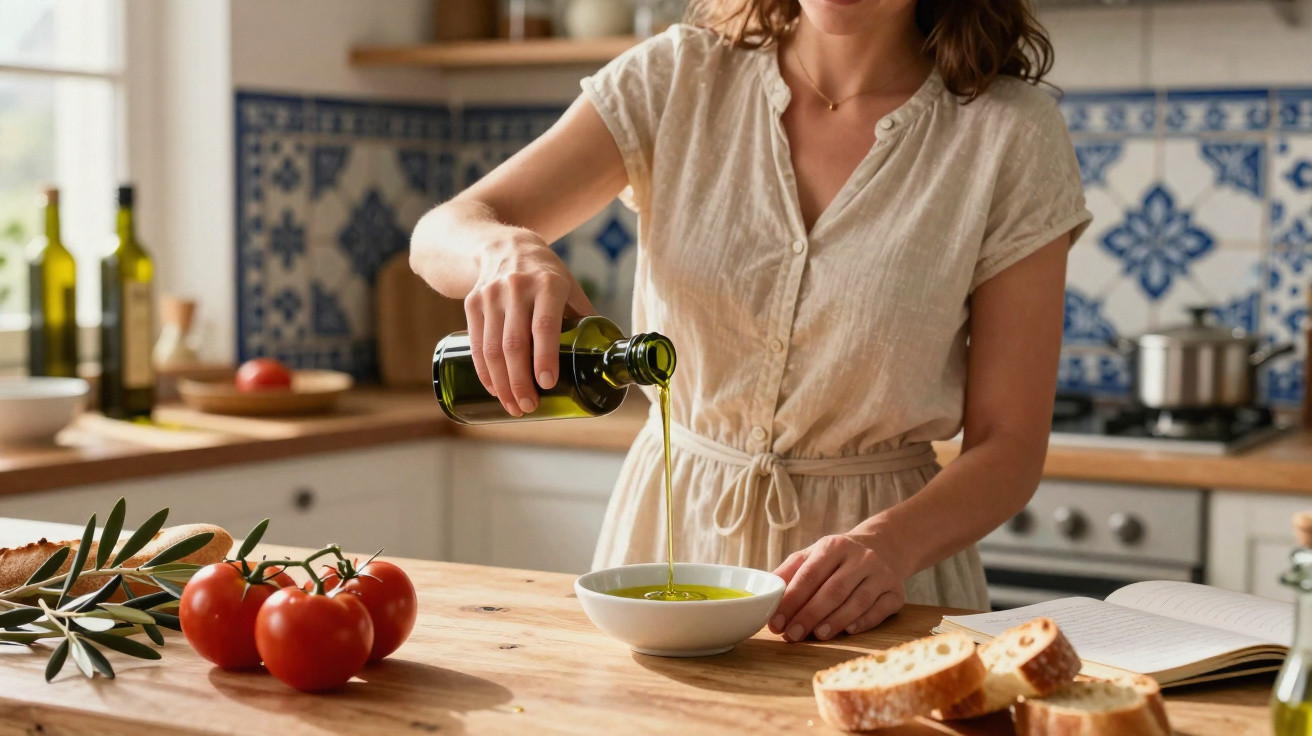
The pan was hot before the aroma filled the room: warm, almost sweet, carrying a lightly toasted scent that made people lift their eyes from their phones. There was no steak crackling away and no butter foaming in the pan. Only a gentle pool of golden oil coated its base, gleaming like liquid sunshine.
Across the table, Nuria, a nutritionist whose job involves scrutinising food labels, watched the bubbles appear. Half in jest and half in earnest, she said: “If people knew what this does inside the body, supermarkets would run out by Friday.”
Forks at the ready, everyone moved closer, intrigued.
They were about to encounter the meal’s real star: an ingredient that has belonged in kitchens for centuries but somehow still seems newly discovered.
The ingredient with a thousand virtues, hiding in plain sight
On the worktop, olive oil can look entirely unremarkable, sitting between the vinegar and salt grinder. Yet pour a slender stream over sliced tomatoes or a slice of sourdough, and the rhythm of the whole dish shifts.
Its appeal goes beyond flavour. It weaves itself effortlessly into everyday eating: over a lunchtime salad, in the pan for morning eggs, or across roast vegetables as they come out of the oven still hot.
Specialists often describe it as a “nutritional powerhouse”, while in most households it is simply the bottle people pick up without a second thought.
Perhaps that is exactly its advantage: it can support you while you scarcely notice it.
When Professor Miguel Ángel Martínez-González, one of the foremost researchers involved in the renowned PREDIMED study, speaks about extra virgin olive oil, he becomes animated in the way others might when discussing their football club.
That long-running Mediterranean diet study found that people using generous quantities of extra virgin olive oil experienced fewer heart issues and strokes, alongside better cognitive ageing, than people following low-fat diets.
This is not magic; it is about people using 3 to 4 tablespoons each day, as naturally as breathing and often without following any formal “health plan”.
It is this understated regularity that appears capable of altering the course of a life.
Scientifically, its benefits read rather like an answer sheet to many modern health concerns. Olive oil contains plenty of monounsaturated fats, which help to maintain healthy cholesterol levels.
Its polyphenols - natural plant compounds responsible for the slightly peppery finish of high-quality oil - have antioxidant and anti-inflammatory properties that have been studied in Europe and the US.
Cardiologists discuss it, while neurologists cite it in conversations about brain health and dementia risk. Some oncologists also refer to its possible role in reducing the risk of certain cancers.
Meanwhile, we fill cupboards with supplements and superfood powders as this oil waits quietly beside the hob for the turn of a cap.
How to make olive oil your quiet daily ritual
Making olive oil a regular cupboard staple does not require a sweeping lifestyle change. It begins with one conscious action: swap.
Replace your usual salad dressing with extra virgin olive oil, lemon juice and a pinch of salt. Exchange the knob of butter in your frying pan for a small amount of oil, warmed gently before you add anything else.
At breakfast, try a spoonful over plain yoghurt with a little honey and crushed nuts. It may sound unusual, but it tastes wonderful.
Rather than framing it as a “diet”, treat it as a habit: a drizzle here and a spoonful there, until reaching for the bottle becomes almost automatic.
This is where many people falter: they buy an impressive bottle, use two tablespoons during the first week, then let it lose its character beside the toaster.
Let’s be honest: nobody truly does this every day if each meal requires getting out a cookbook.
The answer is to connect olive oil with occasions already built into your life. For a speedy pasta supper when you are tired and eating alone, finish it with oil, pepper and grated cheese. For a hurried lunch at work, store a small bottle in your desk drawer to revive an uninspiring takeaway salad.
On a Sunday, pour some into a shallow dish with herbs and chilli flakes. Put it in the centre of the table alongside bread, then see how quickly it goes without anybody needing to try.
British dietitian Emma Slade, a nutrition expert I spoke to, captured the idea in a line that has stayed with me:
“The magic isn’t in a spoonful of olive oil once. It’s in the thousands of spoonfuls across a lifetime.”
To make it part of ordinary life, use small prompts and pleasures:
- Keep the bottle beside the coffee machine so it catches your eye at breakfast.
- Pour it from an attractive refillable cruet: appearance helps habits endure.
- Associate it with enjoyment rather than denial - evenings of dipping bread, shiny roast vegetables, or aromatic soups completed with a swirl.
- Choose a bottle that suits both your budget and your palate. A decent mid-range extra virgin oil is already a kindness to your arteries.
- Allow for imperfection: you will forget on some days, and the following day you simply pour again.
What experts know… and your kitchen is about to feel
One damp Tuesday morning in London, a chef and a cardiologist were having a mild disagreement over a saucepan in the cramped test kitchen behind a nutrition clinic.
The chef was focused on flavour; the doctor was focused on evidence. Yet both reached for the same green-tinted bottle marked “Extra Virgin, Early Harvest”.
They warmed the oil gently, added garlic and chickpeas, then stirred in spinach and lemon. There was nothing elaborate about it: merely store-cupboard ingredients cooking in a fat that was doing more than helping them cook.
Later, at the table, the cardiologist gestured towards the dish and said: “This is anti-inflammatory medicine your grandmother would approve of.”
Everyone agreed as they ate slowly. No one wished for butter.
The evidence continues to accumulate rather than remaining confined to academic journals. Across the major PREDIMED trial and smaller interventions, the same pattern appears: when people replace saturated fats with olive oil, cardiovascular risk markers, blood pressure and even abdominal fat improve.
Some findings also point to advantages for the gut microbiome, as particular polyphenols may act as a mild fertiliser for beneficial bacteria.
In places where olive oil is part of the culture, heart disease and certain chronic illnesses occur less often, even though everyday lifestyles are far from flawless.
In practical terms, this means you can still enjoy bread and pasta and continue eating proper food - provided the fat bringing it together is working in your favour.
We have all had times when a doctor’s advice seems to be spoken in a remote language. Eat less of this, remove that, avoid the very things that make food feel satisfying.
Olive oil stands apart because it contributes instead of taking away. It makes a bowl of vegetables genuinely tempting. It gives fish a silky layer, lends soups more generosity, and can make even a straightforward lentil stew taste as though somebody put care into it.
For anyone finding restrictive diets difficult, this can matter more than any graph. Enjoyment is what drives consistency.
Ultimately, consistency is what turns an ordinary kitchen ingredient into a discreet health companion - one you barely register until you realise you have reached for it for years.
A staple with stories yet to write
There is something almost defiant about choosing a modest, traditional ingredient as a contemporary wellbeing aid. No app, no tracking, just one bottle used frequently.
Olive oil makes no noise. It does not promise a flat stomach in seven days. It simply waits in its glass bottle or tin, ready to make nearly anything you eat feel a little livelier, more nourishing and more distinctly yours.
It evokes long meals in Crete, grandmothers in southern Italy, and Spanish farmers tasting the season’s first pressing on plain bread. Yet it also sits naturally in a studio flat kitchen in Manchester or a shared house in Leeds.
Experts will continue producing graphs and hazard ratios, and brands will continue refining labels with gold leaves and tasting notes.
At home, the important question will remain simple: do you reach for the bottle more often than you do not?
If the answer gradually becomes yes, without any fuss, you may find that the “ingredient with a thousand virtues” is not so much a miracle as a rhythm.
It is a rhythm that accompanies rushed breakfasts and late suppers, your twenties and your sixties, without demanding perfection.
Perhaps, in a few years, you will look back and see this as one of the smallest and wisest changes you made: replacing the fat kept in your kitchen.
Behind the research and beyond the expert quotations lies that personal meeting point where flavour, pleasure and long-term health quietly come together.
A drizzle on your plate, a habit in your day, a thread running through your life.
Then, on some future evening, as that warm and almost sweet smell rises from the pan again, you may find yourself smiling without quite knowing why.
| Key point | Detail | Why it matters to the reader |
|---|---|---|
| Extra virgin, as often as possible | Rich in polyphenols and monounsaturated fats, linked to heart and brain protection | Helps turn everyday meals into support for long-term health |
| Think swaps, not restrictions | Replace butter, margarine or heavy sauces with olive oil in straightforward, repeatable ways | Makes a healthier lifestyle feel manageable rather than punishing |
| Small rituals, big impact | Daily drizzles over vegetables, grains, soups and bread over the years | Creates a subtle, sustainable habit that brings both enjoyment and protection |













Comments
No comments yet. Be the first to comment!
Leave a Comment