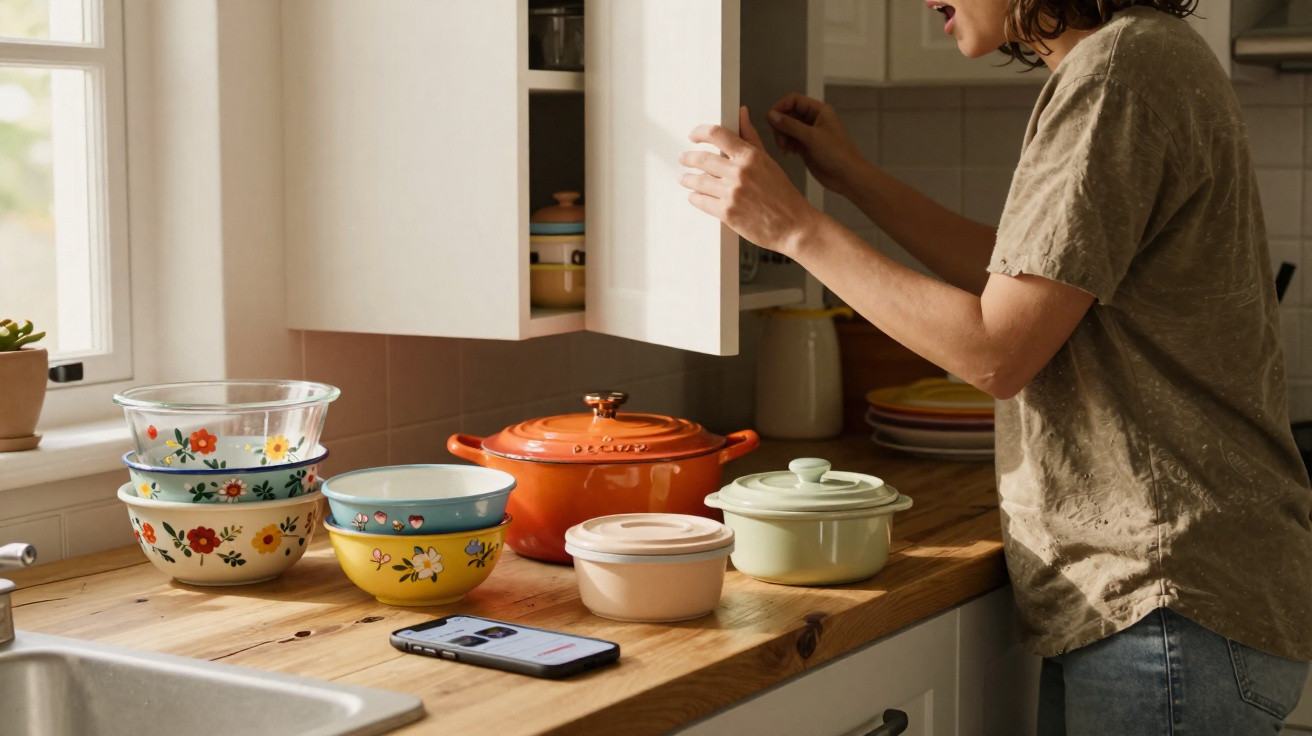
Anna found the box at the back of the pantry, tucked behind a drooping line of cereal packets and a partly open bag of flour. As she dragged it out, the cardboard gave way in her hands, scattering a collection of old kitchenware over the worktop: foggy Pyrex dishes, a bulky orange Tupperware jug and several mismatched mugs bearing worn-out logos. Her first instinct was to put the lot straight into a bin bag. Surely these were simply remnants from another time? The sort of belongings people give away without hesitation when clearing a home after a move or bereavement. Then her brother called from the next room: “Wait, don’t toss the glass dishes, people pay crazy money for those on Vinted.” Anna laughed, rolled her eyes and entered the model number from a scratched measuring jug into her phone.
For a moment, the price that appeared left her unable to breathe.
From junk drawer to jackpot: the quiet craze for kitchen nostalgia
Visit a flea market on a Saturday morning and the change is obvious: boxes labelled “old kitchen stuff” are no longer left untouched in a corner. Shoppers lean over them with phones in their hands, enlarging tiny marks beneath plates and codes stamped into saucepan bases. Items that once sold for 50p at a car-boot sale are now haggled over like vinyl records or high-end trainers.
A fresh kind of treasure hunt is under way, beginning in the kitchen cupboards we usually overlook.
A Paris reseller recounts a similar tale repeatedly. One woman arrived with a plastic bag of what she described as “grandma’s junk”: a floral Pyrex casserole dish, three milk-glass mugs and a chipped enamel coffee pot. She wanted money immediately and nearly walked away when he paused. He then carefully told her that the blue “Cornflower” Pyrex pattern alone could fetch €80 online, provided it still had its lid.
The woman was astonished. She had been on the verge of putting it in the recycling bin alongside old jars. That casserole dish had stood on her grandmother’s cooker for forty years. Yet collectors in the US and Japan were discreetly bidding against one another for precisely that model.
The items have not changed; what has shifted is their meaning. Everyday kitchenware holds a particular sort of reassurance: family dinners, Sunday baking, and the whistle of a pressure cooker in a cramped flat. Modern buyers are not merely buying glass and plastic, but a direct route back to those feelings.
Pyrex, Le Creuset, Tupperware, Luminarc, CorningWare and even supermarket loyalty collections from the 80s have unexpectedly gained cultural significance. Once purely practical, the kitchen has become a miniature museum of personal history, with collectors acting as curators armed with credit cards.
The everyday kitchen items quietly turning into collectibles
Look through cupboards with a new perspective and the trends soon become clear: vintage Pyrex mixing bowls with pastel bands, weighty cast-iron casseroles in discontinued colours, and old Coca-Cola or Danone glasses acquired through supermarket points. There is also that orange Tupperware jug, complete with its perpetually squeaky lid. The nostalgia economy has its own language, and it may be sitting in your draining rack.
The approach is straightforward. Pick up an item, turn it over and search for a stamp, logo or country of manufacture. Enter those exact details into a resale app or online marketplace, using the “sold items” filter only. All at once, an “ugly old” salad bowl has a production date, collection name and, occasionally, a three-figure price.
Consider the unremarkable glass measuring jug your mother once used for beating eggs. In some homes, it will be Pyrex, marked in red or blue and made during the 60s or 70s. On a kitchen table, it may seem worth only a few euros. Online, however, collectors of mid-century kitchenware can pay €40–€60 for one in flawless condition, particularly if it carries the older logo or has imperial-only measurements.
The same principle applies to promotional tumblers children once received with Nutella jars or petrol-station reward points. A set of cartoon glasses from the 90s, largely ignored in a student flat, recently sold for more than €120 because it completed somebody’s collection. To the seller, it was a simple decluttering job; to the buyer, it was the final missing part of their childhood breakfast table.
There is a clear reason behind these unexpectedly high prices. Production methods have changed: glass is lighter, designs are replaced more quickly, and mass-market household goods often feel less “solid” than their 70s or 80s equivalents. Older pieces therefore appear and feel distinctive, even when they were originally the cheapest products on the shelf.
Then there is scarcity. Families discard these objects, homes are cleared, and dishwashers chip paint or fade decorative patterns. Supply gradually falls just as a generation with disposable income begins longing for the things it grew up with. That tension between disappearing stock and rising emotion is what turns a €2 mug into a €50 collectible.
How to quietly audit your kitchen for hidden value
The most useful method may sound slightly ridiculous: take a slow, intentional “treasure walk” around your own kitchen. Work through one cupboard at a time and remove every object made before roughly 2005, including baking dishes, mugs, drinking glasses, plastic containers, metal tins and enamel pans. Arrange everything on a table in good light.
Next, examine every item for identifying details: a stamp underneath a plate, a logo that differs slightly from the current version, or a “Made in France” or “Made in USA” marking. Watch for collection names such as “Arcopal”, “Cornflower”, “Flame” and “Duralex”. Photograph the object as well as all of its marks. The process is unhurried and almost meditative, but it is the only reliable way to distinguish sentimental clutter from possible collector gold.
The usual error is throwing things away or donating whole boxes without a second look because they simply “feel old”. Most people recognise the urge to clear a shelf quickly, keeping only what seems attractive or sufficiently “modern”. Yet the dated-looking and apparently ordinary pieces are often exactly what online buyers are seeking.
The reverse mistake is assuming every item must be worth a fortune. In reality, nobody genuinely does this every day. There is no need to become a professional reseller overnight. Try identifying three or four items that appear promising, check their prices briefly, and learn from that small selection. This prevents you from being overwhelmed by cardboard boxes and unrealistic hopes.
“People bring me boxes of plates thinking they’re worthless, and sometimes the ugliest piece is the one collectors fight over,” says Léa, who runs a small second‑hand shop near Lyon. “They’ll apologize for the ‘old junk’, and then I see a rare Luminarc pattern or a discontinued Tupperware mold sitting on top. The story is always the same: ‘My mum used this every day, I never thought it could be special.’”
- Look underneath, not on top: The key details are nearly always on the underside: brand, model, country and, in some cases, the year.
- Check complete sets and matching pairs: One glass may have little value, while a set of six or a pan with its original lid can multiply the price.
- Make condition a priority: Minor signs of use are acceptable, but deep cracks, scorched handles and patterns faded by dishwashers can often destroy collector interest.
- Search sold listings:
- Do not clean in haste: Harsh scrubbing or modern dishwasher programmes can remove decals or gold trim that buyers particularly want to remain intact.
Why these “ugly” dishes might outlive trends
Once you begin to view your kitchen as an archive of memories rather than merely a practical workspace, it is difficult to stop. A chipped mug becomes more than “rubbish”: it is the first chapter of somebody’s morning routine. A heavy casserole dish is no longer solely for stew; it is the quiet witness to three generations preparing the same family recipe. The collector market merely magnifies that concealed worth through attention and money.
Some people will prefer to sell quickly, creating space and making a little cash. Others will keep their newly “famous” dishes, pleased that ordinary objects now carry a story worth sharing. Both responses reflect the unusual times we inhabit, when the most everyday areas of our homes can suddenly become popular subjects on resale apps and nostalgia forums.
| Key point | Detail | Value for the reader |
|---|---|---|
| Check vintage brands and markings | Search beneath older items for names including Pyrex, Luminarc, Duralex, Tupperware, Le Creuset, Arcopal and CorningWare | Identify possible collectibles before donating or throwing them away |
| Use online sold listings | Look up exact model names or patterns on resale platforms and filter results to items already sold | Find realistic price ranges rather than fantasy valuations or low offers |
| Balance emotion and value | Choose which pieces to retain for their story and which to sell while demand remains high | Transform clutter into either cash or deliberately chosen keepsakes |
FAQ:
- Question 1 Which kitchen items are most likely to be valuable right now?
- Question 2 How can I quickly tell if my old dishes are collectible or just regular?
- Question 3 Are plastic items like Tupperware really worth anything?
- Question 4 Where is the best place to sell these items if I find something interesting?
- Question 5 Should I keep family pieces even if they’re worth good money?











Comments
No comments yet. Be the first to comment!
Leave a Comment