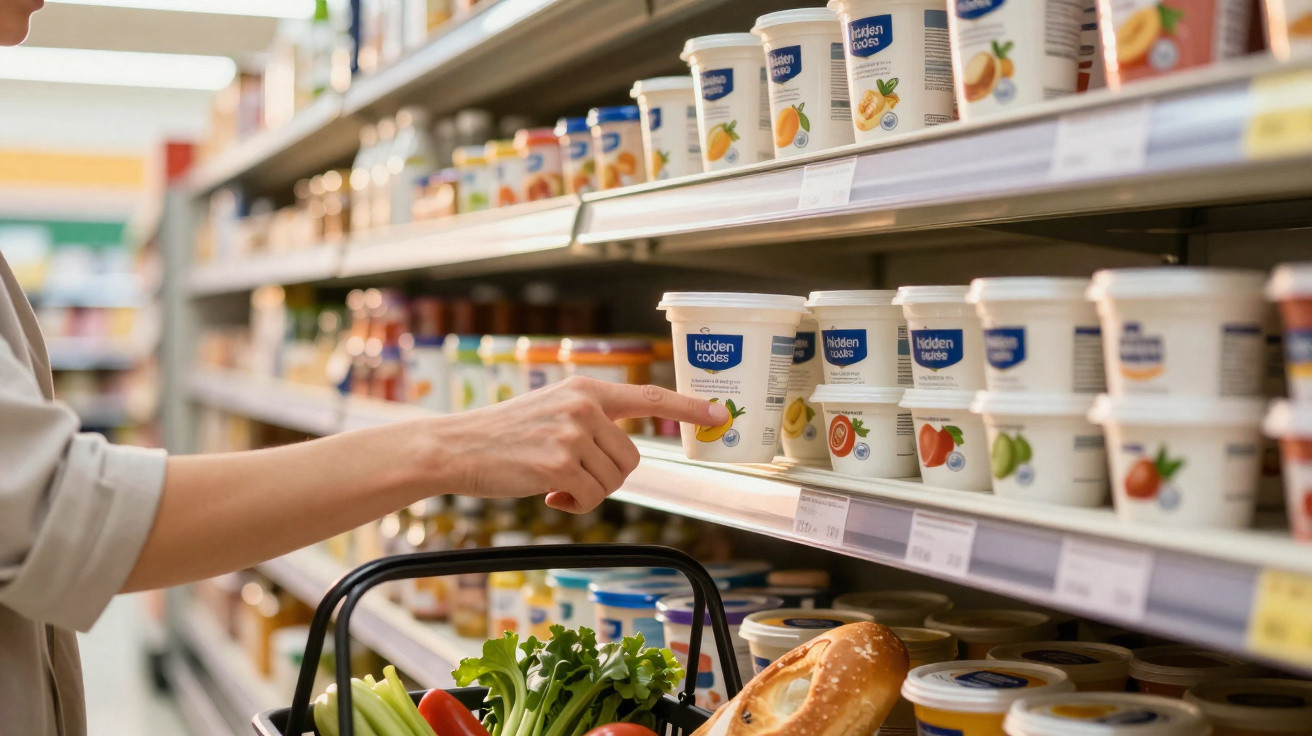
After work, you know that foggy wander around the supermarket: eyelids heavy, hands on a trolley with one squeaking wheel.
You pick up chicken, a bag of salad and perhaps strawberries that seem promising, giving the use-by date only a cursory look. Then life gets in the way. Open the fridge two days later and the strawberries have turned into a miserable furry mess, while the salad carries the faint scent of an abandoned gym bag. Throwing it out brings a small pang of guilt, along with the feeling you have been short-changed. You only just bought it. How can it be going off already?
But what if the explanation has been visible all along, on the slim paper strip beneath the shelf? It is not the large figures or yellow “reduced” labels, but the unobtrusive code on the price tag: one used by staff and usually ignored by shoppers. Within those little numbers and symbols lies something many supermarket employees know: when that food was put on the shelves.
The unobtrusive code right in front of you
At first glance, a shelf label is dull: product name, price and barcode. It is the information your mind screens out while you calculate whether cheese and nappies will both fit into this week’s budget. Look more carefully in some supermarkets, however, and you may spot an extra line in tiny print: a few letters, a brief number, perhaps blocks, dots or apparent gibberish. It is not arbitrary. These markings help employees monitor when stock was shelved and when it should be rotated.
It may sound like the start of a conspiracy theory, yet the reality is much more ordinary - and, somehow, more pleasing. Supermarkets depend on systems, and those systems require discreet cues. Staff cannot put “Put out on Wednesday, dying by Sunday” in huge type. Instead, they create a code: perhaps a weekday letter, a digit indicating the week of the month, or a pattern understood only through training. It is a miniature language printed near floor level.
Some shops use a rolling alphabet, with A for Monday and B for Tuesday, shown at the side of a label. Others include a full but condensed date, intended not for customers but for the person rapidly filling fridges at 6am. Once you have noticed it, it is difficult to ignore. That plain white plastic shelf strip suddenly reveals extra layers.
How a shelf worker explained the supermarket price tag code
I first learned of the code from a teenager in a creased supermarket fleece, stacking yoghurts as tinny drill played from his phone. Half in jest, I asked why strawberries spoiled so quickly. He shrugged and gestured beneath the shelf. “Check that code,” he said. “Tells you when we put ’em out. You want the ones from today, not the ones we’ve been trying to shift since Monday.” He then carried on, while I stared at the label as though I had just discovered fire.
The label held all the standard information - brand, price and barcode - but, at the far right, faintly printed, sat “W3 D2”. He gave a quick explanation: “Week 3, Day 2. So that’s yesterday. Fresh ones are at the back anyway.” With the grin employees wear when they know a trick you do not, he returned to stacking.
Not every supermarket follows precisely that format, although the principle is frequently identical: a staff code showing which stock is oldest and whether it has been rotated correctly. Strawberries at the front may bear a code from two or three days earlier. Fresher stock at the back, or beneath a newer shelf label, can quietly reveal another story. Compare them often enough and you begin to see just how regularly front-row food is already - let us say - “well lived in”.
Why supermarket shelves use silent signals
Supermarkets operate by “first in, first out”. It is the fundamental rule. Older stock must be sold before newer stock, rather than ending up in a bin at the back beside a gloomy food-waste poster. To make that happen, employees need fast visual prompts while working at pace. A small letter, coloured dot or code at the end of the label acts as their traffic-light system.
Certain chains use coloured blocks or shaded corners that alter each day. Others use a cycling letter system: M for Monday, T for Tuesday and W for Wednesday. Your local shop’s approach may not be immediately clear, but standing for a moment and comparing sections can often reveal a pattern. With a basket of carrots in hand, it can feel rather like cracking a safe as you quietly link letters with dates.
There is something unexpectedly human about this unspoken workplace language. You can imagine the night team checking labels in the humming chillers, relying on their small codes amid a blur of boxes and trays. The following day, you read the same marking, half-asleep, as a survival guide: will this cheese last until pizza night or not?
How to use the price tag code in practice
Step one: spot the unusual little line
During your next supermarket visit, stop briefly for one item that matters to you - chicken, berries, fresh pasta or anything else that tends to let you down in the fridge. Examine its shelf label rather than its prominent price. You are looking for faint, smaller details: isolated letters, odd abbreviations or a box at the far end of the strip.
You could find “27/11 W1”, “D4”, or a seemingly random letter such as “F” repeated across an entire section. When two shelves of comparable products carry slightly different small codes, that is usually the sign you need. One batch is older, while the other arrived more recently. Employees learn to recognise this almost instantly, and you can do the same once your eye becomes accustomed to it.
Step two: combine the code with your instincts
You do not actually need to decipher every detail of the system to gain something from it. Comparison is enough. Imagine you are looking at three rows of mince: the front row has one small code throughout, while the row behind displays another. In most cases, that means the rear row was delivered later.
Then add ordinary common sense. Look at the use-by dates to see whether they support the distinction shown by the code. If two packs cost the same, but one has a visibly later date and a code that appears “newer”, you have found the better choice. It is not espionage; it is simply using the discreet internal signals staff use rather than automatically taking whichever pack lands most easily in your hand.
The sting of food going off too early
Everyone has opened the fridge, looked at a drooping bag of spinach and felt strangely beaten. You intended to be the sort of person who meal-preps, freezes leftovers and eats sensibly. Instead, slimy leaves are going into the bin as you promise to “plan better next week”. The problem is not only the cost. It is also that tiny sense of failure: evidence that life is rather more chaotic than your shopping list suggested.
Now consider that some waste may not be down to laziness at all, but timing. You did not fail - you bought food that had spent longer on the shelf than you knew. Those strawberries with three days “left” on their label may already have been heartbroken in the chiller since the previous weekend. The price tag code knew it quietly; you simply had not been taught to interpret it.
Learning the secret brings a modest feeling of control. Instead of being a passive shopper, you begin to feel like someone playing the game with both eyes open. You are no longer merely dropping items into a trolley; you are selecting which batch of “Monday chickens” will make it home and survive until Thursday.
Why supermarkets keep the code low-key
There is no great cover-up here. Shops are not frantically concealing the code from customers; it simply was not designed for them. Shelf labels serve the people working in the store: an exhausted night-shift employee, a supervisor conducting a gap check or a new starter finding out which milk should be reduced first. Filling every strip with prominent explanations would make each label resemble a bus timetable.
And, realistically, supermarkets are not keen for shoppers to rummage to the back of every shelf. Employees rotate stock for good reason. If everybody sought only the newest batch, the older products would remain there, sulking, until their dates passed and they were thrown away. A careful balance exists between selling sufficient stock, reducing waste and keeping shoppers reasonably content. A prominent message saying “Here’s how to avoid all the older stuff” could upset that balance.
The code therefore remains discreet, partly hidden in plain view. Staff use it automatically, while regular customers may only vaguely spot recurring patterns. Gradually, though, some of us realise it is one of those minor adult superpowers school never teaches: like making a polite complaint or resetting a temperamental boiler.
The ritual of checking the back shelf
Before I knew anything about the code, I saw a woman in her seventies in the yoghurt aisle. Resting on her trolley with one hand, she steadily moved pots with the other. She was not hurried at all; she simply reached to the back, inspected lids and set aside the shorter-dated items. It did not seem selfish, but more like a calm routine she had followed for years.
When I eventually asked about it, she smiled. “Love, the front row’s for people in a hurry,” she said. “The good stuff’s always hiding.” She then tapped the shelf label. “And that,” she added, “tells them when they stuck it out.” At the time, I assumed she meant the date printed on the yoghurt pot. I now understand that she was also reading the tag itself, as casually as you or I look at the time.
Adopt that approach and it soon becomes automatic. There is no need to dismantle the shelf or cause a fuss. Move one or two items aside, look at the label below and choose the pack that fits your week, plans and real life. It is a small rebellion against the autopilot approach most of us bring to shopping.
A small stand against food waste
Realistically, nobody performs a forensic assessment of every item in their trolley. Children may be pulling at your coat, work emails are buzzing and the overhead lighting hums like a worried beehive. You will not decode 20 different label systems merely to buy ham, and that is perfectly reasonable.
Learning the pattern for one or two troublesome products, though, is manageable. Think of meat that spoils too quickly, berries that collapse as soon as you turn away, or salad that browns by day two. For these items, the code can become useful. Check the tiny numbers or letters, compare rows and, suddenly, you are choosing the batch with a genuine chance of lasting until Friday night.
After a month or two, that small habit may mean fewer unexplained fridge smells, fewer guilt-ridden trips to the bin and slightly less money literally decaying away. It is neither heroic nor a complete lifestyle transformation. It is simply a matter of reading the shelf’s quiet language and making it serve you, rather than only the shop.
Once noticed, it stays noticeable
The next time you enter through those automatic doors and meet the familiar burst of cold air, try a small experiment. Pause for 30 seconds in front of something you want to keep fresh. Notice the trolley handle in your hands, the low whirr of the fridges, then bend down and read the price tag rather than only the price.
You may discover an obvious date. You may find a code that only begins to make sense after you compare three or four shelves. Or perhaps you will simply see that the front and back rows tell distinctly different stories when given two seconds of attention. That tiny shift in how you look is the real trick here.
Once you understand that a supermarket price tag code can reveal when food was stocked, you stop being another hurried figure in the aisle. You become the person who quietly reaches to the back, reads the hidden line and takes home food that works with your life instead of undermining it. Those supposedly boring little labels will never look quite the same again.















Comments
No comments yet. Be the first to comment!
Leave a Comment