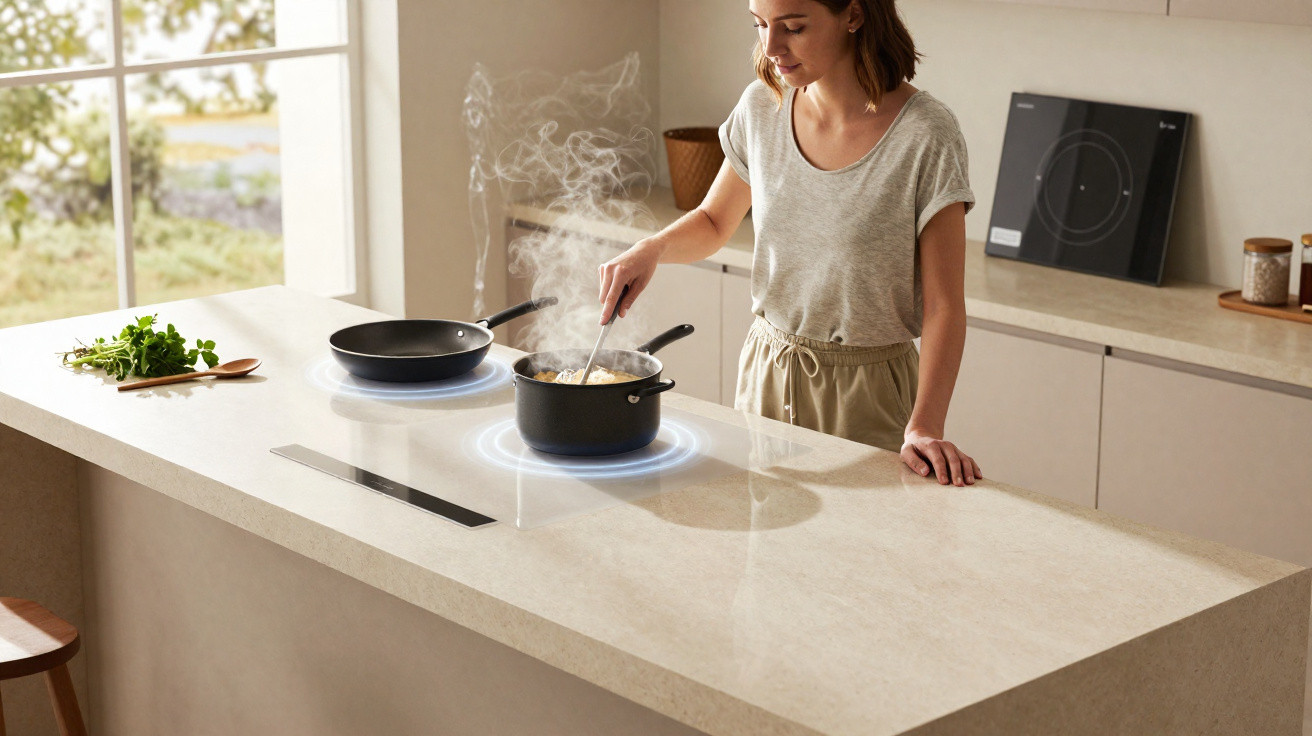
No more sharp-edged glass panels or discreet induction rings on the worktop. At a trade fair in Cologne this autumn, visitors gathered around what appeared to be… empty counters. There were no controls, circles or black glass slabs. Instead, there were warm, quiet stretches of “nothing”, where a chef effortlessly seared scallops, charged a phone and moved pans about as though the rules of physics had been subtly changed.
To one side, two induction hobs blinked their digital 9s, largely unnoticed.
Manufacturers were all quietly mentioning the same year: 2026. Architects nodded with tablets in hand. Retail buyers photographed the displays, then took more photographs. “This,” a product manager told me while tapping the edge of the unseen cooktop, “is what replaces induction. Faster than you think.”
At that moment, the demise of the conventional hob began to feel unmistakably real.
The quiet disappearance of the black glass hob
Step into any newly opened upmarket kitchen showroom today and the change is immediately obvious. The bold black rectangle of the induction hob is becoming smaller, shifting position or disappearing completely. Its replacement is a seamless cooking area concealed beneath porcelain, sintered stone or ultra-thin composite material. Brands use varying labels - “invisible hob”, “integrated cooking surface” and “full-surface induction” - but the underlying message is identical. The hob is no longer a standalone product. It becomes part of the kitchen furniture.
It may sound like a merely visual change, until you watch how people use it. Guests rest against it holding a glass of wine. Children draw beside it. Someone drops their keys on the surface, then a pan begins boiling there five seconds later. The mental boundary between “this is a machine” and “this is the centre of the room” quietly fades away.
At a Milan launch event, an Italian manufacturer staged something almost theatrical. Journalists were welcomed into a mock flat, nothing was said about appliances, and everyone was simply invited to “hang out” in the kitchen. Following fifteen minutes of conversation, a chef appeared, pressed a glowing dot that materialised on the stone, and started making risotto in the exact spot where someone had been scrolling through Instagram moments earlier. Every phone was raised at once. That is the footage its marketing team is promoting, but the figures behind it are more significant. Internal forecasts, shared unofficially, suggest a major shift: by late 2026, certain European brands anticipate that invisible or fully integrated cooking surfaces, rather than conventional hobs, will account for up to 60% of their premium sales.
Several forces explain why this is happening now rather than at some vague point in the future. Energy rules are eliminating gas from new-build homes. Standard induction has become an unremarkable default, under pressure on price. Meanwhile, kitchen design has become lifestyle content rather than simply cabinetry. Manufacturers therefore needed a new spectacle that could support margins and spread across social feeds. Seamless cooktops meet that need precisely. They resemble science fiction, while still operating on the same 230 V supply. For the industry, it is an ideal move: induction remains the hidden technology, but the hob disappears as a visible product category. On the shop floor, the star is no longer a gadget sitting on the worktop. It is the worktop itself.
How invisible cooking surfaces work in everyday use
The central principle sounds almost too straightforward. Rather than fitting a separate hob, manufacturers place induction modules beneath a reinforced slab, most often made from ceramic, porcelain or engineered stone. Directly above the coils sits a thin layer designed for thermal performance. Intelligent sensors recognise a pan within the “active” area, while controls illuminate through the surface itself or appear on a narrow strip along its edge. You cook, wipe it down and leave… then the kitchen returns to looking like a design visualisation.
Early versions from a few years ago were expensive and unpredictable. Pans had to sit in unusually exact positions, while heating seemed less powerful than on traditional induction. This is where 2026 is expected to alter the experience. New models use full-surface mapping, monitoring a pan in real time and transferring power along with it. Move a pot 20 cm to the left as you stir, and the invisible field follows it like a shadow. After ten minutes, it feels surprisingly intuitive, almost too effortless - precisely why designers expect it to become addictive.
Naturally, the first question people raise is whether an entire “live” worktop is safe. Engineers give a short answer: yes, because the active space is far smaller than the surface suggests. Only the zones directly above the coils heat cookware, while the surrounding material remains comparatively cool. Software restrictions also activate when sensors identify hands, spills or the absence of a pan. Even so, there is an adjustment period. Some areas will feel warmer than an ordinary worktop. You may forget where a zone begins. Let’s be honest: nobody reads the complete 60-page manual before making their first pasta dish. That is why 2026 models are adding visual signals, haptic feedback and voice prompts, ensuring this new invisibility does not turn into confusion.
Living with an invisible hob
If you are considering this trend, the first practical move is to think like an architect rather than a gadget enthusiast. Instead of asking, “Which hob do I want?”, ask, “What do I actually do in my kitchen, and where?” Create a mental plan of your everyday disorder. Where do you prepare food? Where are groceries put down? Where do people gather with drinks? In those places, integrated cooking can either be brilliant or become a complete nightmare.
For families who enjoy sprawling snack boards and shared cooking evenings, a broad central island with a large invisible zone can turn the room into a social focal point. If you usually cook alone on weekdays, a smaller, clearly marked area near the wall may suit you better, leaving the island entirely for dining. Industry insiders say the most satisfied early adopters are those who mapped out these invisible limits on paper well before the stone was cut.
This is also where expectations can cause problems. Many people imagine an immaculate empty worktop, only to find that daily life is much messier. On a Tuesday evening filled with school bags, post, lunch boxes and a rushed dinner at 8:45 pm, the minimalist Pinterest ideal quickly suffers. The most frequent error is using the whole invisible cooktop as a place to dump things. Papers buckle because of residual heat, plastic lunch boxes soften at the edges, and somebody places a chopping board partly over a zone that is still warm. On a difficult day, it can feel as though the kitchen is playing a trick on you.
The answer is to establish small routines. Keep a shallow tray for everything that arrives when you come in. Set aside a clear “no-go” area that everybody at home understands, including the teenager making instant noodles. Put discreet stick-on markers beneath the worktop edge so you can feel where zones begin when the interface is switched off. It may not look as polished as the promotional images, but it is how real kitchens remain manageable.
Industry designers are notably frank about this. One senior product lead at a major brand told me:
“We’re not just selling a new appliance. We’re asking people to change muscle memory they’ve had since childhood. That takes more than a nice leaflet.”
To ease that transition, some showrooms now offer what amount to brief driving lessons for prospective owners. Customers receive fifteen minutes of guided cooking, including quick mistakes, so they encounter the limitations before they are at home with guests looking on.
For anyone undecided, several practical questions can cut through the hype:
- How often do you genuinely cook using more than three pans at once?
- Who else uses the kitchen, and how comfortable are they with technology?
- Do you place greater value on a “wow” factor than on instantly seeing where the heat is?
- If the surface fails on a Sunday evening, is local servicing available or not?
- Will this layout still work if your life changes in five years?
These questions can seem rather weighty in a quiet showroom. In a loud family kitchen, they are an enormous relief.
So… are we really saying goodbye to classic induction?
Industry insiders will not state it publicly, but many concede off the record that, by the end of 2026, the black-glass rectangle known as “the induction hob” will begin to appear dated in glossy catalogues. It will not be obsolete or pointless, merely… entry-level. Much like the first flat-screen televisions after chunky plasmas became dominant. Gas is already declining in new flats. The next domino to fall is the visible hob as we know it.
That does not mean anyone should remove appliances that work perfectly well. Technology shifts rarely happen in that way. Gas remained in cherished older homes long after flats adopted induction entirely. The same pattern will apply here. Rental kitchens and budget ranges will continue offering traditional hobs for years. However, energy policy, TikTok kitchen tours and the understated ambitions of major brands are all moving in the same direction. The future flagship product is not a device placed on the worktop. It is a surface that performs every function, then conceals itself.
The most revealing aspect is not only the cooking technology, but what it suggests about the way we want to live. Kitchens that once declared “I am a machine room” now suggest “I am a living room that happens to cook”. Work, homework, remote meetings and late-night snacks all merge on the same stone slab. Some find this extremely appealing. Others miss the straightforward presence of a substantial appliance that announces: here, we cook. That tension will influence how architects design homes, how families move through them, and how we understand energy and space.
The change prompts understated questions. When the tools vanish, do we lose part of the ritual? Or does cooking become less daunting once the hardware no longer resembles a cockpit? When your hob is invisible, it is easier to forget it exists - both positively and negatively. Perhaps that is why the industry is advancing so quickly: whoever establishes this new normal first could control your worktop for the next fifteen years. By then, your children may consider a visible hob as retro as a fax machine.
| Key point | Detail | Why it matters to the reader |
|---|---|---|
| The hob becomes the worktop | Induction modules are concealed beneath stone or ceramic, transforming the entire surface into a cooking zone | Helps you understand what an “invisible hob” means in everyday life |
| 2026 as a tipping point | Brands quietly anticipate that integrated surfaces will generate a majority of premium sales instead of classic hobs | Indicates when it may be sensible to upgrade or negotiate over older models |
| Design before gadget | Planning the space, household habits and safety routines matters more than raw technology specifications | Helps make your future kitchen both attractive and genuinely practical |










Comments
No comments yet. Be the first to comment!
Leave a Comment